


The Real Business Problem This Service Solves
1️⃣ Problem
Why are your videos getting views occasionally but failing to generate consistent audience growth or business inquiries?
Why it happens
Many businesses record videos regularly but treat editing as a finishing task instead of a strategic process. Videos are uploaded without audience retention planning, storytelling structure, pacing optimization, or platform-specific formatting. Without aligning editing decisions with YouTube behavior and viewer psychology, content struggles to hold attention.
Business impact
Videos may receive impressions but low watch time and engagement prevent long-term visibility. Businesses invest time in shooting content yet see unpredictable growth, weak subscriber retention, and minimal conversions. This creates frustration because effort feels high while results remain inconsistent and unclear.
How we solve it
Our video editing service focuses on performance-driven editing. We structure videos around viewer retention, clear messaging flow, and platform optimization. Editing decisions are guided by audience behavior, not aesthetics alone — helping videos communicate better, retain viewers longer, and support sustainable channel growth.
2️⃣ Problem
Why do professionally shot videos still fail to rank or appear in YouTube search results?
Why it happens
High production quality alone does not guarantee discoverability. Many businesses overlook YouTube search engine optimization — including metadata structure, keyword alignment, thumbnail psychology, and audience intent matching. Videos are published without understanding how YouTube evaluates relevance and engagement signals.
Business impact
Even valuable videos remain hidden, leading to missed organic reach and dependency on paid promotion. Marketing teams begin questioning video ROI, and content production slows because visibility feels unpredictable.
How we solve it
We combine youtube video editing with structured YouTube SEO services. Every video is optimized through search-focused titles, retention-based editing, audience intent mapping, and discoverability enhancements. This approach helps videos become searchable assets rather than one-time uploads.
3️⃣ Problem
Why does video content look good but fail to represent your brand professionally or convert viewers into clients?
Why it happens
Editing styles are often inconsistent across videos, especially when different freelancers or internal teams handle production. Messaging clarity, branding elements, pacing, and call-to-action placement are not standardized. Without a defined content framework, videos feel disconnected from business goals.
Business impact
Viewers may watch but struggle to understand the brand’s value or next step. This results in weak trust signals, lower inquiry rates, and confusion within marketing teams about what type of content actually works.
How we solve it
As a structured video editing agency, we establish consistent editing guidelines aligned with brand positioning and audience expectations. Each video follows a clear communication flow — from hook to engagement to action — ensuring content supports marketing objectives while maintaining visual consistency across the channel.
By the end of this section, the reality becomes clear:
the challenge is rarely creating videos — it’s creating videos that perform, communicate, and grow consistently.
Professional Website Development Built to Convert & Scale
High-performance websites designed SEO-ready structure Clean, user-focused design Scalable foundations
Why Businesses Struggle With This Service
1️⃣ The Struggle
Videos are being produced consistently, yet channel performance fluctuates without clear patterns or predictable growth.
Why it happens
Teams often focus on publishing frequency rather than performance structure. Editing decisions are made visually instead of strategically — intros run too long, pacing doesn’t match viewer behavior, and storytelling lacks retention checkpoints. A common misconception is that uploading more videos automatically improves reach, while audience retention and watch behavior remain unoptimized.
Business impact
Content creation starts feeling exhausting because effort increases without proportional results. Marketing teams struggle to identify what works, leading to inconsistent growth and uncertainty around content direction. Over time, confidence in video marketing declines, and valuable production resources are underutilized.
How we fix the gap
We introduce a retention-first editing framework where every video is structured around viewer engagement signals. Editing choices — hooks, transitions, pacing, and visual emphasis — are guided by performance insights rather than preference. This aligns creative execution with measurable outcomes, creating stability instead of guesswork.
2️⃣ The Struggle
Businesses invest in editing tools or freelancers, but videos lack consistency in style, messaging, and audience experience.
Why it happens
Execution becomes fragmented when multiple editors or ad-hoc workflows are used without a defined content system. Many organizations assume software or templates alone will ensure quality, overlooking the need for editorial guidelines and brand storytelling standards. As a result, each video feels different, even when targeting the same audience.
Business impact
Viewers struggle to recognize brand identity across videos, weakening trust and recall. Internal teams spend extra time revising edits, clarifying expectations, and correcting inconsistencies. This slows production cycles and creates frustration between marketing, creative, and leadership teams.
How we fix the gap
We establish structured editing workflows and brand-aligned visual frameworks. Style consistency, messaging clarity, and storytelling flow are documented and applied across all content. This reduces revisions, improves collaboration, and ensures every video contributes to a recognizable and professional channel presence.
3️⃣ The Struggle
Analytics exist, but teams don’t know how to translate performance data into better video execution.
Why it happens
Metrics like watch time, audience drop-off, and click-through rates are available, yet often misunderstood. Businesses may copy competitor formats or chase trending styles without understanding why those formats work. The focus shifts toward imitation instead of insight-driven improvement.
Business impact
Decision-making becomes reactive rather than strategic. Content direction keeps changing, results remain inconsistent, and teams feel stuck between creativity and performance pressure. This leads to unclear ROI and hesitation in scaling video marketing efforts.
How we fix the gap
We connect analytics directly to editing and content decisions. Performance data is interpreted through audience behavior analysis, helping refine structure, pacing, and storytelling over time. Instead of chasing trends, execution evolves through informed adjustments, creating clearer direction and sustainable improvement.
By the end of this stage, businesses typically recognize something important:
the challenge wasn’t effort or content volume — it was the absence of a structured execution system guiding video performance.
Phone: +91 79820 69569 | +91 90689 73411
Email: contact@quantamminds.com
The Reality of This Service Today
A Major Shift: Video Content Is Now Measured by Retention, Not Just Production Quality
A few years ago, video editing was largely about visual polish — smooth cuts, transitions, music, and cinematic presentation. Today, platforms like YouTube prioritize viewer behavior signals such as watch time, audience retention, session duration, and engagement patterns. This shift has fundamentally changed what successful video editing and YouTube marketing actually mean.
Editing is no longer just creative work. It has become a performance discipline where storytelling structure, pacing decisions, and viewer psychology directly influence visibility and growth. Videos now compete not only on quality but on how effectively they hold attention second by second.
Present Market Reality: Content Volume Has Increased, Attention Has Decreased
Most businesses entering video marketing today face a crowded environment where thousands of videos are published every minute. Many organizations still approach video editing as a finishing step rather than a strategic process.
Typical current approaches include:
-
producing videos without retention planning
-
editing based on aesthetics instead of audience behavior
-
publishing content without platform-specific optimization
-
measuring success only through views rather than engagement quality
As competition grows, audiences decide within moments whether to continue watching. Basic editing workflows that worked earlier often fail to maintain viewer interest today, which is why simply creating videos no longer guarantees performance.
Client expectations have also changed. Businesses now expect videos to support brand positioning, lead generation, education, and long-term audience building — not just visibility.
The Hidden Industry Gap
Across the industry, execution frequently focuses on delivering completed videos rather than building sustainable channel performance systems. Many workflows emphasize speed and output quantity, while deeper elements like audience psychology, retention strategy, and data-informed editing receive less attention.
This is not about capability gaps — it reflects how rapidly video platforms have evolved. Deliverables alone are no longer enough; structured performance thinking has become essential.
Present-Focused vs Future-Focused Execution
| Execution Area | Typical Industry Approach (Present-Focused) | Our Future-Focused Approach |
|---|---|---|
| Content Planning | Editing begins after filming | Editing strategy influences scripting and structure |
| Video Editing | Visual polish prioritized | Retention-driven storytelling and pacing |
| Performance Insight | Views as primary metric | Engagement and audience behavior analysis |
| Workflow | Project-by-project editing | Scalable content systems and repeatable frameworks |
| Adaptability | Adjustments after performance drops | Continuous optimization based on early signals |
| Long-Term Value | Individual video success | Sustainable channel and audience growth |
Why Future-Ready Execution Matters Now
Modern video marketing requires more than creative execution. It depends on structured systems that connect production, editing, analytics, and audience understanding.
Future-ready execution involves:
-
planning videos around viewer intent before editing begins
-
building scalable editing frameworks for consistent publishing
-
using performance insights to refine storytelling over time
-
adapting formats as platform algorithms and audience habits evolve
-
integrating automation and AI-assisted workflows where they enhance efficiency without replacing creativity
This approach ensures that videos improve cumulatively rather than starting from zero each time.
Industry Truths Businesses Rarely Hear
-
High-performing videos are rarely accidental; they are structured intentionally.
-
Advanced editing software does not guarantee engagement without strategic storytelling.
-
Consistency in format often outperforms occasional viral attempts.
-
Sustainable growth comes from iterative improvement, not one-time creative breakthroughs.
When businesses understand these realities, video editing shifts from a creative expense into a long-term growth system.
By this point, the direction becomes clear: success today depends less on producing more videos and more on building smarter, adaptable video ecosystems designed for how audiences actually consume content now — and how they will consume it next.
Our Proven Process
Delivering effective video editing and YouTube marketing requires more than editing footage after recording. A structured workflow ensures that every video supports audience growth, brand positioning, and measurable performance improvement over time.
Our process is designed to move from understanding your content goals to building a sustainable video ecosystem that improves with every upload.
Discovery
What happens
The process begins by understanding how your video content currently performs and what role it plays in your business. We review existing videos, channel analytics, audience behavior patterns, content themes, and publishing consistency. For new creators or brands, we analyze goals, target viewers, competitors, and content formats aligned with the industry.
Why it matters
Many video efforts fail because editing starts without clarity about audience expectations or platform behavior. Discovery prevents guesswork and ensures that creative decisions are grounded in real viewer insights rather than assumptions.
Service-specific adaptation
For video editing and YouTube marketing, this phase includes analyzing watch-time trends, drop-off points, thumbnail performance, content length suitability, and storytelling structure — helping us understand not just what videos look like, but how viewers actually respond to them.
Strategy
What happens
Insights gathered during discovery are translated into a structured video growth plan. We define content direction, editing style guidelines, publishing rhythm, optimization priorities, and performance goals. Decisions are made around pacing, hooks, branding consistency, and content categories suitable for your audience.
Why it matters
Without a clear strategy, videos become isolated pieces of content instead of part of a larger growth system. Strategy connects each upload to long-term channel development.
Service-specific adaptation
In YouTube-focused projects, strategy includes retention planning, SEO-aware structuring, title and thumbnail alignment, and defining how educational, promotional, or storytelling videos support different stages of audience engagement.
Execution
What happens
This is where raw footage transforms into performance-ready content. Editing includes storytelling refinement, pacing adjustments, visual hierarchy, sound balancing, motion graphics integration, subtitle optimization, and platform-ready formatting. YouTube optimization elements such as structure timing, engagement triggers, and viewer flow are incorporated during editing itself.
Why it matters
Editing decisions directly influence whether viewers continue watching or leave early. Execution ensures that creative quality and audience psychology work together rather than separately.
Service-specific adaptation
Execution varies depending on content type — educational YouTube videos may emphasize clarity and retention pacing, real estate videos focus on visual storytelling and transitions, while brand content prioritizes identity consistency and viewer trust.
Optimization
What happens
After publishing, performance signals are reviewed continuously. Audience retention graphs, engagement behavior, click patterns, and viewer responses guide iterative improvements. Editing styles, video length, intro structure, and storytelling approaches evolve based on real data.
Why it matters
Video performance improves through refinement, not one-time perfection. Optimization turns each upload into a learning opportunity that strengthens future content.
Service-specific adaptation
For YouTube marketing, optimization may include adjusting hook timing, restructuring intros, refining editing pace, testing content formats, and improving metadata alignment to support discoverability and viewer satisfaction.
Reporting
What happens
Clear performance summaries are shared regularly, focusing on insights rather than overwhelming statistics. Reports explain what improved, what needs adjustment, and what actions should come next.
Why it matters
Businesses need clarity, not just numbers. Reporting connects performance outcomes with decision-making so future videos are guided by understanding rather than trial and error.
Service-specific adaptation
Reporting highlights meaningful indicators such as audience retention improvement, engagement quality, content consistency impact, and channel growth patterns — helping clients understand how editing and marketing decisions influence long-term results.
By following this structured process, video editing becomes more than production support. It evolves into a repeatable system where creativity, analytics, and strategy work together — allowing businesses to build sustainable visibility and audience trust through video content.
Tools and Technologies We Use
Effective video editing and YouTube marketing is not driven by creativity alone. Consistent results come from structured workflows supported by data visibility, performance tracking, and informed creative decisions. The right systems help transform raw footage into content that not only looks professional but also performs reliably across platforms.
Tools, in this context, act as decision-support systems — helping us understand viewer behavior, refine storytelling, and continuously improve video outcomes.
Analytics & Performance Tracking
Example systems: YouTube Analytics, Google Analytics, audience retention dashboards, engagement tracking tools.
How they improve outcomes
These platforms reveal how viewers actually interact with videos — where they stop watching, what keeps attention, and which topics generate engagement. Instead of guessing what works, editing and content structure decisions are guided by measurable viewer behavior. This allows continuous refinement of pacing, video length, and storytelling flow based on real performance signals.
Editing & Post-Production Systems
Example systems: Adobe Premiere Pro, DaVinci Resolve, After Effects, professional audio enhancement tools.
How they improve outcomes
Professional editing environments allow precise control over pacing, transitions, sound clarity, color grading, and visual hierarchy. More importantly, they enable consistency across videos — ensuring brand identity, visual tone, and viewer experience remain aligned as channels grow. Structured editing workflows also reduce production delays and maintain predictable quality standards.
Research & YouTube Optimization Tools
Example systems: TubeBuddy, VidIQ, keyword insight platforms, thumbnail testing utilities.
How they improve outcomes
Optimization tools help identify how audiences search, what topics are gaining traction, and how videos can be positioned for discoverability. Instead of uploading content blindly, these insights guide title structuring, keyword placement, content themes, and thumbnail direction — improving visibility while keeping content aligned with viewer intent.
Collaboration & Workflow Management
Example systems: Frame.io, Trello, Notion, cloud storage collaboration environments.
How they improve outcomes
Video production often involves creators, editors, marketers, and decision-makers. Collaboration platforms centralize feedback, revisions, and approvals, preventing version confusion and communication gaps. This structured workflow shortens turnaround time and ensures creative decisions remain aligned with business goals.
Reporting & Continuous Improvement Systems
Example systems: custom performance dashboards, reporting frameworks, engagement comparison tracking.
How they improve outcomes
Rather than presenting isolated metrics, reporting systems translate performance into actionable insights. Businesses understand which video formats perform best, how audience engagement evolves, and where adjustments should be made. This turns video marketing into an iterative growth process rather than a one-time production activity.
When tools are used intentionally, editing becomes part of a measurable growth system. Each upload contributes data, each insight improves future videos, and creative decisions become progressively smarter — creating stability and scalability in video marketing efforts.
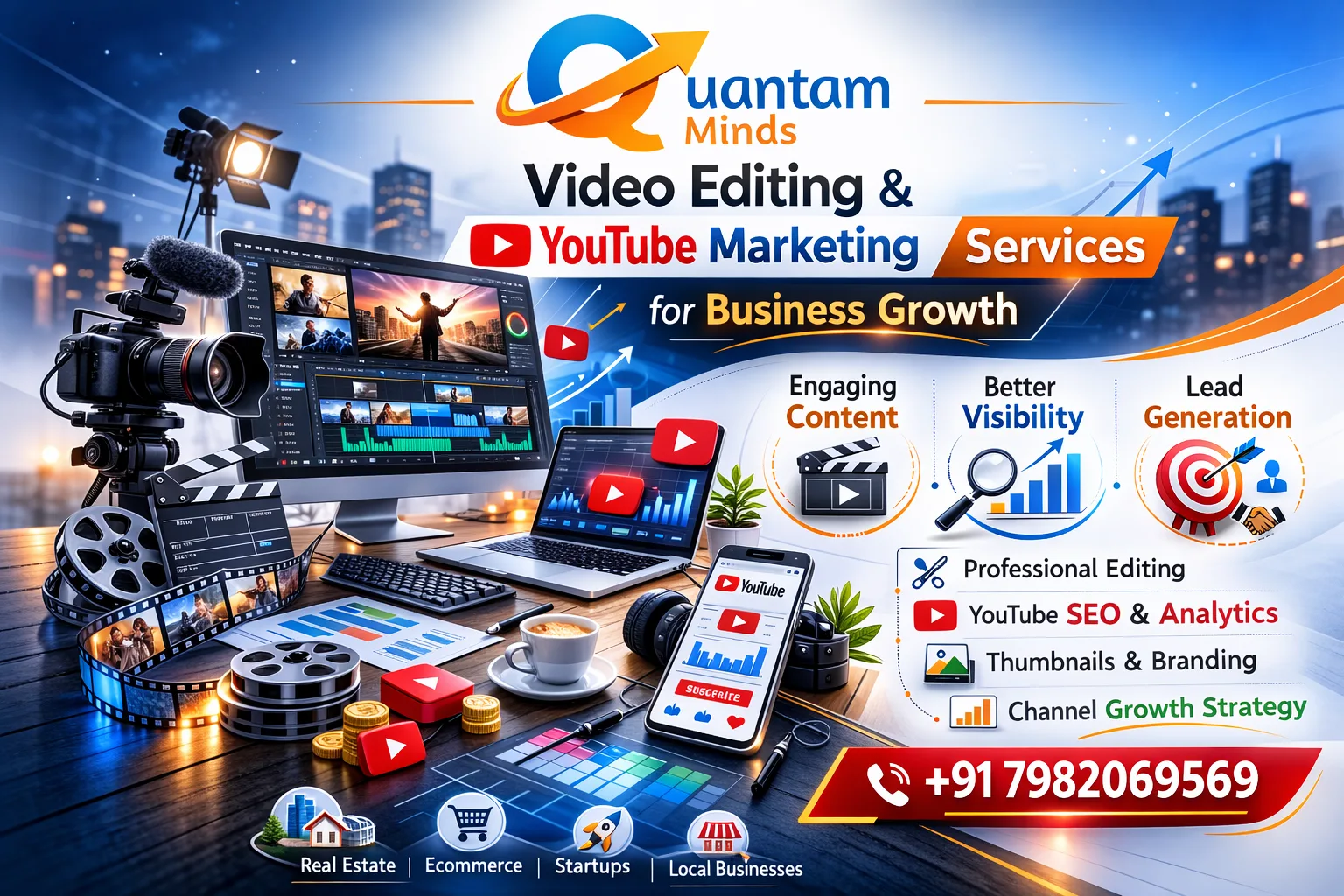
Professional Image Concept (Illustrative Direction)
Image Theme:
Modern Video Editing & YouTube Marketing Workflow Ecosystem
Visual Concept:
A clean, business-focused digital illustration showing a structured workflow pipeline:
-
Left side: raw video clips and media assets entering the workflow
-
Center: editing timeline interface with motion graphics layers and audio waveforms
-
Right side: YouTube dashboard analytics displaying retention graphs, engagement metrics, and optimization indicators
-
Subtle connecting lines showing flow from Editing → Optimization → Analytics → Growth
Design Style:
-
Minimal and modern UI-inspired layout
-
Dark + light contrast with professional accent colors
-
Flat illustration or semi-isometric design (not stock photography)
-
Dashboard-style visuals emphasizing systems and process
-
No posed people — focus on technology and workflow
Brand Integration:
-
Quantam Minds logo placed subtly in a corner
-
Clean typography space reserved for service title
-
Business-professional banner composition suitable for website hero section
Purpose of Image:
To visually communicate that video editing and YouTube marketing operate as a structured performance system — combining creativity, analytics, and optimization into one continuous workflow.
Real Results and Case Examples
Business Situation
A mid-sized real estate consultancy expanding into premium property listings wanted to use YouTube as a long-term lead generation channel. The team was already recording walkthrough videos using drones and mobile cameras, but their goal was to position themselves as a trusted local authority through consistent video content. Despite regular uploads, their channel lacked momentum, and videos were not contributing meaningfully to inquiries.
Challenge
The issue was not the availability of video content — it was how the content was presented and distributed. Videos were uploaded with minimal editing, inconsistent branding, and no structured storytelling. Viewer drop-offs happened within the first few seconds, thumbnails lacked clarity, and titles did not align with how potential buyers searched on YouTube. As a result, engagement stayed low even when the properties themselves were attractive.
Approach
The first step was reviewing viewer behavior and identifying where attention declined. Instead of focusing only on visual polish, the editing strategy shifted toward audience retention. Property videos were restructured to introduce value earlier, drone shots were shortened to maintain pacing, and voiceover sequencing was adjusted to guide viewers through the property logically.
A consistent editing template was created to maintain branding across uploads. Alongside editing improvements, YouTube optimization practices were introduced — including clearer titles, structured descriptions, and thumbnails designed around buyer intent rather than aesthetics alone. The goal was steady improvement rather than viral reach.
Outcome
Over the following months, videos began holding viewer attention longer, and engagement became more predictable. The channel started receiving more meaningful comments and inquiries related to specific properties rather than general browsing interest. The sales team also reported that prospects arriving through YouTube already understood property details, making conversations smoother and more efficient.
Growth appeared gradual but stable, with clearer visibility into which types of videos performed best and why.
Learning
The key realization was that video success depended less on filming quality alone and more on structured editing and audience-focused presentation. When storytelling, optimization, and consistency aligned, YouTube became a reliable visibility channel rather than an experimental marketing effort. Incremental improvements in editing decisions created long-term stability instead of short-term spikes.
Benefits and Realistic Challenges
Practical Benefits
When video editing and YouTube marketing are executed with structure and intent, the value goes far beyond producing visually appealing videos. The real impact comes from how content communicates, engages, and continues working for the business long after publishing.
One of the most noticeable improvements businesses experience is stronger discoverability. Properly edited videos retain viewer attention longer, which signals relevance to YouTube’s recommendation system. Over time, videos begin appearing in suggested results and search listings, allowing businesses to reach audiences who were not actively searching for them initially.
Another important benefit is higher-quality audience engagement. Strategic editing — such as pacing adjustments, clear messaging flow, and purposeful visual emphasis — helps viewers understand the message quickly. Instead of passive watching, audiences stay longer, interact more, and develop familiarity with the brand. This often leads to conversations that start with trust already established.
Businesses also gain better content efficiency. A single recording session can generate multiple usable assets — long-form videos, short clips, promotional snippets, or educational segments. This reduces pressure on teams constantly needing new content ideas while maintaining consistent visibility across platforms.
Additionally, YouTube analytics provide clearer decision-making insights. Engagement patterns reveal what topics resonate, where viewers lose interest, and which formats perform reliably. Over time, content creation becomes less guesswork and more informed planning, supporting scalable and sustainable growth rather than unpredictable outcomes.
These benefits emerge gradually because audience trust and platform visibility are built through consistency rather than isolated uploads.
Realistic Challenges — And How They Are Managed
Video marketing often looks simple from the outside, but maintaining consistent performance involves ongoing refinement. One common reality is that results develop progressively, not immediately. YouTube prioritizes content history, audience behavior, and retention signals, which means early videos often function as learning stages rather than peak performers.
Another challenge is the need for continuous optimization. Viewer preferences evolve, formats change, and what worked months ago may require adjustment. Editing styles, thumbnails, and publishing strategies must be refined based on performance data rather than personal preference.
Collaboration can also require alignment between teams. Businesses must provide clear goals, raw footage, or subject expertise, while editors translate that material into audience-friendly storytelling. Without structured coordination, content may feel inconsistent.
Professional execution helps reduce these challenges through clear systems and expectations. Realistic timelines are established from the beginning so businesses understand how growth develops. Performance is monitored regularly to identify improvement opportunities early. Editing and optimization decisions are guided by data rather than assumptions, allowing gradual refinement instead of repeated trial and error.
Most importantly, transparent communication ensures businesses understand what is working, what needs adjustment, and why certain changes are recommended. This steady, process-driven approach turns video marketing into a manageable long-term asset rather than a confusing experiment.
By understanding both the advantages and the natural effort involved, businesses can approach video editing and YouTube marketing with confidence — recognizing that meaningful results come from consistency, clarity, and informed execution rather than shortcuts.
Pricing and Investment Overview
Understanding How Investment Is Determined
Investment in video editing and YouTube marketing is shaped by the goals a business wants to achieve rather than a fixed service structure. Some businesses aim to build consistent brand visibility through educational content, while others focus on lead generation, product promotion, or authority building within a niche. Because each objective requires a different level of planning, creative effort, and optimization, the overall investment naturally varies.
The scope of execution also plays an important role. Editing a single promotional video is fundamentally different from managing an ongoing YouTube growth strategy that includes editing, optimization, publishing workflows, and performance tracking. The complexity of storytelling, audience targeting, and long-term content planning directly influences the level of work involved.
Rather than treating pricing as a preset package, investment aligns with outcomes — ensuring the effort, resources, and strategy match what the business expects to achieve.
Key Factors That Influence Investment
Several service-specific elements affect how resources are allocated within video editing and YouTube marketing projects:
-
Content Volume and Frequency
Regular publishing schedules require structured editing workflows, content calendars, and faster turnaround systems compared to occasional video production. -
Editing Complexity
Simple cuts and transitions differ greatly from advanced storytelling edits involving motion graphics, subtitles, branding elements, sound design, or drone footage integration. -
Channel Growth Objectives
Videos optimized for YouTube discovery require keyword research, metadata structuring, thumbnail strategy, and retention-focused editing — adding strategic depth beyond editing alone. -
Audience Competition Level
Highly competitive niches demand stronger content positioning, refined storytelling, and continuous optimization to stand out. -
Ongoing Optimization and Analytics Support
Monitoring performance, refining titles or thumbnails, and improving future videos based on viewer behavior creates additional long-term value but also influences investment levels.
Each factor reflects the effort needed to produce consistent and measurable outcomes rather than simply delivering edited files.
Different Investment Scenarios
Businesses typically fall into different engagement levels depending on their stage and priorities:
-
Foundational Projects
Suitable for businesses starting YouTube or experimenting with video marketing. Focus remains on clean editing, branding consistency, and establishing a publishing rhythm. -
Growth-Oriented Implementation
Involves structured editing combined with YouTube SEO optimization, audience targeting, and performance learning across multiple uploads. -
Ongoing Collaboration
Designed for brands treating YouTube as a long-term marketing channel. Includes continuous editing support, optimization cycles, and strategic content refinement. -
Strategic Partnership Level
Video becomes part of broader marketing goals — aligning messaging, analytics insights, and content planning with business growth objectives.
These scenarios help businesses understand where their needs currently fit without locking them into predefined models.
Where the Investment Goes
A significant portion of effort happens behind the scenes. Resources are typically distributed across:
-
Research and Planning — understanding audience intent, content positioning, and video objectives
-
Creative Execution — editing, visual enhancement, pacing, sound refinement, and branding integration
-
Optimization and Testing — thumbnails, titles, retention improvements, and publishing strategy adjustments
-
Performance Monitoring — analyzing viewer behavior and engagement patterns
-
Continuous Improvement — refining future videos based on real performance insights
This structure ensures that videos are not just produced but gradually improved over time.
Long-Term Value Perspective
Video marketing performs differently from one-time marketing activities. Growth tends to compound as content libraries expand, audience familiarity increases, and platform signals strengthen. Structured execution, consistent refinement, and data-informed decisions allow videos to continue generating visibility long after publishing.
Businesses that approach investment with a long-term perspective often experience clearer direction, more predictable performance patterns, and stronger audience relationships. The focus shifts from individual videos to building a sustainable content system — one that evolves alongside business goals rather than requiring constant reinvention.
By understanding how investment connects to strategy, effort, and ongoing improvement, businesses can enter discussions with clarity and realistic expectations, making collaboration more productive from the very beginning.
Who This Service Is Best For
Video editing and YouTube marketing do not serve every business in the same way. Different industries use video content for different purposes — some need education and trust-building, others require visual storytelling or product demonstration. Understanding where this service fits helps businesses recognize how video can support real operational goals instead of becoming just another marketing activity.
Below are industries where structured video editing and YouTube marketing create the strongest practical impact.
Healthcare
Industry Situation
Healthcare providers often struggle to explain complex treatments, procedures, or wellness advice in ways patients can easily understand. Written content alone rarely builds enough confidence, and inconsistent video quality can reduce credibility rather than strengthen it.
How the Service Helps
Professional video editing transforms doctor explanations, patient education sessions, and awareness campaigns into clear, structured visual content. YouTube optimization ensures videos reach people actively searching for health information, while careful pacing and visuals maintain professionalism and trust.
Industry-Valued Outcome
Healthcare organizations benefit from stronger patient confidence, improved educational reach, and consistent authority positioning — helping patients feel informed before even booking a consultation.
Real Estate
Industry Situation
Property buyers increasingly expect immersive visual experiences before scheduling visits. Raw walkthrough footage or poorly edited drone videos often fail to highlight property value, leading to reduced engagement despite high-quality listings.
How the Service Helps
Strategic editing enhances property storytelling through smooth transitions, cinematic pacing, aerial integration, and location highlights. YouTube marketing helps agents showcase neighborhoods, investment insights, and property tours that continue attracting potential buyers over time.
Industry-Valued Outcome
Real estate businesses gain higher-quality inquiries, longer viewer engagement, and improved perception of professionalism — making listings feel more premium and trustworthy.
Ecommerce
Industry Situation
Online stores frequently depend on product images alone, which makes differentiation difficult in competitive marketplaces. Customers hesitate when they cannot clearly see product usage, benefits, or real-life demonstrations.
How the Service Helps
Video editing converts product demonstrations, unboxings, and comparison videos into engaging visual experiences optimized for YouTube discovery. Structured storytelling helps viewers understand value quickly while maintaining attention throughout the video.
Industry-Valued Outcome
Ecommerce brands experience improved product understanding, stronger buyer confidence, and more informed purchase decisions — reducing hesitation during the buying journey.
Startups
Industry Situation
Startups often have strong ideas but struggle to communicate them clearly to audiences, investors, or early adopters. Unstructured videos or inconsistent branding dilute messaging and make growth efforts feel scattered.
How the Service Helps
Video editing and YouTube marketing create cohesive storytelling around product vision, founder insights, and educational content. Optimization ensures videos reach niche audiences searching for solutions rather than relying only on paid promotion.
Industry-Valued Outcome
Startups build early authority, clearer brand identity, and steady audience growth — supporting long-term visibility while refining market positioning.
Local Businesses
Industry Situation
Local service providers depend heavily on trust and familiarity, yet many rely only on static posts or advertisements that disappear quickly. Without video presence, businesses struggle to show real expertise or personality.
How the Service Helps
Professionally edited videos showcase services, customer experiences, behind-the-scenes processes, and community engagement. YouTube visibility allows local audiences to discover businesses through helpful content rather than advertisements alone.
Industry-Valued Outcome
Local businesses develop stronger recognition, improved customer trust, and consistent inbound interest from people already familiar with their work before making contact.
Across these industries, the value of video editing and YouTube marketing lies in transforming communication into visual experiences that educate, engage, and build credibility over time. Businesses that rely on explanation, demonstration, or storytelling typically find this service aligns naturally with how modern audiences prefer to learn and make decisions.
Frequently Asked Questions About Video Editing and YouTube Marketing
How long does it usually take to turn raw footage into a finished YouTube-ready video?
The timeline depends on video length, complexity, and editing style rather than a fixed schedule. A simple talking-head video may take only a few days, while storytelling edits with graphics, motion elements, or drone footage require more refinement. The goal is not speed alone but clarity and viewer retention. Clear planning and structured feedback cycles help keep delivery predictable without rushing quality.
How is investment decided for video editing and YouTube marketing projects?
Costs typically vary based on editing complexity, number of videos, branding requirements, animation needs, and whether YouTube optimization is included. Some businesses need basic cleanup edits, while others require scripting support, thumbnails, SEO setup, and channel strategy. Investment reflects the level of creative involvement and ongoing optimization rather than just editing hours, ensuring the work supports long-term content performance.
What level of involvement is required from our team during the process?
Your involvement mainly includes sharing goals, brand preferences, and feedback at key checkpoints. After initial alignment, most technical work — editing structure, pacing, optimization, and publishing preparation — is handled professionally. Regular communication keeps everything aligned without demanding constant supervision, allowing your team to focus on creating content while the production workflow stays organized and efficient.
How do we know if our videos are actually performing well on YouTube?
Performance is evaluated using meaningful indicators such as watch time, audience retention, click-through rate, and engagement patterns — not just views. These signals show whether viewers stay interested and whether the content reaches the right audience. Over time, insights from analytics guide editing style, thumbnails, and publishing strategy, helping videos improve gradually rather than relying on guesswork.
Is this service suitable for businesses that are new to YouTube or video marketing?
Yes, especially for businesses starting without a clear content structure. The process focuses on building a sustainable foundation — defining content themes, editing consistency, and search visibility from the beginning. Instead of expecting viral outcomes immediately, the approach helps businesses learn what resonates with their audience while building a reliable video presence step by step.

 Pallavi Singh
 Ashwani Kumar