Share Article

Google Ads vs SEO: Understanding the Difference and Choosing the Right Strategy for Your Business

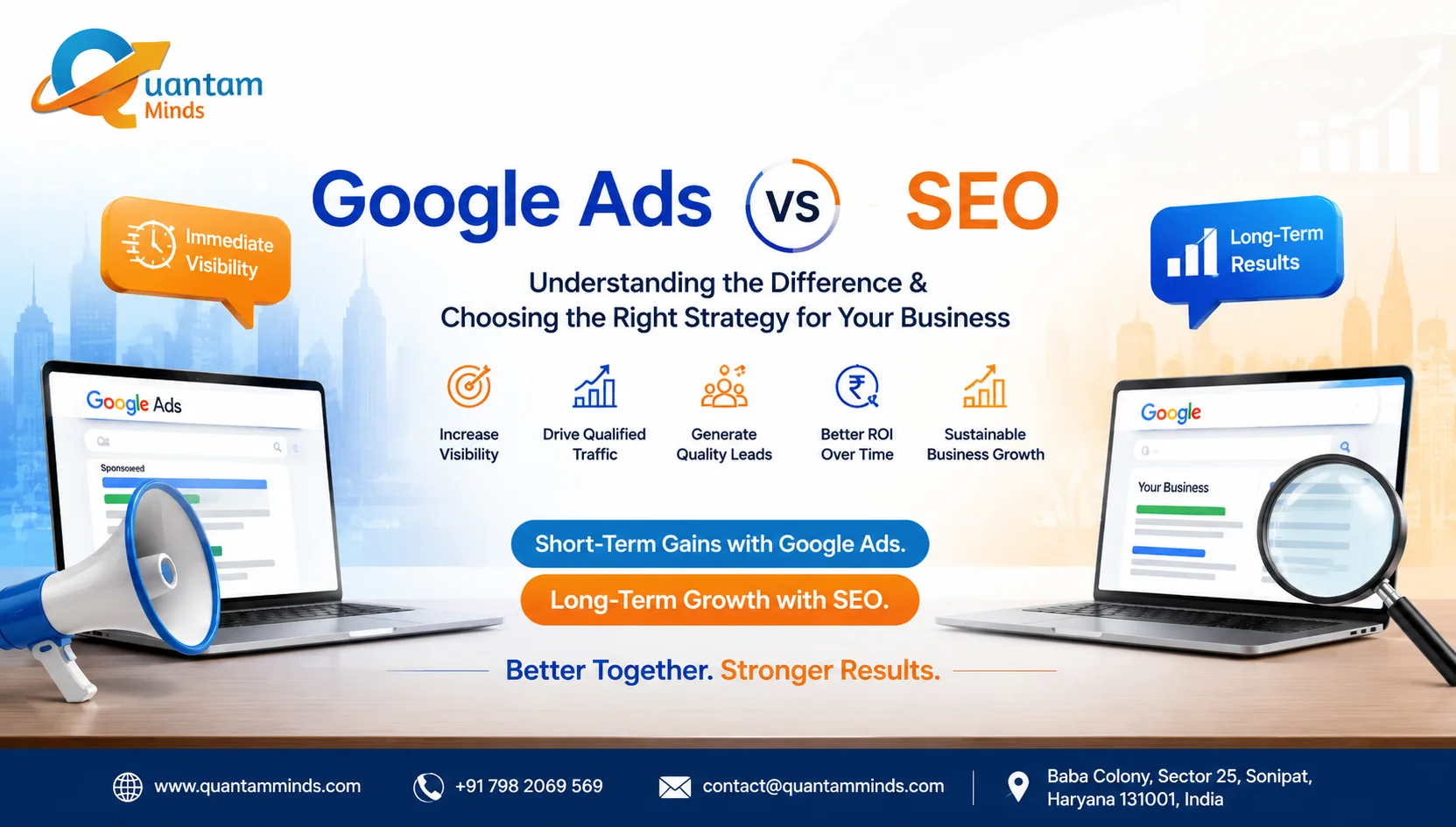
When businesses begin investing in digital marketing, one question almost always comes up: Google Ads vs SEO. Both channels help people discover your business through Google Search, yet they work in completely different ways. Understanding those differences is important before deciding where to invest your marketing budget.

At a glance, SEO vs Google Ads is not about choosing which one is universally better. The better option depends on your business goals, industry, competition, available budget, timeline, and the way your customers search for products or services. A newly launched business that needs immediate visibility may have different priorities than an established company looking to reduce long-term customer acquisition costs through consistent organic traffic.

The biggest difference lies in how visibility is earned.

Google Ads SEO
Paid search advertising Organic search optimization
Immediate visibility after campaign approval Builds visibility gradually over time
Pay for clicks on advertisements No payment for individual clicks
Works while campaigns remain active Can continue generating traffic after optimization efforts
Budget determines advertising reach Website quality and SEO determine rankings

Understanding organic search vs paid search makes this comparison much clearer.

With Google Ads, businesses bid on keywords to display sponsored advertisements at the top of Google Search results. Every click is paid for, making it an effective option for businesses launching new products, promoting seasonal offers, generating enquiries quickly, or testing new markets. The performance of Google Ads for business depends on campaign strategy, keyword selection, landing page quality, competition, and continuous optimization.

SEO, on the other hand, focuses on improving a website so that Google naturally considers it relevant and valuable for users. This involves technical improvements, high-quality content, website performance, user experience, internal linking, authority building, and continuous optimization. Unlike paid advertising, SEO is generally viewed as a long-term investment whose outcomes develop gradually and depend on many factors, including website condition, competition, and consistent implementation.

This is why the discussion around SEO vs PPC should not be framed as a competition between two opposing strategies. They solve different business problems.

For example:

  • A local clinic launching a new healthcare service may use Google Ads to generate immediate enquiries while gradually improving its website through SEO.
  • An ecommerce business running festive promotions may rely on paid campaigns for limited-time offers while investing in SEO to attract customers throughout the year.
  • A manufacturing company may focus more heavily on SEO because buyers often conduct detailed research before making enquiries, while still using Google Ads for specific high-value keywords.

For many businesses in India, the decision between Google Ads or SEO is influenced by practical considerations such as available marketing budget, expected timeline, competitive landscape, and business objectives. Startups often seek faster market visibility, whereas established businesses may prioritize building long-term digital assets through SEO services that continue supporting online discoverability over time.

Rather than asking whether SEO or Google Ads for small business is always better, a more useful question is:

"What marketing objective are we trying to achieve right now?"

If the priority is immediate visibility for a new campaign, product launch, or limited-time promotion, Google Ads services may align more closely with that objective. If the focus is creating sustainable online visibility, improving website authority, and attracting customers consistently over time, SEO often becomes a strategic long-term investment.

In many cases, businesses achieve stronger overall results by viewing both channels as complementary parts of a broader digital marketing strategy rather than treating them as mutually exclusive options. Paid advertising can create immediate opportunities while SEO strengthens long-term visibility, helping businesses build a more balanced and resilient online presence over time.

Choosing between SEO and paid advertising becomes much easier when you understand how search engines evaluate websites. Explore our SEO Services to learn how technical optimization, quality content, and search-focused strategies help businesses improve long-term online visibility alongside other digital marketing efforts.

SEO vs Google Ads: Which Delivers Better Long-Term Results and Return on Investment?

When businesses compare SEO vs Google Ads, the conversation usually comes down to one question: Which delivers a better return on investment over the long term? The answer is rarely the same for every business because ROI depends on several factors, including your industry, customer buying cycle, competition, marketing budget, and overall business objectives.

Many business owners expect a simple winner between Google Ads vs SEO, but both channels generate value in different ways. Instead of measuring only how quickly enquiries arrive, it is more useful to evaluate how each strategy contributes to sustainable customer acquisition, brand visibility, and marketing efficiency over time.

One of the biggest differences is how each investment continues to provide value.

Comparison Factor SEO Google Ads
Initial Results Gradual Often quicker after campaign launch
Long-Term Visibility Can continue growing with ongoing optimization Stops when advertising budget is paused
Cost Structure Investment in optimization and content Pay for every eligible click
Brand Trust Builds credibility through organic presence Provides immediate visibility through sponsored listings
Maintenance Continuous optimization required Continuous campaign management and budget required

From a long-term perspective, SEO services often become more cost-efficient because the improvements made to a website continue supporting organic visibility even after individual pages have been published. Well-optimized content, technical enhancements, improved user experience, and strong website architecture can continue attracting relevant visitors for months or even years, although performance depends on search competition, algorithm updates, and ongoing optimization.

For example, a law firm that publishes detailed legal resources, optimizes its website, and consistently improves its content may gradually increase organic visibility for multiple search queries. Instead of paying for every visitor, the website becomes a valuable digital asset that can continue attracting qualified users through search engines over time.

By comparison, Google Ads services provide immediate exposure for targeted keywords. This makes them particularly valuable when businesses need visibility for product launches, seasonal promotions, new locations, or competitive markets where waiting for organic rankings may not be practical. However, every visit generated through paid campaigns is directly linked to the advertising budget. Once campaigns are paused, sponsored visibility also stops.

This difference explains why SEO vs PPC is often viewed as a comparison between building long-term marketing assets and renting immediate visibility.

That does not automatically make SEO the better investment.

Consider these real business situations:

  • A newly launched ecommerce store with no search presence may benefit from Google Ads while its SEO foundation is still being developed.
  • A local home service business entering a highly competitive market may use paid advertising to generate enquiries while gradually building organic authority.
  • An established manufacturing company with hundreds of product pages may find greater long-term value in strengthening SEO because buyers often research extensively before making purchasing decisions.

In these situations, Google Ads for business solves immediate visibility challenges, while SEO focuses on reducing long-term dependence on paid acquisition.

Another factor that influences ROI is customer buying behaviour.

Businesses selling high-value products or professional services often experience longer buying cycles. Prospective customers compare providers, read multiple articles, visit several websites, and return more than once before making a decision. Strong organic visibility through SEO helps businesses appear consistently throughout this research process, while Google Ads can reinforce visibility during high-intent searches.

For smaller businesses asking whether SEO or Google Ads for small business offers better value, the answer usually depends on available resources.

If the marketing budget is limited but the business can invest consistently over time, SEO may gradually become a more sustainable acquisition channel. If immediate enquiries are required because of a new launch or competitive market conditions, Google Ads may provide faster exposure while SEO develops in parallel.

Rather than measuring success solely by short-term costs, businesses should evaluate how each channel supports their broader digital marketing strategy.

SEO contributes to long-term online visibility, website authority, and consistent organic discovery. Google Ads provides speed, targeting flexibility, and measurable campaign control. In many cases, businesses that integrate both channels create a balanced marketing approach where paid advertising supports immediate business objectives while SEO strengthens long-term digital performance. The right mix ultimately depends on business goals, competition, implementation quality, and continuous optimization rather than one strategy being universally superior.

If your business needs faster visibility while building long-term marketing assets, professionally managed paid campaigns can complement your overall strategy. Discover our Google Ads Services to see how targeted advertising can support lead generation, product launches, and local customer acquisition based on your business goals.

Free Strategy Consultation

Turn These Insights Into Business Growth

Our experts help businesses convert ideas into measurable digital growth through strategy, technology and performance-driven execution.

Free Initial Consultation
Experienced Industry Experts
Tailored Business Solutions
Transparent Recommendations

Let's Talk

Discuss your business goals with our specialists and discover practical digital solutions that align with your objectives.

Book Free Consultation Call +91 79820 69569

Google Ads or SEO for Small Businesses: Which One Should You Invest in First?

For many entrepreneurs, marketing decisions are shaped by limited budgets rather than unlimited possibilities. This is why one of the most common questions small business owners ask is whether they should invest in Google Ads or SEO first. The answer is not simply about choosing the cheaper option or the faster one. It depends on what the business needs today while also preparing for where it wants to be six months or even two years from now.

Small businesses often operate with fewer marketing resources than larger competitors. Every marketing investment needs to contribute toward measurable business objectives, whether that means generating enquiries, increasing brand awareness, attracting local customers, or building a stronger online presence. Understanding how Google Ads vs SEO fits into those objectives helps business owners make more informed decisions.

One useful way to approach the decision is to evaluate the current stage of the business.

Business Situation Recommended Priority Why
Newly launched business Google Ads + Basic SEO Faster visibility while building organic foundations
Established business with an existing website SEO Strengthens long-term visibility and website authority
Seasonal business or limited-time campaign Google Ads Supports immediate promotional goals
Local service provider SEO with selective Google Ads Builds consistent local presence while targeting high-intent searches
Ecommerce business Combined strategy Paid campaigns drive immediate traffic while SEO supports sustainable growth

A newly launched business often faces an immediate challenge: very few people know it exists. Even a professionally designed website may receive limited traffic if search engines have not yet developed confidence in its content and authority. In these situations, Google Ads for business can help introduce products or services to potential customers more quickly while the website gradually gains organic visibility through SEO.

However, relying only on paid advertising can create long-term challenges. Every visitor generated through advertisements depends on an active campaign budget. If advertising stops, visibility typically declines as well. This is why many experienced marketers recommend building SEO alongside paid campaigns rather than treating them as separate investments.

For businesses that already have a functioning website and some market presence, investing in SEO services often becomes a logical next step. Improving technical SEO, publishing useful content, strengthening internal linking, enhancing page speed, and optimizing for search intent can gradually increase organic visibility. Although results vary based on competition, website quality, and consistent implementation, SEO creates a stronger digital foundation that supports future marketing efforts.

The discussion around SEO vs Google Ads also changes depending on customer behaviour.

Imagine a neighbourhood dental clinic. People searching for "dentist near me" usually want immediate information, making Google Ads valuable for attracting high-intent visitors. At the same time, informative website content about treatments, patient resources, and local SEO optimization helps the clinic appear for many additional searches over time.

Now consider a B2B manufacturing company. Buyers rarely make purchasing decisions after a single search. They compare suppliers, read technical specifications, review company credentials, and evaluate multiple websites before submitting an enquiry. In this scenario, SEO often plays a larger role because customers spend more time researching before making contact.

This is one reason SEO vs PPC should always be evaluated within the context of the buying journey rather than marketing channels alone.

Small businesses should also think beyond immediate lead generation. Questions worth considering include:

  • How competitive is the industry?
  • How quickly does the business need visibility?
  • Is the marketing budget sustainable for ongoing advertising?
  • Does the website already provide a good user experience?
  • Are customers likely to research before making a purchase?

The answers to these questions often reveal whether paid advertising, SEO, or a combination of both is the most practical starting point.

For many Indian startups and SMEs, the most balanced approach is not choosing between SEO or Google Ads for small business, but prioritizing them according to current business needs. Paid campaigns can help create early momentum, while SEO gradually develops long-term online visibility, brand credibility, and organic customer acquisition. As the business grows, both channels can work together as part of a broader digital marketing strategy, allowing paid advertising to support immediate opportunities while SEO continues building sustainable search presence through continuous optimization.

Every business has different marketing priorities, budgets, and growth objectives. As a trusted Digital Marketing Agency In Sonipat, we help startups, SMEs, and growing businesses choose the right mix of SEO, Google Ads, website optimization, and other digital marketing services based on practical business requirements rather than one-size-fits-all solutions.

Organic Search vs Paid Search: When to Use SEO, Google Ads, or Both Together

Businesses often compare organic search vs paid search as though one approach replaces the other. In reality, they serve different purposes within a successful digital marketing strategy. Understanding when to use SEO, Google Ads, or a combination of both allows businesses to allocate their marketing budget more effectively and reach customers at different stages of the buying journey.

Organic search refers to the unpaid listings that appear on search engines based on relevance, content quality, website authority, and user experience. Paid search, on the other hand, places sponsored advertisements above or alongside organic results through platforms such as Google Ads. While both increase online visibility, they operate differently and produce value in different ways.

The following comparison highlights the key differences.

Organic Search (SEO) Paid Search (Google Ads)
Builds visibility over time Provides immediate search visibility
No cost per click Charges for eligible ad clicks
Focuses on long-term website growth Focuses on campaign-based visibility
Improves website authority and content Targets specific keywords, audiences, and locations
Continues generating traffic with ongoing optimization Visibility depends on active campaign budgets

Understanding these differences makes it easier to decide which strategy fits a particular business objective.

When SEO Is the Better Choice

Investing in SEO services is often suitable when businesses want to establish a long-term online presence rather than relying solely on advertising. SEO helps improve website quality, strengthen search relevance, and increase visibility across a wider range of search queries.

SEO is commonly appropriate when:

  • Building long-term organic visibility.
  • Publishing educational or informational content.
  • Improving local search presence.
  • Reducing long-term dependence on paid advertising.
  • Strengthening website authority and user experience.

For example, a coaching institute publishing career guidance articles or a healthcare clinic creating treatment information can benefit from SEO because customers frequently research these topics before making decisions.

When Google Ads Makes More Sense

There are situations where businesses cannot wait for gradual organic growth. A new business launch, festive promotion, limited-time discount, or highly competitive market may require immediate exposure.

In these situations, Google Ads services can be a practical solution because campaigns begin generating visibility soon after approval and optimization.

Businesses often use Google Ads for business when they need to:

  • Promote new products or services.
  • Generate enquiries for time-sensitive campaigns.
  • Test demand in new markets.
  • Reach customers searching with strong purchase intent.
  • Compete for highly commercial keywords.

Because campaign performance depends on factors such as targeting, bidding strategy, ad quality, landing page experience, and competition, continuous monitoring and optimization remain important.

When Using Both Together Creates Better Results

Many experienced marketers no longer view Google Ads vs SEO as an either-or decision. Instead, they combine both channels because each supports different stages of customer acquisition.

Consider a business launching a premium home renovation service.

Google Ads can immediately place the business in front of homeowners actively searching for renovation services. At the same time, SEO helps publish detailed project guides, renovation cost articles, design inspiration, and frequently asked questions that attract customers during their research phase.

This combination allows businesses to remain visible throughout different stages of the customer journey instead of relying on a single source of traffic.

Another example is an ecommerce brand introducing a new product category. Paid campaigns may generate immediate sales opportunities, while SEO gradually helps product pages, buying guides, and category pages appear in organic search results over time.

Choosing the Right Strategy for Your Business

The choice between SEO vs Google Ads becomes easier when business goals are clearly defined.

Business Goal Recommended Approach
Immediate visibility Google Ads
Long-term organic growth SEO
Product launch Google Ads with supporting SEO
Local business growth SEO supported by selective Google Ads
Sustainable digital marketing Combined SEO and Google Ads strategy

Businesses should also consider practical factors such as available budget, competition, customer buying behaviour, and website readiness before deciding where to invest first.

For many startups and SMEs, the discussion around SEO vs PPC is not about finding a permanent winner. Marketing priorities evolve as businesses grow. Early-stage companies may initially rely more on paid campaigns to create visibility, while gradually expanding their SEO efforts to build sustainable organic traffic.

Ultimately, Google Ads or SEO should be viewed as complementary tools rather than competing investments. SEO strengthens long-term search visibility and website authority, while Google Ads provides speed, precision, and campaign flexibility. When both are aligned under a well-planned digital marketing strategy, businesses can reach customers more effectively across different stages of the decision-making process while building a stronger and more resilient online presence over time.

Whether visitors arrive through SEO or Google Ads, the page they land on plays a major role in converting interest into enquiries. Our Landing Page Design services focus on creating fast, user-friendly, and conversion-oriented landing pages that support both organic and paid marketing campaigns.

Free Strategy Consultation

Turn These Insights Into Business Growth

Our experts help businesses convert ideas into measurable digital growth through strategy, technology and performance-driven execution.

Free Initial Consultation
Experienced Industry Experts
Tailored Business Solutions
Transparent Recommendations

Let's Talk

Discuss your business goals with our specialists and discover practical digital solutions that align with your objectives.

Book Free Consultation Call +91 79820 69569

How to Build a Winning Digital Marketing Strategy by Combining SEO and Google Ads Services

Businesses often ask whether they should invest in SEO or Google Ads, but a more effective question is how both can work together. While each channel has its own strengths, combining SEO services and Google Ads services allows businesses to create a balanced marketing strategy that supports both immediate visibility and long-term online growth. Rather than relying on a single source of traffic, businesses can reach potential customers throughout different stages of their buying journey.

A well-planned digital marketing strategy does not treat Google Ads vs SEO as competing investments. Instead, it assigns each channel a specific role based on business goals, customer behaviour, and available marketing resources.

Start with Clear Business Objectives

Before investing in either channel, businesses should define what they want to achieve. Marketing decisions become much easier when objectives are specific rather than broad.

Common objectives include:

  • Increasing qualified enquiries
  • Building long-term online visibility
  • Launching a new product or service
  • Improving local search presence
  • Growing ecommerce sales
  • Expanding into new markets
  • Strengthening brand awareness

Each objective may require a different balance between SEO and Google Ads. For example, a newly launched service may benefit from paid advertising for immediate exposure, while an established business may prioritize SEO to strengthen organic visibility over time.

Build a Strong Website First

Neither SEO nor Google Ads performs at its full potential without a well-structured website. Even highly targeted advertising campaigns may struggle to convert visitors if the landing pages load slowly, provide limited information, or create a poor user experience.

A strong website should include:

  • Fast loading pages
  • Mobile-friendly design
  • Clear navigation
  • Helpful, user-focused content
  • Secure browsing experience
  • Simple enquiry or contact options

This foundation supports both SEO services and Google Ads for business, making future marketing efforts more effective.

Use Google Ads to Generate Immediate Visibility

For businesses launching new products, entering competitive markets, or promoting limited-time offers, Google Ads can create visibility while longer-term marketing efforts continue to develop.

Paid campaigns are often useful for:

  • High-intent commercial keywords
  • Local service promotions
  • Seasonal campaigns
  • Product launches
  • Brand awareness during expansion

Because campaign performance depends on keyword selection, audience targeting, bidding strategy, ad quality, and landing page experience, continuous optimization is generally required to maintain efficiency.

Strengthen Organic Visibility Through SEO

While paid advertising attracts visitors immediately, SEO focuses on building sustainable online visibility.

Effective SEO typically includes:

  • Technical website optimization
  • Search intent-focused content creation
  • Internal linking
  • Local SEO improvements
  • Website performance optimization
  • Ongoing content updates

Unlike advertising campaigns that depend on an active budget, SEO contributes to building a long-term digital asset that can continue attracting relevant visitors through consistent optimization.

Let SEO and Google Ads Support Each Other

Businesses often achieve stronger outcomes when both channels share insights instead of operating independently.

For example:

  • High-performing Google Ads keywords can help identify topics worth targeting through SEO.
  • SEO content can improve landing page relevance for paid campaigns.
  • Organic search data can reveal new opportunities for advertising campaigns.
  • Paid campaigns can test customer demand before investing heavily in long-form SEO content.

This exchange of insights allows marketing decisions to become increasingly data-informed rather than assumption-driven.

Measure Performance Across Both Channels

A successful digital marketing strategy depends on regular evaluation rather than one-time setup.

Instead of focusing only on clicks, businesses should monitor broader performance indicators such as:

Marketing Area Examples of Performance Indicators
SEO Organic traffic, keyword visibility, user engagement, conversions
Google Ads Click-through rate, conversion rate, cost per conversion, campaign quality
Website Bounce rate, page speed, enquiry completion, user behaviour
Overall Strategy Lead quality, customer acquisition trends, return on marketing investment over time

Looking at these metrics together provides a more complete understanding of how SEO and paid advertising contribute to overall business objectives.

Build a Sustainable Growth Strategy

The discussion around SEO vs Google Ads, SEO vs PPC, or Google Ads or SEO should not end with choosing a single channel. Businesses evolve, markets become more competitive, and customer behaviour changes over time. Marketing strategies should adapt accordingly.

For many startups, SMEs, ecommerce businesses, local service providers, and growing enterprises, combining SEO services with Google Ads services creates a more balanced approach. Paid advertising can help generate immediate visibility for important campaigns, while SEO strengthens long-term search presence, website authority, and organic discoverability. When both channels work together under a clearly defined digital marketing strategy, businesses are better positioned to respond to changing market conditions, support different stages of the customer journey, and build a stronger online presence through continuous optimization rather than relying on a single marketing channel.

Even the most effective SEO and Google Ads campaigns perform better when supported by a fast, secure, and technically optimized website. Explore our Website Development services to build a responsive business website that provides an excellent user experience while supporting long-term digital marketing performance.

Verified Editorial Team

Our content is researched, written and reviewed by professionals specialising in Digital Marketing, SEO, Website Development, Branding, Google Ads, Artificial Intelligence, Automation and Business Growth strategies.

Practical Business Insights
Industry Best Practices
Regular Content Updates
Trusted Digital Experts

Connect With Us

Looking for expert guidance? Our team is ready to help.

Visit Website Contact Us Author Profile
FREQUENTLY ASKED QUESTIONS

Everything You Need To Know

FAQ

Need Help?

Our experts are ready to answer your questions.

The biggest difference is how they generate visibility. Google Ads places your business in sponsored search results through paid campaigns, while SEO focuses on improving your website so it appears naturally in organic search results. Neither approach is universally better because the right choice depends on business goals, competition, budget, and how quickly you need visibility. In many cases, businesses benefit from using both together, with Google Ads supporting short-term campaigns and SEO building long-term online presence through continuous optimization.

For most small businesses, the decision depends on current priorities. If immediate enquiries or product visibility are important, Google Ads may provide faster exposure. If the goal is to build sustainable online visibility and reduce long-term reliance on advertising, investing in SEO services can be a practical choice. Many businesses begin with a combination of basic SEO and carefully managed Google Ads campaigns, gradually increasing their SEO efforts as their website and online presence become stronger over time.

Google Ads can often begin generating visibility shortly after campaigns are approved and optimized, although campaign performance depends on targeting, competition, and budget. SEO generally requires more patience because search engines need time to evaluate website improvements, content quality, and overall authority. Progress varies by industry, keyword competition, website condition, and implementation quality. Rather than expecting fixed timelines, businesses should focus on consistent optimization and regular performance reviews to achieve sustainable improvements over time.

Yes. In many cases, combining SEO and Google Ads services creates a more balanced marketing strategy than relying on either channel alone. Google Ads can help generate immediate visibility for high-intent searches, while SEO strengthens long-term organic presence through quality content, technical optimization, and improved user experience. Businesses also gain useful insights by sharing keyword data and customer behaviour between both channels, allowing future marketing decisions to be based on real search trends rather than assumptions.

Look for a provider that focuses on understanding your business goals before recommending a solution. A reliable agency should explain its strategy clearly, set realistic expectations, provide transparent reporting, and avoid guaranteeing rankings or fixed business outcomes. Ask about experience in your industry, campaign management process, communication frequency, and how success will be measured. The right partner should recommend SEO, Google Ads, or a combination of both based on your objectives, competition, available budget, and long-term digital marketing strategy rather than promoting a one-size-fits-all approach.

Yes. We provide website maintenance, security updates, hosting support, marketing optimization and technical assistance.

Still Have Questions?

Talk directly with our experts and get personalized guidance for your business.

Table of Contents

Navigate this page
Contact Quantam Minds

Let's Build Something Amazing Together

Have a website, CRM, HRM, ERP or custom software requirement? Connect with our team and discuss your project goals today.

Office Address

Baba Colony, Sector 25, Sonipat, Haryana 131001

Working Hours

Monday - Saturday
09:00 AM - 07:00 PM

Need Immediate Assistance?

Chat directly with our development experts and get quick guidance.

WhatsApp Us
Call Expert WhatsApp Us