Share Article

Why a Fast Website Has Become Essential for Every Business in Sonipat

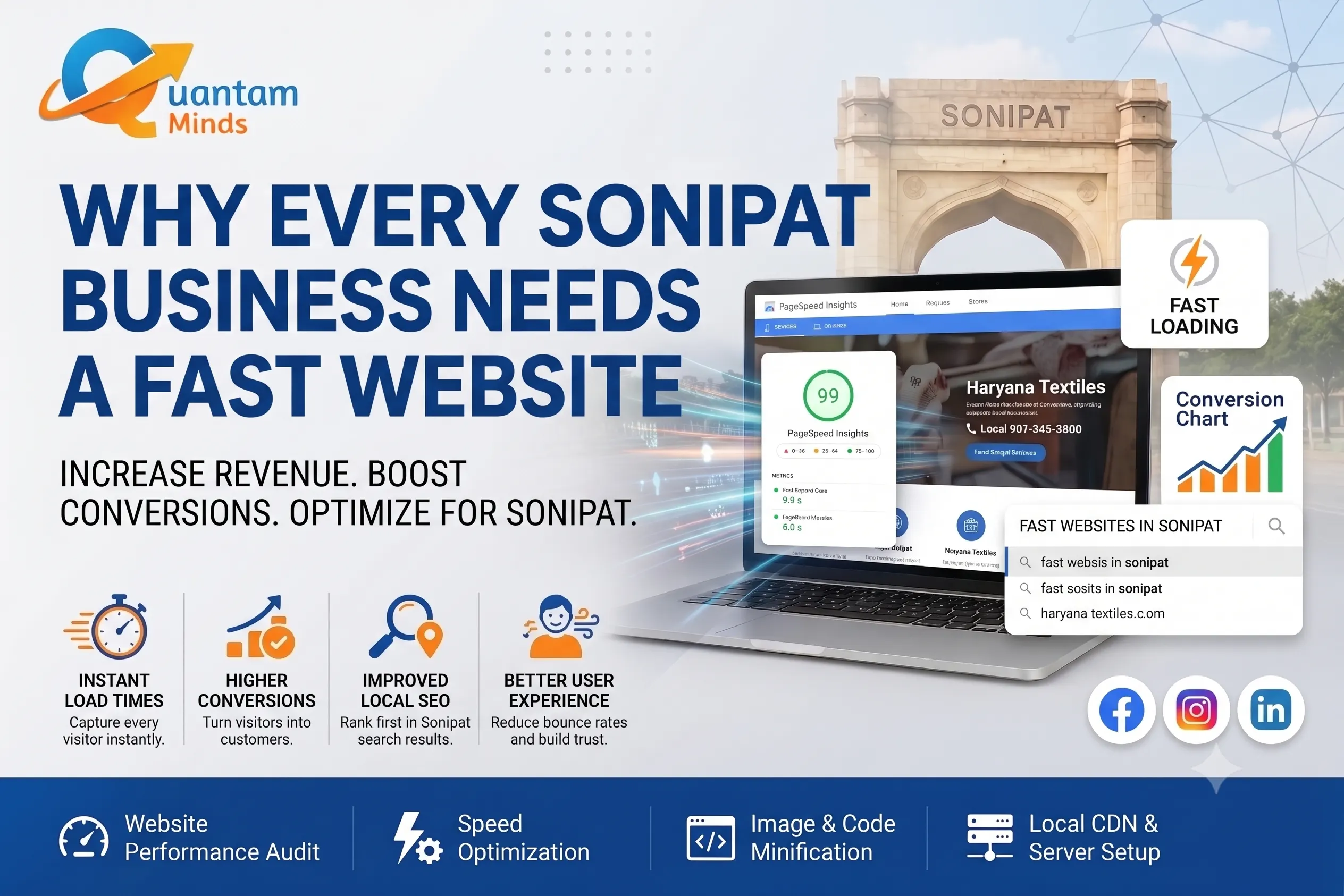
A few years ago, many businesses in Sonipat could still rely on word-of-mouth referrals, local visibility, and repeat customers. That approach still has value, but buying behavior has changed. Today, whether someone is looking for a restaurant, manufacturing supplier, coaching institute, clinic, gym, or retail store, the first interaction often happens online. If your website takes too long to load, many visitors leave before they even discover what your business offers.

That is why investing in web development is no longer just about having an online presence. It is about creating a fast website for business that makes it easy for potential customers to find information, browse services, and take the next step without unnecessary delays. For businesses across Sonipat, a fast website has become a practical business asset rather than a marketing luxury.

Many business owners assume that visitors will wait a few extra seconds if their products or services are good enough. In reality, that rarely happens. Over the years, internet users have become accustomed to websites that respond almost instantly. Even a slight delay can interrupt the decision-making process, especially when several competitors are only one search away.

Imagine a customer searching for an interior designer in Sonipat during a lunch break. They open three websites. Two load immediately, while one continues showing a loading screen. Most people do not compare patiently. They simply move to the next option. The business may never know it lost a potential enquiry because of website speed rather than service quality.

A well-planned business website in Sonipat combines attractive design with technical performance. It should load quickly across different devices, display content correctly, and help visitors reach important pages without frustration. This is where website performance optimization becomes an important part of long-term digital success instead of an afterthought.

Businesses also need to remember that customer expectations are different today.

  • People browse while travelling.
  • They compare multiple businesses at the same time.
  • Most searches now happen on smartphones.
  • They expect pages to open quickly regardless of their internet connection.

Because of these changing habits, mobile-friendly website performance has become just as important as desktop performance. A professionally built responsive website design ensures that visitors receive a consistent experience whether they are using a phone, tablet, or computer.

Not every slow website is caused by poor internet. In many cases, outdated code, oversized images, unnecessary plugins, weak hosting, or missing website speed optimization practices gradually reduce performance. Business owners often focus on adding new features while overlooking the technical foundation that keeps a website efficient.

The table below highlights how website speed influences everyday business interactions.

Website Experience Possible Business Impact
Fast page loading Better user engagement and longer browsing sessions
Responsive navigation Easier access to products and services
Mobile-optimized experience Improved usability across smartphones and tablets
Optimized website performance More efficient customer journeys and fewer interruptions
Well-structured pages Higher confidence and improved brand perception

Another factor that deserves attention is business credibility. Visitors often associate website quality with business professionalism. An outdated or slow website can unintentionally create doubts, even when the company offers excellent products or services. A clean, modern website supported by professional website development sends a stronger message about reliability and attention to detail.

That said, speed alone does not solve every business challenge. A fast website with confusing navigation or weak content may still struggle to convert visitors into enquiries. Sustainable results usually depend on the combination of thoughtful web design and development, relevant content, ongoing maintenance, and continuous technical improvements based on changing business goals.

For many businesses in Sonipat, working with an experienced website development company in Sonipat or choosing reliable web development services in Sonipat can help identify performance issues that are not immediately visible. The exact improvements, however, depend on the existing website, business objectives, and the level of technical optimization already in place.

As local competition continues to grow across Haryana, businesses that invest in professional web development services, page speed optimization, and modern responsive web design are generally better positioned to deliver a smoother digital experience. While faster websites cannot guarantee enquiries or sales, they remove one of the most common barriers between a potential customer and the decision to get in touch.

A fast website creates the foundation for every successful online business, but performance begins with thoughtful planning and development. Learn how our Website Development services help businesses build modern, responsive, and high-performing websites designed around real customer needs and long-term business goals.

How to Improve Website Speed Step by Step

Improving website speed is not about applying one quick fix. Businesses often search for a plugin or a single tool that promises instant results, only to discover that the website still feels slow. In reality, website speed optimization is a process. Every improvement removes a small bottleneck, and together those changes create a noticeably faster website.

Earlier, many websites could get away with large images, heavy animations, and unnecessary scripts. That approach no longer works well. Visitors expect pages to respond quickly, especially on mobile devices, and search engines increasingly value websites that provide a smooth browsing experience.

The good news is that most speed issues can be identified and improved with a structured approach.

Step 1: Measure Your Current Website Performance

Before making any changes, understand where your website stands today.

Many businesses start optimizing without knowing what is actually slowing the website. That usually leads to unnecessary work.

Begin by checking:

  • Overall loading speed.
  • Mobile performance.
  • Desktop performance.
  • Largest page elements.
  • Slow-loading resources.
  • Core loading issues.

This creates a baseline for future improvements. It also helps prioritize changes instead of guessing.

Remember, a performance score is only one indicator. A website with a perfect score may still deliver a poor user experience if navigation or content structure creates friction.

Step 2: Optimize Images Without Reducing Quality

Images are among the biggest reasons websites become slow.

High-resolution photographs look impressive, but uploading them directly from a camera or design software often creates unnecessarily large files.

A better approach includes:

  • Compressing images before uploading.
  • Using modern image formats where appropriate.
  • Serving different image sizes for different devices.
  • Removing images that add little value.
  • Loading images only when users scroll to them.

A local furniture showroom, for example, may showcase dozens of product photographs. Optimizing those images can significantly reduce loading time without affecting visual quality.

This simple improvement often contributes to both website performance optimization and a better browsing experience.

Step 3: Reduce Unnecessary Code and Scripts

Over time, websites accumulate features that are no longer used.

Unused plugins.

Tracking codes from old campaigns.

Multiple font libraries.

Animation scripts.

Widgets that no longer serve any purpose.

Each one increases the amount of work a browser performs before displaying the page.

A professional web development review should identify which scripts are genuinely necessary and which can be removed.

Some common areas to review include:

Technical Element Improvement Opportunity
Unused CSS files Remove unnecessary styles
JavaScript libraries Load only required scripts
Third-party widgets Eliminate inactive integrations
Plugins Remove unused extensions
Fonts Reduce excessive font requests
Tracking scripts Keep only active analytics tools

Not every website requires aggressive code reduction. Custom applications, ecommerce stores, and business portals often depend on specific scripts for essential functionality.

Step 4: Improve Mobile Performance

A website that loads quickly on desktop may still struggle on smartphones.

That is why improving a mobile-friendly website deserves dedicated attention rather than being treated as part of desktop optimization.

Review areas such as:

  • Mobile navigation.
  • Button sizes.
  • Image scaling.
  • Text readability.
  • Touch interactions.
  • Mobile page loading speed.

An effective responsive website design should allow visitors to browse comfortably regardless of screen size.

Many businesses lose potential enquiries because mobile visitors become frustrated before reaching the contact page.

Step 5: Upgrade Hosting When Necessary

Hosting is often overlooked until problems become obvious.

Businesses sometimes spend considerable time optimizing websites while running them on servers that cannot deliver consistent performance.

A better hosting environment may improve:

  • Server response time.
  • Website reliability.
  • Resource availability.
  • Traffic handling during busy periods.
  • Overall loading consistency.

That said, upgrading hosting alone rarely solves every speed issue. Poorly optimized websites can remain slow even on premium servers.

The right solution usually depends on website size, visitor volume, and technical architecture.

Step 6: Enable Browser Caching and Compression

Many website resources do not change every time someone visits.

Browser caching allows returning visitors to reuse previously downloaded files instead of downloading everything again.

Similarly, file compression reduces the amount of data transferred between the server and the visitor's browser.

Together these improvements can contribute to:

  • Faster repeat visits.
  • Reduced server load.
  • Lower bandwidth usage.
  • Better overall browsing performance.

These optimizations are commonly included during professional web development services rather than being treated as optional extras.

Step 7: Review Website Structure and Navigation

Speed is not only about technical loading time.

Visitors also perceive websites as slow when they cannot find information easily.

Imagine someone looking for industrial machinery on a manufacturer's website.

The pages load quickly.

Yet the visitor spends several minutes searching through confusing menus before finding the product catalogue.

Technically, the website is fast.

From the customer's perspective, it feels slow.

Improving navigation often delivers just as much value as reducing loading time.

Step 8: Perform Regular Website Maintenance

Website performance is not permanent.

As businesses publish new blogs, upload images, install plugins, or expand services, websites naturally become more complex.

Regular website management services help maintain performance by:

  • Updating software.
  • Removing unnecessary files.
  • Monitoring technical issues.
  • Checking broken links.
  • Reviewing loading performance.
  • Identifying new optimization opportunities.

Businesses that review website performance only when problems appear often spend more time correcting accumulated issues than preventing them.

Step 9: Monitor Performance After Every Major Update

Many websites perform well after launch but gradually slow down following content updates or feature additions.

Every significant change should be followed by a quick performance review.

Examples include:

  • Launching new landing pages.
  • Installing additional plugins.
  • Adding video content.
  • Integrating CRM systems.
  • Expanding ecommerce functionality.
  • Introducing web application development features.

Continuous monitoring helps detect performance issues before customers begin noticing them.

Step 10: Work With Professionals When Technical Issues Become Complex

Some website improvements are straightforward.

Others require deeper technical expertise.

Server configuration, database optimization, advanced caching, custom coding, and architecture improvements often benefit from experienced developers.

Businesses comparing a website development company, searching for web developers near me, or evaluating web development services in Sonipat should look beyond visual design and ask how performance is measured, maintained, and improved over time.

A capable website development company in Sonipat or experienced website developers will usually treat speed as part of the overall development strategy instead of offering it as a separate service.

There is no universal checklist that guarantees every website will become significantly faster because performance depends on factors such as hosting quality, website complexity, existing code, media assets, and business requirements. However, following these steps consistently creates a stronger technical foundation that supports better user experience, more efficient web design and development, and a website that remains reliable as your business continues to grow.


Free Strategy Consultation

Turn These Insights Into Business Growth

Our experts help businesses convert ideas into measurable digital growth through strategy, technology and performance-driven execution.

Free Initial Consultation
Experienced Industry Experts
Tailored Business Solutions
Transparent Recommendations

Let's Talk

Discuss your business goals with our specialists and discover practical digital solutions that align with your objectives.

Book Free Consultation Call +91 79820 69569

How Professional Web Development Improves Website Speed, User Experience, and Business Growth

Many business owners assume that once a website is live, the hard work is done. In practice, that is often where the real work begins. A website may look attractive on the surface, but if it loads slowly, behaves inconsistently on mobile devices, or makes visitors work too hard to find information, it quietly creates friction that affects every marketing effort built around it.

This is where web development becomes much more than writing code. It is the process of building a website that performs efficiently, supports business objectives, and creates a better experience for every visitor. Whether someone discovers your business through Google Search, social media, or a paid advertisement, the website often becomes the place where first impressions turn into business conversations.

A professionally developed website balances design, performance, usability, and technical reliability instead of prioritizing only visual appearance. That balance becomes increasingly important as businesses in Sonipat compete for attention across digital channels.

Website Speed Creates Better First Impressions

Visitors rarely judge a website only by its design. They notice how quickly pages respond, how smoothly they navigate between sections, and whether information appears without delays. These small moments shape trust long before a customer reads about your services.

A properly built fast loading website improves the overall browsing experience by reducing unnecessary waiting time and helping users reach important information with fewer interruptions.

Some of the technical improvements that contribute to better performance include:

  • Website speed optimization through efficient coding practices.
  • Image compression without noticeable quality loss.
  • Browser caching and optimized resource loading.
  • Removal of unnecessary scripts and plugins.
  • Better hosting configuration where appropriate.
  • Continuous page speed optimization as the website evolves.

Not every website requires the same optimization strategy. Older websites, ecommerce platforms, and custom applications often present different technical challenges, so improvements usually depend on the existing website condition and business requirements.

User Experience Depends on More Than Design

A visually attractive website can still frustrate visitors if navigation feels confusing or pages behave differently across devices.

Businesses sometimes invest heavily in branding while overlooking usability. The result is a website that looks modern but becomes difficult to use during everyday interactions.

A well-planned responsive website design focuses on helping users complete tasks with minimal effort. Whether someone wants to book an appointment, request a quotation, browse products, or call your business, every step should feel straightforward.

An effective user experience usually includes:

Website Element Business Benefit
Mobile-friendly website layout Easier browsing on smartphones and tablets
Clear navigation structure Faster access to products and services
Logical page hierarchy Better content discovery
Consistent page design Stronger brand credibility
Fast page loading Reduced visitor frustration
Accessible contact options Simpler customer enquiries

Recently, businesses have also noticed another shift. Visitors are less willing to "figure out" complicated websites. If navigation feels confusing, they often leave without exploring further. That behaviour is difficult to measure because many businesses never hear from the customers who chose a competitor instead.

Professional Web Development Supports Long-Term Business Goals

A website should not become outdated every time a business grows.

As new services are introduced, additional locations are targeted, or marketing campaigns expand, the website should be able to support those changes without requiring a complete rebuild. That flexibility is one reason businesses choose professional web development services rather than focusing only on initial website design.

An experienced professional website developer typically considers future requirements while building the website, including:

  • Scalability for new pages and services.
  • Easier content management.
  • Better technical structure for SEO.
  • Integration with CRM or enquiry systems.
  • Support for future web application development if business operations expand.
  • Ongoing website management services to maintain performance and security.

Earlier, many businesses rebuilt their websites every few years because they were difficult to update. Today, careful planning during development often makes future improvements much easier. It does not eliminate every technical challenge, but it usually reduces unnecessary redevelopment costs over time.

Responsive Development Supports Modern Customer Behaviour

Customer behaviour continues to evolve.

Someone may begin researching a business on a mobile phone, compare options later on a laptop, and finally submit an enquiry from a tablet. If the experience changes dramatically across devices, confidence often decreases.

That is why responsive web design, mobile website design, and mobile friendly website design have become essential components of modern web design and development rather than optional features.

A responsive website helps businesses deliver:

  • Consistent layouts across different screen sizes.
  • Faster interaction on mobile devices.
  • Easier reading without excessive zooming.
  • Better accessibility for different user groups.
  • A smoother customer journey regardless of device.

Better Technical Foundations Strengthen Every Marketing Effort

A business can invest in SEO, paid advertising, social media campaigns, and content marketing. Yet if visitors land on a slow or poorly developed website, much of that investment becomes less effective.

Think of a manufacturer in Sonipat launching a seasonal advertising campaign. The advertisements perform well and attract qualified visitors, but the enquiry form repeatedly loads slowly on mobile devices. Marketing is not the real problem. The website is quietly creating friction at the point where customers are ready to take action.

This situation is more common than many businesses realise.

Choosing a reliable website development company, experienced website developers, or a trusted web development company allows businesses to evaluate technical issues before they affect customer experience. For companies looking locally, working with a website development company in Sonipat or exploring web development services in Sonipat can also make collaboration easier, particularly when ongoing improvements, consultations, or future website enhancements are required.

Professional development does not guarantee business growth because outcomes always depend on market demand, competition, marketing strategy, and business execution. What it does provide is a stronger digital foundation that supports faster performance, better usability, and a website capable of growing alongside the business instead of holding it back.

A technically strong website becomes even more valuable when paired with the right search strategy. Explore our SEO Services to understand how website performance and search optimization work together to improve online visibility over time.

What Makes a Responsive and Mobile-Friendly Website More Effective for Local Businesses

A website no longer serves only the people sitting in front of a desktop computer. For many local businesses, the majority of visitors now arrive through smartphones. They might be searching while travelling, waiting outside a client's office, comparing nearby service providers, or looking for a quick solution during a busy workday. That small shift in customer behaviour has changed how businesses should approach web development.

A website that works perfectly on a large monitor but feels difficult to use on a phone creates unnecessary obstacles. Visitors may still appreciate your products or services, but if they struggle to read content, tap buttons, or navigate pages, many simply move on. The opportunity disappears before your business has a chance to make an impression.

This is why businesses in Sonipat are increasingly investing in responsive website design and mobile-friendly website development as part of their long-term digital strategy rather than treating mobile optimization as an optional upgrade.

Responsive Design Adapts to How People Actually Browse

Customer journeys are rarely predictable anymore.

Someone may discover your business through Google on their phone, revisit your website later from a laptop at work, and finally contact you using a tablet at home. If the experience changes significantly across those devices, confidence can fade without the visitor consciously realizing why.

A well-built responsive web design automatically adjusts layouts, images, navigation menus, and content according to screen size. Instead of maintaining separate desktop and mobile versions, businesses provide one consistent experience that feels natural regardless of the device.

This approach improves usability by helping visitors:

  • Read content comfortably without zooming.
  • Navigate menus with fewer taps.
  • Find contact information quickly.
  • Browse products and services without layout issues.
  • Complete enquiry forms more easily.

The goal is not to impress visitors with animations or visual effects. It is to remove small frustrations before they become reasons to leave.

Mobile Users Make Decisions Faster Than Desktop Users

Mobile visitors often behave differently.

They usually have a specific objective and expect immediate answers. Whether they need a nearby clinic, a manufacturer, a restaurant, or a coaching institute, they want information without unnecessary waiting or complicated navigation.

Imagine a business owner searching for a packaging supplier in Sonipat between meetings. The first website displays tiny text, overlapping buttons, and slow-loading images. The second opens instantly, displays clearly on the phone, and makes the enquiry button easy to find.

The decision is often made within moments.

That does not mean the second company offers better products. It simply removed enough friction to keep the conversation moving.

A properly planned mobile website design focuses on these real-world browsing habits rather than assuming every visitor will patiently explore every page.

Responsive Development Supports Better User Experience

Design is only one part of the equation.

Behind every smooth mobile experience is careful technical planning. Professional web development services combine usability with performance so visitors can interact naturally without noticing the technology working behind the scenes.

Some of the characteristics commonly found in an effective mobile friendly website design include:

Feature Why It Matters for Local Businesses
Responsive page layouts Adapts to different screen sizes automatically
Fast page loading Reduces waiting time for mobile visitors
Easy navigation Helps users reach important pages quickly
Clickable contact buttons Simplifies phone calls and enquiries
Optimized images Improves loading speed without reducing quality
Readable typography Makes information easier to consume on smaller screens

These improvements may appear small individually, but together they create a browsing experience that feels effortless.

Website Performance and Mobile Design Work Together

Many businesses separate design from performance, although visitors experience them at the same time.

A visually attractive website that loads slowly still creates frustration. Likewise, a fast website with poor navigation can confuse visitors.

That is why website performance optimization, website speed optimization, and page speed optimization should complement responsive development rather than replace it.

Over the years, developers have learned that reducing unnecessary scripts, optimizing images, improving code efficiency, and simplifying page structures often contribute just as much to mobile usability as visual design itself.

Still, every website has different technical limitations. Older websites, custom-built systems, and ecommerce platforms often require different optimization approaches. There is rarely a single solution that fits every business.

Local Businesses Need Websites That Support Everyday Customer Actions

The most effective websites do not try to impress everyone.

They help visitors complete the actions that matter most.

For many local businesses, those actions include:

  • Finding business information quickly.
  • Calling directly from a smartphone.
  • Sending an enquiry without lengthy forms.
  • Browsing products or services comfortably.
  • Locating the business address.
  • Reading customer-focused information without distractions.

A professionally built business website in Sonipat should support these everyday interactions instead of forcing visitors to search for basic information.

Businesses looking for a dependable website development company in Sonipat often focus on design first. In reality, the better question is whether the website will continue serving customers effectively as devices, browsing habits, and business requirements evolve.

Responsive Websites Create Stronger Long-Term Value

A responsive website is not simply about following modern design trends. It prepares a business for changing customer expectations without requiring separate websites for different devices.

An experienced professional website developer understands that flexibility becomes increasingly important as businesses expand their services, publish more content, or introduce new digital tools. Whether future plans involve SEO, paid advertising, CRM integration, or web application development, a responsive technical foundation usually makes those improvements easier to implement.

Businesses searching for web developers near me, evaluating a website development company, or comparing professional web development services should look beyond visual appearance alone. A website that responds smoothly across devices, loads efficiently, and keeps visitors engaged often delivers greater long-term value than one built primarily to look impressive.

Responsive design cannot guarantee more enquiries or business growth because outcomes always depend on factors such as competition, marketing strategy, customer demand, and the quality of the products or services offered. What it can do is remove unnecessary barriers, helping visitors interact with your business in a way that feels simple, consistent, and trustworthy from the very first visit.

A responsive website becomes even more important when visitors arrive through paid campaigns. Discover how our Google Ads Services help drive qualified traffic to fast, mobile-friendly landing pages that create a better browsing experience for potential customers.

Free Strategy Consultation

Turn These Insights Into Business Growth

Our experts help businesses convert ideas into measurable digital growth through strategy, technology and performance-driven execution.

Free Initial Consultation
Experienced Industry Experts
Tailored Business Solutions
Transparent Recommendations

Let's Talk

Discuss your business goals with our specialists and discover practical digital solutions that align with your objectives.

Book Free Consultation Call +91 79820 69569

Common Website Performance Problems That Cost Sonipat Businesses Customers and Sales

Many business owners assume that if their website looks modern, it must also perform well. Unfortunately, appearance tells only part of the story. A website can have an attractive design, high-quality images, and detailed service pages while still creating enough friction to push potential customers away.

The difficult part is that these problems often go unnoticed. Businesses rarely receive an email saying, "Your website was too slow, so I contacted someone else." Visitors simply leave. Another business gets the opportunity instead.

For companies investing in web development, identifying performance issues early is often more valuable than adding new features. A technically sound website helps every marketing effort work more efficiently, whether visitors arrive through search engines, social media, paid advertising, or direct referrals.

Slow Loading Pages Reduce Visitor Engagement

One of the most common issues affecting a business website in Sonipat is slow page loading.

Every extra second spent waiting gives visitors another reason to leave. This becomes even more noticeable on mobile devices where users expect information almost immediately.

A slow website may result from:

  • Large, uncompressed images.
  • Poor hosting infrastructure.
  • Excessive plugins or third-party scripts.
  • Outdated website code.
  • Heavy animations and unnecessary visual effects.
  • Lack of regular website speed optimization.

Many businesses continue adding new features over time without reviewing how those additions affect overall performance. Eventually, the website becomes slower with every update.

Poor Mobile Experience Frustrates Potential Customers

A website that performs well on a desktop may still create problems on smartphones.

Buttons become difficult to tap.

Menus overlap.

Images fail to resize correctly.

Text becomes difficult to read.

These may seem like minor technical issues, but together they create an experience that feels unprofessional.

Today, a significant share of local searches begins on mobile devices. Without a properly developed mobile-friendly website, businesses risk losing visitors before meaningful engagement even begins.

This is one reason why responsive website design and thoughtful mobile website design have become standard expectations rather than premium features.

Confusing Navigation Creates Hidden Barriers

Sometimes the website loads quickly, yet visitors still leave.

The reason is surprisingly simple.

They cannot find what they came looking for.

Imagine someone searching for industrial equipment suppliers in Sonipat. They land on a website where the services are buried under multiple menus, contact details are difficult to locate, and product categories feel disorganized.

After a few unsuccessful clicks, they close the website.

Nothing technically failed.

The customer simply became tired of searching.

An effective responsive web design guides visitors naturally instead of forcing them to think about where information might be hidden.

Outdated Technical Structure Affects Overall Performance

Technology changes much faster than many websites.

A website built several years ago may still function, but its technical foundation could limit future improvements.

Common technical issues include:

Performance Issue Possible Impact on Business
Outdated code structure Slower page rendering
Unoptimized images Increased loading time
Broken internal pages Poor user experience
Missing mobile optimization Reduced usability on smartphones
Poor caching setup Slower repeat visits
Heavy scripts Lower website responsiveness

These problems rarely appear overnight. They usually develop gradually as websites expand without regular technical reviews or website performance optimization.

Weak Website Maintenance Creates Long-Term Challenges

Launching a website is only the beginning.

Without ongoing attention, even well-built websites gradually become less efficient.

Software updates are postponed.

Unused plugins remain installed.

Old pages accumulate.

Media files become larger.

Performance slowly declines.

Businesses sometimes focus entirely on marketing campaigns while overlooking routine maintenance. Later, they discover that technical issues are limiting the effectiveness of those campaigns.

This is where ongoing website management services become valuable. Regular monitoring helps identify problems before they affect customer experience or create larger technical complications.

Design Without Performance Is an Expensive Compromise

There was a time when websites were judged mainly by appearance.

That expectation has changed.

Visitors now expect websites to be visually appealing, fast, responsive, and easy to navigate at the same time.

A beautifully designed website that responds slowly often performs worse than a simpler website built with efficiency in mind.

That balance between appearance and performance is a major reason businesses invest in professional website development instead of focusing exclusively on graphic design.

Common Performance Problems and Practical Improvements

Many technical issues can be identified before they begin affecting customers.

Some examples include:

Common Problem Practical Improvement
Slow image loading Compress and optimize images
Large page files Remove unnecessary code and scripts
Poor mobile usability Improve mobile friendly website design
Delayed page rendering Apply page speed optimization techniques
Inconsistent layouts Upgrade responsive web design
Technical bottlenecks Review website architecture through professional web development services

The right solution always depends on the existing website. A local service business, an ecommerce platform, and a manufacturing company may require completely different optimization priorities.

Professional Development Helps Prevent Problems Before They Grow

Many website issues become expensive only because they remain unnoticed for too long.

A manufacturer may lose quotation requests because enquiry forms fail on mobile devices.

A clinic may experience fewer appointment bookings because service pages load slowly during busy hours.

A restaurant could lose customers simply because its menu is difficult to read on smartphones.

These situations happen more often than businesses realize.

Working with an experienced website development company in Sonipat, choosing reliable web development services in Sonipat, or consulting skilled website developers allows businesses to identify technical weaknesses before they affect customer experience. Businesses comparing a website development company, a web development company, or searching for web developers near me should evaluate not only design capabilities but also long-term performance, scalability, and technical maintenance.

No website can eliminate every business challenge. Customer demand, competition, pricing, and service quality will always influence results. However, resolving performance problems removes avoidable obstacles that may otherwise prevent interested visitors from becoming genuine business opportunities.

Website performance is only one part of building a successful online presence. Explore our Digital Marketing Agency in Sonipat solutions to see how SEO, paid advertising, social media, and website optimization work together as part of a practical digital growth strategy.

How the Right Website Development Company in Sonipat Can Build a Fast, High-Performing Business Website

Choosing a company to build your website is not simply a design decision. It is a business decision that can influence how customers experience your brand, how efficiently your marketing performs, and how easily your website adapts as your business grows.

Many businesses make the mistake of comparing only price or visual design. Months later, they discover that the website is difficult to update, loads slowly, performs poorly on mobile devices, or cannot support new business requirements. Fixing those problems often costs more than building the website correctly in the first place.

The right website development company in Sonipat approaches a website as a long-term business asset rather than a one-time project. Instead of focusing only on appearance, experienced developers pay attention to performance, usability, scalability, and maintainability from the beginning.

A Good Development Company Understands Business Before Technology

Every business has different priorities.

A manufacturer may need product catalogues and quotation forms.

A clinic may focus on appointment bookings.

A restaurant wants customers to view menus quickly.

An ecommerce business requires secure product management and smooth checkout experiences.

Using the same website structure for every business rarely produces the best outcome.

An experienced team begins by understanding business objectives before recommending technical solutions. That approach often leads to better decisions because the website is designed around how customers actually interact with the business instead of following a generic template.

This is one of the biggest differences between simply creating a website and delivering professional website development.

Performance Is Planned During Development, Not After Launch

Website speed is often treated as a separate service.

In reality, much of a website's performance is determined while it is being built.

Careful web development considers technical efficiency from the beginning by reducing unnecessary complexity and ensuring every component serves a purpose.

A professionally developed website generally focuses on:

  • Clean and efficient coding practices.
  • Optimized image delivery.
  • Logical page structure.
  • Efficient database interaction where required.
  • Proper implementation of website performance optimization techniques.
  • Future-ready architecture that supports growth.

Businesses sometimes assume they can solve every performance issue later through page speed optimization. While improvements are certainly possible, correcting structural issues after launch is often more difficult than preventing them during development.

Responsive Design Should Be Built Into Every Project

Customer behaviour has changed significantly.

Today, a potential customer might discover your business through a smartphone during the morning commute, revisit your website on an office computer, and finally submit an enquiry later from a tablet.

If the website behaves differently on each device, trust can gradually decline.

A reliable development company treats responsive website design as a standard requirement rather than an optional feature.

An effective mobile-friendly website typically provides:

Development Focus Benefit for Businesses
Responsive web design Consistent experience across devices
Optimized navigation Faster access to important information
Mobile website design Improved usability on smaller screens
Fast page loading Better visitor engagement
Clear contact options Simpler customer communication
Scalable website structure Easier future expansion

Good responsiveness is not about making the desktop version fit onto a phone. It involves designing every interaction around how mobile users naturally browse.

Scalability Matters More Than Many Businesses Expect

A website rarely stays the same.

Businesses introduce new services.

Additional team members join.

More locations are added.

Marketing campaigns expand.

Customer expectations evolve.

A website that cannot grow alongside the business eventually becomes a limitation.

This is where professional web development services provide long-term value. Instead of creating something that works only today, experienced developers build websites capable of supporting future improvements such as CRM integrations, web application development, ecommerce functionality, automation tools, and expanded service pages.

Not every business needs these features immediately.

Planning for future growth, however, usually saves both time and redevelopment costs later.

Ongoing Support Is Just as Important as Initial Development

Launching a website should not mark the end of the relationship.

Technology continues to evolve, browsers receive updates, security requirements change, and customer expectations shift over time.

Without regular maintenance, even well-built websites gradually lose efficiency.

Businesses should consider whether their development partner offers:

  • Regular website management services.
  • Technical updates.
  • Performance monitoring.
  • Security improvements.
  • Backup management.
  • Ongoing optimization recommendations.

Recently, many companies have started viewing websites as evolving business platforms rather than static digital brochures. That mindset usually leads to more sustainable digital growth because improvements happen continuously instead of only when problems become visible.

Questions Worth Asking Before Choosing a Development Partner

Selecting a development company becomes easier when the conversation focuses on business outcomes instead of sales promises.

Consider asking questions such as:

  • How will the website support future business growth?
  • What approach is used for website speed optimization?
  • How is mobile performance tested?
  • Will the website remain easy to update?
  • What maintenance options are available after launch?
  • How is scalability handled if additional features are needed later?

These discussions often reveal more about a company's experience than a portfolio alone.

Choosing the Right Partner Is About Long-Term Value

A website may represent the first interaction someone has with your business. That experience should feel fast, reliable, and easy to navigate.

Businesses comparing a website development company, evaluating different website developers, or searching for web developers near me should look beyond attractive layouts and low pricing. A capable web development company combines technical expertise with business understanding, helping create websites that remain useful as customer expectations and digital strategies evolve.

At Quantamminds, our approach reflects that philosophy. We work with startups, SMEs, and established businesses to deliver web development services, web design and development, and scalable digital solutions that align with real business goals rather than short-term trends. Every project is planned around usability, technical performance, and long-term flexibility because the most effective websites are not simply built to launch. They are built to support businesses as they continue to grow, adapt, and compete in an increasingly digital marketplace.

A high-performing website should combine technical excellence with a professional visual identity. Our Graphic Designing services help businesses create clean, engaging designs that strengthen brand credibility while complementing modern website development.

Verified Editorial Team

Ashwani Kumar

Our content is researched, written and reviewed by professionals specialising in Digital Marketing, SEO, Website Development, Branding, Google Ads, Artificial Intelligence, Automation and Business Growth strategies.

Practical Business Insights
Industry Best Practices
Regular Content Updates
Trusted Digital Experts

Connect With Us

Looking for expert guidance? Our team is ready to help.

Visit Website Contact Us Author Profile
FREQUENTLY ASKED QUESTIONS

Everything You Need To Know

FAQ

Need Help?

Our experts are ready to answer your questions.

A fast website for business helps visitors access information quickly, whether they are searching for products, booking services, or requesting a quotation. Local customers often compare several businesses before making a decision, and a slow website may discourage them from exploring further. While website speed alone does not guarantee more enquiries, it creates a smoother user experience that supports SEO, paid advertising, and customer trust. The overall impact depends on factors such as website quality, industry competition, and how well the website meets user expectations.

Professional web development focuses on much more than visual design. It involves creating efficient code, optimizing images, improving navigation, implementing responsive website design, and applying website performance optimization techniques that help pages load more efficiently. An experienced developer also considers future scalability, security, and ease of maintenance. The exact improvements vary depending on your existing website, hosting environment, and business requirements, so the development approach is usually tailored rather than standardized.

Yes, in many cases it is. Today, a large number of customers search for local businesses using smartphones before making contact. A properly built mobile-friendly website with effective responsive web design allows visitors to browse comfortably regardless of screen size. This creates a better experience for potential customers and reduces common usability issues such as difficult navigation or unreadable content. While mobile optimization cannot guarantee business growth, it helps remove barriers that may otherwise prevent visitors from engaging with your business.

There is no single timeline because every website starts from a different point. Some improvements, such as image optimization or page speed optimization, can often be completed relatively quickly, while larger technical changes may require more planning. Ecommerce websites, custom applications, and older platforms generally involve additional complexity. The overall timeline depends on the website's condition, technical structure, hosting environment, and the scope of optimization required rather than a fixed schedule.

Choosing a website development company in Sonipat should involve more than comparing prices or reviewing design portfolios. Ask how the company approaches performance, mobile optimization, future scalability, security, and ongoing support. A reliable development partner should explain their process clearly, understand your business goals, and recommend solutions based on your actual requirements rather than offering generic packages. Businesses should also consider post-launch maintenance, communication quality, and long-term technical support before making a decision.

Yes. We provide website maintenance, security updates, hosting support, marketing optimization and technical assistance.

Still Have Questions?

Talk directly with our experts and get personalized guidance for your business.

Contact Quantam Minds

Let's Build Something Amazing Together

Have a website, CRM, HRM, ERP or custom software requirement? Connect with our team and discuss your project goals today.

Office Address

Baba Colony, Sector 25, Sonipat, Haryana 131001

Working Hours

Monday - Saturday
09:00 AM - 07:00 PM

Need Immediate Assistance?

Chat directly with our development experts and get quick guidance.

WhatsApp Us
Call Expert WhatsApp Us