services

Ecommerce SEO That Turns Search Visibility Into Sustainable Sales

Ecommerce SEO helps online stores improve organic visibility by researching customer search intent, optimizing product and category pages, strengthening technical performance, and building relevant content and internal links. It benefits D2C brands, Shopify and WooCommerce stores, marketplaces, and growing ecommerce businesses by attracting qualified traffic, improving product discovery, supporting conversions, and creating a more sustainable customer acquisition channel.

1545+

Projects Delivered

174+

Business Clients

10+

Years Experience
  • Ecommerce-focused SEO strategy
  • Product & category optimization
  • Technical SEO for scalable stores
  • Search-intent driven planning
  • Conversion-focused SEO
  • Long-term organic growth approach
seoservices

Ecommerce SEO Services

Get expert guidance for your business.

TRUSTED DIGITAL GROWTH PARTNER

Trusted By 100+ Businesses Across Multiple Industries

From ambitious startups to established enterprises, Quantam Minds helps businesses generate qualified leads, improve online visibility, automate operations, and accelerate growth through strategic digital marketing, custom web development, AI-powered automation, and business software solutions.

Healthcare Real Estate Education Manufacturing Fitness Hospitality Ecommerce Retail Travel Professional Services Startups Corporate

Why Ecommerce SEO Matters More Than Ever for Online Stores

Online shopping is no longer a straight path from search to checkout. A customer might discover a product on Google, compare alternatives through Google Shopping, read reviews, browse social media, visit your store, leave without purchasing, and return days later when they are ready to buy.

That longer journey makes ecommerce SEO more important than simply getting a handful of product pages to rank. Your category pages, collections, product pages, supporting content, internal links, and technical website structure all influence how easily potential customers can discover and evaluate your store.

Customers Are Searching With More Specific Intent

Ecommerce searches have become increasingly detailed.

Instead of searching only for a broad product category, shoppers may look for specific features, materials, sizes, use cases, price ranges, colours, or alternatives before deciding what to buy.

For example, someone searching for running shoes may move from a broad query to something much more specific, such as shoes for long-distance running, lightweight running shoes, or running shoes for beginners.

This creates opportunities beyond individual product names.

A well-planned ecommerce website SEO strategy helps stores build visibility across different stages of product research by optimising relevant category pages, product pages, collections, buying guides, and other useful resources around genuine customer search behaviour.

Search Is Becoming Another Product Discovery Channel

Google Search is no longer limited to traditional blue-link results.

Product discovery is increasingly becoming more visual, conversational, and AI-assisted. Customers may use search features, shopping experiences, or AI-powered tools to research products and narrow down their choices.

That does not make traditional SEO less important.

If anything, it makes the quality of your ecommerce information more important.

Search engines and shoppers need to understand:

  • What the product is
  • Who it is suitable for
  • Which features matter
  • How products differ
  • What makes your offering credible
  • Where the product fits within its category

This is why SEO for ecommerce websites should not be reduced to adding keywords to product descriptions. Strong ecommerce SEO combines useful information with a technically accessible website and a clear structure that helps both shoppers and search engines understand the store.

Paid Traffic Is Useful, But Organic Visibility Builds an Additional Acquisition Channel

Paid advertising can deliver immediate visibility.

For ecommerce brands launching a new product, testing an offer, or trying to generate sales quickly, that can be extremely valuable.

But paid traffic comes with an ongoing cost.

Every campaign requires budget, and rising competition can make customer acquisition increasingly expensive. Once advertising stops, the traffic generated directly through those campaigns generally stops with it.

Organic search works differently.

A well-optimised product or category page can continue attracting relevant visitors after the initial SEO work has been completed. That does not mean organic traffic is free—effective SEO requires investment, content development, technical work, monitoring, and ongoing optimisation.

The difference is in how the acquisition channel works.

A strong ecommerce SEO strategy can create an additional source of qualified traffic that does not depend entirely on paying for every individual visit.

The Modern Ecommerce Customer Journey Is More Complicated

The path from discovering a product to purchasing it can involve several interactions:

Discovery → Research → Comparison → Product Evaluation → Trust Check → Purchase

At each stage, customers may have different questions.

Early in the journey, they may want to understand what products are available.

During comparison, they may evaluate features, prices, materials, specifications, or alternatives.

Before purchasing, they may look for reviews, shipping information, return policies, product details, and signs that the store is trustworthy.

Good ecommerce SEO services take this broader journey into account rather than focusing exclusively on ranking individual products.

Your SEO strategy should help customers discover the right category, understand the products, compare relevant options, and reach the purchase stage with fewer unanswered questions.

Product Pages Alone Are Not Enough

One common ecommerce SEO mistake is treating product pages as the entire organic search strategy.

Product pages are important, but they are only one part of the website.

A strong ecommerce structure may include:

Ecommerce SEO Area Purpose
Category pages Capture broader product-category searches
Product pages Target specific products and purchase intent
Collection pages Organise related products around meaningful themes
Buying guides Help customers research and compare options
Informational content Address questions earlier in the buying journey
Internal linking Connect related products, categories, and resources
Technical SEO Help search engines crawl and understand the website
Product information Improve relevance, clarity, and purchase confidence

When these elements work together, the website becomes more than an online catalogue.

It becomes a useful product discovery resource.

Ecommerce SEO Works Alongside Your Other Marketing Channels

SEO should not replace Google Ads, social media, marketplaces, email marketing, or other acquisition channels.

It should strengthen the overall digital marketing system.

A customer may discover your brand through an advertisement, later find your product through organic search, follow the brand on social media, and eventually return through an email campaign to complete the purchase.

That is why an ecommerce SEO agency should look beyond rankings and consider how organic search contributes to the wider customer journey.

The goal is not simply to generate more sessions.

It is to attract relevant shoppers who have a genuine reason to consider your products.

The Real Value of Ecommerce SEO Is Measured Beyond Rankings

Ranking positions can be useful indicators, but they are not the final business objective.

An ecommerce brand ultimately needs to understand whether organic search is contributing to:

  • Qualified product discovery
  • Organic revenue
  • Product and category visibility
  • Conversion rates
  • Customer acquisition efficiency
  • New customer growth
  • Repeat purchases
  • Overall brand discovery

This is where ecommerce SEO services India can provide meaningful long-term value for growing online stores. The strategy should connect search visibility with actual commercial outcomes instead of treating rankings and traffic as the end goal.

For ecommerce businesses, SEO is increasingly about being present when shoppers are researching, comparing, and deciding what to buy. Strong product information, useful category content, technical accessibility, credible brand signals, and a well-structured website give an online store more opportunities to enter that journey.

The objective isn't to replace paid marketing. It's to build an organic acquisition channel that continues creating opportunities alongside it. Over time, that visibility can support stronger product discovery, more qualified traffic, better customer acquisition efficiency, and sustainable ecommerce growth.

Free Business Consultation

Need Help Choosing the Right Ecommerce SEO Services?

Our specialists will help you understand the complete process, documentation requirements, estimated timelines and the best approach for your Ecommerce SEO Services project.

Free Expert Consultation
Transparent Process
Dedicated Project Manager
Personalized Business Solutions

Everything Your Business Needs To Grow Online

We combine digital marketing, creative branding, web development, automation, and business software into one complete growth ecosystem.

Digital Marketing Agency in Bangalore

Digital Marketing Agency in Bangalore

A digital marketing agency in Bangalore helps startups, local businesses, and growing comp...

Check Digital Marketing Agency in Bangalore
Ecommerce SEO Services

Ecommerce SEO Services

Running an online store today requires more than great products. Ecommerce SEO services he...

Check Ecommerce SEO Services
Digital Marketing for Hotels

Digital Marketing for Hotels

In today's competitive hospitality market, Digital Marketing for Hotels helps hotels, reso...

Check Digital Marketing for Hotels
Digital Marketing for Manufacturers

Digital Marketing for Manufacturers

Manufacturing businesses need more than a strong production capability to stay competitive...

Check Digital Marketing for Manufacturers
Digital Marketing for Real Estate

Digital Marketing for Real Estate

Digital marketing for real estate helps builders, developers, property consultants, and re...

Check Digital Marketing for Real Estate
SEO for Educational Institutes

SEO for Educational Institutes

Students and parents begin researching coaching institutes long before they make an admiss...

Check SEO for Educational Institutes
Digital Marketing Company in Delhi

Digital Marketing Company in Delhi

Choosing the right Digital Marketing Company in Delhi is about building a strategy that su...

Check Digital Marketing Company in Delhi
Digital Marketing Company in Noida

Digital Marketing Company in Noida

Every business reaches a point where referrals and traditional marketing alone are no long...

Check Digital Marketing Company in Noida
READY TO GROW?

Let's Build A Digital Growth Strategy That Actually Delivers Results

Whether you need SEO, Google Ads, Website Development, CRM Software, AI Automation, or a complete digital transformation strategy, our experts are ready to help you grow faster.

Biggest SEO Challenges Ecommerce Websites Face

Ecommerce SEO becomes increasingly difficult as an online store grows. Adding more products does not automatically create more organic visibility. In many cases, the search structure becomes harder to manage as the catalogue expands, leaving valuable products buried beneath layers of categories, filters, duplicate URLs, and weak internal links.

Google recommends making important ecommerce pages accessible through normal website navigation and internal links, particularly by connecting categories to subcategories and individual products. For larger stores, this structure becomes one of the foundations of effective ecommerce website SEO.

Low Organic Traffic to Valuable Products

One of the most common challenges is low organic product traffic.

A store may sell excellent products and still receive very few visitors from Google. The problem may not be the products themselves. Product pages may target weak search queries, category pages may provide little useful information, or important products may be buried several clicks deep.

A large catalogue is not necessarily a well-optimised catalogue.

For an ecommerce SEO company, one of the first priorities is identifying which products and categories have genuine search demand and whether those pages are easy for both search engines and customers to discover.

The objective is to make commercially important products easier to find—not simply to increase the total number of indexed URLs.

Duplicate Product URLs and Faceted Navigation

Filters are essential for ecommerce shoppers.

Customers may want to narrow products by:

  • Size
  • Colour
  • Brand
  • Price
  • Material
  • Rating
  • Availability
  • Product specifications

The problem begins when every combination of those filters creates a separate URL that search engines can crawl.

A large ecommerce website can quickly generate thousands—or even millions—of URL variations. Poorly managed faceted navigation can consume crawl resources while making it harder for search engines to discover and process the pages that actually matter.

This is why technical ecommerce SEO services need to consider how filters, sorting options, parameters, canonicalisation, and indexation work together.

Not every URL needs to appear in Google.

Sometimes, the best SEO decision is preventing low-value variations from competing with the pages that deserve visibility.

Thin and Duplicate Product Descriptions

Another common problem appears when stores use manufacturer-provided descriptions across hundreds of products.

The descriptions may technically be accurate.

But they often provide very little additional value.

If several ecommerce websites use almost identical manufacturer copy, there is little differentiation in the content itself. More importantly, the description may not answer the questions your actual customers have before purchasing.

A stronger product page can provide information such as:

  • Key product features
  • Practical use cases
  • Specifications
  • Size or compatibility information
  • Materials
  • Care instructions
  • Frequently asked questions
  • Shipping and return information
  • Product comparisons where relevant

This does not mean every product description needs to become extremely long.

It means the content should be useful, specific, and relevant to the product and customer.

For SEO for ecommerce websites, unique and genuinely helpful product information can be far more valuable than simply making descriptions longer.

Large Ecommerce Sites Develop Indexing Problems

As an ecommerce store expands, website architecture can become difficult to control.

Products may become orphaned.

Important category pages may receive very few internal links.

Discontinued products may remain accessible.

Old URLs may continue generating crawl activity.

New products may be added without being properly connected to the rest of the website.

Google recommends clear ecommerce navigation and direct links to products that businesses want search engines to discover and index.

This makes internal linking particularly important for large stores.

A well-planned structure might look something like:

Homepage → Main Category → Subcategory → Product → Related Products

Supporting content can then connect back to relevant categories and products where appropriate.

This helps create a logical relationship between different parts of the store while making important pages easier to discover.

Slow Websites Can Affect the Shopping Experience

Technical SEO is only one side of the problem.

The other is what happens when a customer actually reaches the page.

Ecommerce shoppers have little patience for pages that take too long to load, especially on mobile devices. A slow product page can interrupt the shopping journey before the visitor has even seen the product properly.

Common issues include:

  • Heavy product images
  • Excessive JavaScript
  • Poor mobile optimisation
  • Slow server response
  • Unnecessary third-party scripts
  • Poorly implemented tracking tools
  • Layout instability
  • Inefficient website code

For an ecommerce SEO expert, improving technical performance is therefore not simply about satisfying search engines. It is also about creating a smoother path from search result to product evaluation and purchase.

A customer who cannot comfortably use the website is unlikely to become a customer simply because the page ranks well.

Ranking for Thousands of Keywords Does Not Guarantee Revenue

This is one of the biggest misconceptions in ecommerce SEO.

A store may rank for thousands of keywords and still struggle to generate meaningful organic revenue.

Why?

Because not every keyword has commercial value.

Ranking for informational searches can increase traffic without necessarily increasing sales. Conversely, a store may have relatively modest organic traffic but generate strong revenue because it ranks for highly relevant product and category searches.

The more useful questions are:

  • Are important categories gaining visibility?
  • Are valuable products receiving organic traffic?
  • Are organic visitors converting?
  • Is organic revenue increasing?
  • Are new customers being acquired through search?
  • Which landing pages contribute to sales?

A strong ecommerce SEO agency should therefore measure SEO against business performance rather than treating rankings as the final objective.

Marketplace Competition Makes Attribution More Complicated

Ecommerce brands also operate in a multi-channel environment.

A customer may discover a product through Google, research it on the brand's website, compare prices on Amazon or Flipkart, and ultimately complete the purchase through a marketplace.

That can make organic search performance difficult to evaluate.

Without proper analytics and ecommerce conversion tracking, a business may see organic traffic but fail to understand how that traffic contributes to revenue and customer acquisition.

This is particularly important for brands that sell through both their own website and third-party marketplaces.

SEO reporting should provide enough visibility to understand the relationship between:

Organic Search → Product Discovery → Website Engagement → Conversion → Revenue

Traffic is useful.

Revenue tells a much more complete story.

Ecommerce Growth Can Create SEO Problems Faster Than Teams Expect

A growing store often adds products, categories, filters, landing pages, promotional URLs, and content at a much faster rate than its SEO structure is reviewed.

That creates problems gradually.

A category gets duplicated.

A product is removed without a proper URL strategy.

A filter generates thousands of crawlable URLs.

A new product isn't internally linked.

An important category becomes buried.

None of these issues may look serious individually.

Together, they can make a large ecommerce website increasingly difficult for search engines to understand and for customers to navigate.

This is why ecommerce SEO services should not be treated as a one-time optimisation project. Ecommerce websites change constantly, and their SEO structure needs to evolve with them.

The Real Ecommerce SEO Challenge Is Connecting Search With Purchase

The biggest challenge is not simply getting more pages indexed.

It is creating an ecommerce website where search engines can efficiently discover valuable products and customers can move smoothly from search → product → trust → purchase.

That requires more than keyword optimisation.

It requires a combination of:

  • Strong website architecture
  • Search-focused category pages
  • Well-optimised product pages
  • Effective internal linking
  • Controlled faceted navigation
  • Unique and useful product content
  • Technical SEO
  • Mobile performance
  • Conversion-focused UX
  • Accurate ecommerce tracking
  • Continuous performance analysis

This is where professional ecommerce SEO services become valuable. The goal is not to make every page rank or generate traffic for its own sake. The goal is to create a search-friendly ecommerce system that makes commercially valuable products easier to discover and gives shoppers a clear path towards making a purchase.

The strongest ecommerce SEO strategy is not the one with the most indexed pages. It is the one that helps the right customers find the right products and gives them a better reason to buy.

How Customers Search Before Buying Products Online

Online shoppers rarely move directly from a search result to a purchase. Most people explore several types of searches before deciding whether a product—and the store selling it—is worth their money.

A shopper may discover a product through Google, compare several alternatives, check prices and availability, read reviews, visit the product page, leave the website, and return later before finally purchasing.

For ecommerce brands, understanding this journey is important because ecommerce SEO needs to support customers at more than one stage of their decision-making process.

The Ecommerce Search Journey Usually Starts Broad

The first search is often about a product category rather than a specific brand.

For example:

  • "Running shoes for men"
  • "Skincare products for oily skin"
  • "Office chairs for home"
  • "Wireless headphones"
  • "Cotton dresses for women"

At this stage, the shopper is still exploring.

They may not know exactly which product they want or which brand they will eventually purchase. They are trying to understand their available options.

This makes category pages particularly important for SEO for ecommerce websites.

A well-optimised category page can introduce customers to relevant products while helping them understand the differences between the available options.

Searches Become More Specific as Customers Narrow Their Choices

Once shoppers understand what they want, their searches often become more detailed.

Someone who initially searched for "running shoes for men" might later search for:

  • "Nike running shoes under ₹5,000"
  • "Lightweight running shoes for beginners"
  • "Best running shoes for long distance"
  • "Running shoes for flat feet"

These longer and more specific searches often reveal stronger commercial intent.

The customer is no longer simply learning about a product category.

They are evaluating potential purchases.

This creates opportunities for product pages, category pages, comparison content, buying guides, and other resources to capture highly relevant searches.

Search Intent Changes Throughout the Buying Journey

A typical ecommerce search journey can be represented as:

Discovery → Research → Comparison → Trust Check → Purchase

Each stage involves different questions.

Stage What Customers May Search For
Discovery What products are available?
Research Which features or specifications matter?
Comparison Which product or brand is better for my needs?
Trust Check Are the reviews, seller, and website reliable?
Purchase Where can I buy this product?

This is why an ecommerce SEO strategy should not focus exclusively on transactional keywords.

A customer may discover your brand through an informational search long before they search for your product by name.

Product Information Helps Customers During Evaluation

As shoppers move closer to purchasing, they begin looking for specific information.

They may compare:

  • Product features
  • Specifications
  • Size or compatibility
  • Price
  • Availability
  • Materials
  • Delivery options
  • Return policies
  • Customer reviews
  • Alternative products

Google Shopping also supports this comparison behaviour by helping shoppers discover product information and evaluate different options.

For ecommerce businesses, this makes detailed and accurate product information an important part of ecommerce website SEO.

A product page should not leave customers searching elsewhere for basic information that could have been provided directly.

Comparison Searches Reveal Strong Commercial Intent

Comparison searches are particularly valuable because the customer is actively evaluating alternatives.

Examples include:

  • "iPhone vs Samsung"
  • "Best office chair for back support"
  • "Nike vs Adidas running shoes"
  • "Best laptop under ₹60,000"
  • "Which air purifier is best for a large room?"

These searches often occur after the customer already understands the basic product category.

They are trying to reduce uncertainty.

For ecommerce brands, useful comparison guides, product explanations, buying guides, and well-structured category content can help capture this stage of the journey.

The objective isn't to force a purchase.

It is to provide enough useful information for the customer to make a confident decision.

Reviews and Ratings Influence the Final Decision

Even when shoppers have found a product they like, they often want reassurance before purchasing.

Reviews and ratings can help answer questions that product descriptions cannot.

Customers may want to know:

  • Did other people like the product?
  • Was the product accurately described?
  • How was the quality?
  • Was the product suitable for its intended use?
  • Did customers experience any problems?

Authentic customer feedback can therefore become an important trust signal during the final stages of product research.

For an ecommerce SEO company, reviews should not be treated only as a reputation feature. They are also part of the broader product discovery and decision-making experience.

Brand Searches Usually Appear Later in the Journey

Not every customer begins by searching for a specific brand.

Some discover a product category first and become familiar with several brands during their research.

Later, their searches may become brand-specific:

"Nike running shoes"

"Apple iPhone 16"

"The Ordinary vitamin C serum"

These searches can indicate that the shopper has already moved further through the decision-making process.

Strong organic visibility across category, product, and informational searches can therefore help ecommerce brands become part of the customer's consideration set before a branded search happens.

Mobile Shopping Makes the Journey Less Predictable

Customers can now research products almost anywhere.

They may search on their phone while travelling, check a product during a conversation, compare prices while inside a physical store, or read reviews immediately before purchasing.

The journey can move repeatedly between:

Google → Product Page → Reviews → Social Media → Search → Product Page → Purchase

This makes the mobile experience particularly important.

Product pages need to load efficiently, display information clearly, provide easy navigation, and make the purchasing process straightforward.

A strong ecommerce SEO strategy therefore needs to consider what happens after the customer clicks the search result—not just how the page ranks.

AI-Powered Shopping Is Adding Another Discovery Layer

Product research is also becoming more conversational.

Instead of entering short keyword phrases, shoppers may increasingly ask AI-powered tools questions such as:

  • "Which running shoes are suitable for long-distance beginners?"
  • "Compare these two office chairs for back support."
  • "What should I look for when buying a laptop for video editing?"

This creates another reason for ecommerce businesses to maintain clear, accurate, and useful product information.

The more clearly a website communicates its products, features, specifications, and use cases, the easier it becomes for customers—and emerging search experiences—to understand what the store offers.

AI does not eliminate the importance of traditional search.

It adds another layer to the product discovery process.

Ecommerce SEO Needs to Cover More Than Transactional Keywords

The customer journey does not begin with "buy now."

It often begins with a question.

That makes the relationship between different search intents important:

Informational searches → Discovery

Commercial searches → Evaluation

Transactional searches → Purchase

A strong ecommerce SEO strategy connects these stages rather than treating them as separate opportunities.

Informational content can introduce a customer to a product category. Category pages can help them explore options. Product pages can answer specific purchase questions. Reviews and trust signals can reduce hesitation. A clear website experience can then make the final purchase easier.

The goal is not simply to generate more organic traffic.

It is to help the right shopper move from discovery to evaluation and, ultimately, purchase.

That is where effective ecommerce SEO services create their real value—by aligning search visibility with the way people actually research products and make buying decisions.

Free Business Consultation

Need Help Choosing the Right Ecommerce SEO Services?

Our specialists will help you understand the complete process, documentation requirements, estimated timelines and the best approach for your Ecommerce SEO Services project.

Free Expert Consultation
Transparent Process
Dedicated Project Manager
Personalized Business Solutions
INDUSTRIES WE SERVE

Digital Solutions Built For Every Industry

Every industry has different challenges, customers, and growth goals. We build customized marketing strategies, websites, automation systems, and business software designed specifically for your industry.

Don't See Your Industry?

We create customized digital strategies and software solutions for businesses across every sector.

Discuss Your Business

Ecommerce SEO Strategies That Drive Organic Sales

Successful ecommerce SEO is rarely the result of one optimisation. Strong organic growth usually comes from several parts of the website working together—technical health, search intent, category and product visibility, internal architecture, useful content, authority, and the experience customers have after they arrive.

For an ecommerce business, the goal is not to optimise every URL equally. It is to identify where organic search can create meaningful commercial value and build the website around those opportunities. Google also recommends making important ecommerce pages discoverable through clear navigation and internal links, while relevant product structured data can help search engines understand product information.

Build an Ecommerce SEO Strategy Around Business Priorities

Many stores begin SEO by optimising individual products without considering how categories, collections, content, and technical structure work together.

A better approach starts with the business.

Which products have the strongest margins? Which categories have meaningful search demand? Which products are best sellers? Where is competition strongest? Which pages already generate organic conversions?

These questions help create an SEO roadmap based on commercial priorities rather than treating thousands of URLs as equally important.

The objective is simple: prioritise the categories and products that can contribute meaningful value while building an organic acquisition system that can scale with the store.

Technical SEO

Technical problems can quietly restrict organic growth.

Indexing errors, duplicate URLs, crawl inefficiencies, JavaScript-related issues, poor mobile performance, and weak website architecture become particularly difficult to manage as product catalogues grow.

A technical ecommerce SEO strategy should examine:

  • Crawlability
  • Indexation
  • Canonical URLs
  • Redirects
  • XML sitemaps
  • Mobile performance
  • Core Web Vitals
  • Structured data
  • Ecommerce architecture
  • URL management

This becomes especially important for stores with large catalogues, product variants, filters, and frequently changing inventory.

The goal is not technical perfection for its own sake. It is to give search engines a cleaner path to the products and categories that matter most to the business.

Category Page SEO

Category pages are often some of the most commercially valuable pages on an ecommerce website, yet many contain little more than a product grid.

That leaves limited context about what the category actually represents.

A stronger category-page strategy considers:

  • Search intent
  • Page titles and headings
  • Supporting content
  • Product organisation
  • Relevant FAQs
  • Metadata
  • Internal links
  • Category-specific customer questions

For example, a store selling footwear might optimise a category around "women's running shoes" rather than expecting individual product pages to capture every broader search.

Strong category pages can become durable entry points for shoppers who know what type of product they need but haven't decided which specific product to purchase.

Product Page SEO

Product pages sit much closer to the purchasing decision.

Yet many ecommerce stores rely heavily on manufacturer descriptions, weak titles, incomplete specifications, poor images, or insufficient buying information.

A stronger product page should address the questions a potential customer actually has:

  • What are the key features?
  • What is the product used for?
  • What are its specifications?
  • Is it compatible with my requirements?
  • What does it cost?
  • Is it currently available?
  • What are customers saying about it?
  • What are the delivery options?
  • What is the return policy?

Product-page optimisation should also prioritise products that matter commercially—such as best sellers, high-margin products, strategically important products, and products with meaningful search demand.

This allows SEO for ecommerce websites to connect highly specific searches with genuine purchase opportunities.

Collection Page Optimization

Collection pages can be particularly important for platforms such as Shopify, where stores may create multiple collections around similar products.

The problem begins when several collections target almost identical searches without having a distinct purpose.

Each important collection should have:

  • A clear search intent
  • A distinct purpose
  • A useful title
  • A meaningful URL
  • Appropriate supporting context
  • A relevant product selection

A fashion store, for example, may have meaningful collections for "linen shirts," "formal shirts," and "summer dresses" rather than creating dozens of nearly identical pages.

A cleaner collection structure helps both customers and search engines understand how products are grouped while expanding opportunities for relevant commercial searches.

Keyword Research Based on Search Intent

High-volume keywords can look attractive in an SEO report.

But traffic alone does not guarantee sales.

Someone searching for "best moisturiser for dry skin" may still be researching. Someone searching for "buy moisturiser for dry skin" is closer to a transaction.

A useful keyword strategy therefore maps searches across:

  • Informational intent
  • Commercial intent
  • Branded searches
  • Category searches
  • Product searches
  • Comparison searches
  • Transactional searches

For example, a skincare store could target both "best moisturiser for dry skin" and "buy moisturiser for dry skin", using different types of pages to serve each intent.

This creates visibility across multiple stages of the buying journey instead of relying only on bottom-of-funnel product searches.

Internal Linking

A large ecommerce catalogue can hide valuable pages simply because they are difficult to reach.

A strong internal linking structure can connect:

Homepage → Categories → Subcategories → Products

Relevant guides, blogs, comparison pages, and related products can then provide additional contextual links.

For example, a buying guide about running shoes could link to relevant running-shoe categories and priority products.

Internal linking helps customers discover related products while giving search engines clearer signals about the relationships and relative importance of pages.

Content Marketing

Product pages cannot answer every question customers have.

Many shoppers begin researching before they know exactly what they want to purchase.

That creates opportunities for useful content such as:

  • Buying guides
  • Product comparisons
  • Product explainers
  • Use-case content
  • Problem-solving resources
  • Product selection guides

For example, a furniture store could publish "How to Choose a Sofa for a Small Living Room" and connect that guide to relevant sofa collections.

This allows the brand to enter the customer journey earlier while creating additional opportunities to rank for informational and commercial searches.

Schema Markup

Search engines need structured information to better understand details such as products, prices, availability, ratings, and other relevant attributes.

Implementing accurate structured data can help communicate this information in a machine-readable format.

For ecommerce stores, product-related structured data can include information such as:

  • Product name
  • Price
  • Availability
  • Ratings
  • Product identifiers

Google supports product-related structured data and notes that appropriate product markup can make pages eligible for richer search experiences. This is about eligibility, not a guarantee that a particular rich result will appear.

Image SEO

Product images are a major part of ecommerce.

They help customers understand what they are buying and can also create additional opportunities for visual discovery.

A practical image SEO strategy includes:

  • Descriptive filenames
  • Useful alt text
  • Appropriate image formats
  • Responsive sizing
  • High-quality product photography
  • Efficient image delivery

This is especially valuable for image-heavy stores where visual discovery can contribute to product awareness.

Good image optimisation can support both search visibility and the overall product-page experience.

Ecommerce Link Building

Strong on-site optimisation may not be enough in highly competitive ecommerce markets.

Established brands may already have stronger authority, making it difficult for a newer or smaller store to compete for valuable commercial searches.

An effective off page SEO service for ecommerce should focus on earning relevant authority through:

  • Original research
  • Useful guides
  • Digital PR
  • Industry partnerships
  • Product expertise
  • Valuable resources
  • Relevant editorial mentions

The objective is not to acquire random links or build hundreds of links to individual product pages.

Instead, authority should support commercially important categories, resources, and sections of the website in a way that strengthens the broader domain.

Conversion Rate Optimization

Organic traffic has limited value if visitors cannot understand the product or complete their purchase comfortably.

This is where SEO and conversion rate optimisation need to work together.

Important areas include:

  • Product information
  • Calls to action
  • Mobile usability
  • Checkout flow
  • Trust signals
  • Reviews
  • Shipping information
  • Return policies
  • Page clarity

Imagine an SEO campaign increases organic traffic to a product page but add-to-cart activity remains weak.

Publishing another hundred articles may not be the best next move.

The product page may need better information, stronger trust signals, clearer calls to action, or a simpler buying experience.

The objective is to improve the connection between:

Search Visibility → Product Engagement → Purchase

That is where SEO starts creating measurable commercial value.

Ecommerce SEO Strategy Comparison

Strategy Primary Goal Best Use Business Impact
Technical SEO Crawl and indexing health Large or complex stores Stronger technical foundation
Category SEO Commercial visibility Product categories More qualified discovery
Product SEO Product-level visibility Important products Purchase-intent traffic
Keyword Research Search-intent mapping All ecommerce stores Better targeting
Internal Linking Website structure Large catalogues Better page discovery
Content Marketing Research-stage visibility Competitive niches Earlier customer discovery
Schema Markup Product understanding Product pages Rich-result eligibility
Image SEO Visual discovery Image-heavy stores Additional discovery
Link Building Authority Competitive markets Stronger organic competitiveness
CRO Conversion efficiency High-traffic stores More value from existing traffic

The right combination depends on the store's size, catalogue, competition, technical condition, and commercial priorities.

How to Prioritize Ecommerce SEO Work

Not every ecommerce website needs to work on every SEO activity at the same time.

Trying to optimise everything simultaneously can actually make prioritisation harder.

Priority 1 — Fix the Foundation

Start with:

Technical SEO → Indexing → Site Architecture → Mobile Performance → Internal Linking

If important pages cannot be properly discovered or crawled, adding more content may simply increase the size of the problem.

The foundation needs to be reliable before scaling organic content and product visibility.

Priority 2 — Optimize Commercial Pages

Once the foundation is stable, focus on:

Category Pages → Collections → Priority Products → Product Information → Search Intent

These are the pages most directly connected to product discovery and revenue.

Improving them can create a stronger connection between organic visibility and commercially valuable searches.

Priority 3 — Build Search Demand

Next, expand the website's ability to capture customers earlier in their research.

Focus on:

Buying Guides → Comparisons → Product Education → Supporting Content → Digital PR and Link Acquisition

This helps the brand reach people who are still researching rather than only those who already know exactly what they want to buy.

Priority 4 — Improve Commercial Efficiency

Finally, look beyond rankings and traffic.

Measure:

Organic Traffic → Product Engagement → Add to Cart → Checkout → Purchase → Revenue

If organic traffic is growing but revenue is not, the next SEO priority may actually be improving the product experience or conversion journey rather than producing more content.

Which Ecommerce SEO Strategy Should You Prioritize?

The answer depends on what is currently limiting growth.

If organic traffic is low:
Start with keyword research, technical SEO, category optimisation, and site architecture.

If traffic is growing but products remain difficult to discover:
Review product SEO, internal linking, indexing, and category structure.

If rankings are improving but sales are not:
Investigate CRO, product information, trust signals, pricing, and checkout friction.

If the website is generating thousands of URLs:
Prioritise technical SEO, faceted navigation, canonicalisation, and index management.

If competitors dominate valuable commercial searches:
Combine category SEO, content marketing, internal linking, and relevant authority building.

If the store already receives substantial organic traffic:
Focus more heavily on conversion rate optimisation, revenue attribution, and product-level performance.

The strongest ecommerce SEO strategy is therefore not a checklist where every task receives equal attention.

It is a prioritisation exercise:

Fix what restricts visibility. Improve the pages closest to revenue. Expand into valuable search demand. Then measure whether organic traffic is actually producing business value.

Why Quantam Minds

10+

Years of Digital Excellence

WHY QUANTAM MINDS

More Than A Marketing Agency. Your Growth Partner.

We don't simply build websites or run campaigns. We create complete digital ecosystems that help businesses attract customers, automate operations, improve conversions, and scale with confidence.

Strategy First

Every project begins with understanding your business objectives.

In-House Development

Websites, CRM, ERP and custom software under one roof.

Performance Driven

Every campaign is optimized using measurable KPIs.

AI Automation

Save time through intelligent automation and workflows.

Dedicated Support

Real experts available whenever you need assistance.

Long-Term Partnership

We grow alongside your business, not just deliver projects.

Schedule Free Strategy Session

Which Ecommerce SEO Strategy Works Best for Different Business Models?

There is no single ecommerce SEO strategy that works equally well for every online store.

A Shopify D2C brand has different priorities from a B2B ecommerce website. A large marketplace faces a very different technical challenge from a small online store with 50 products. Even businesses selling similar products may need different SEO priorities because their buying cycles, margins, catalogue sizes, platforms, and customer journeys are not the same.

The right approach is to match SEO investment with the way the business actually acquires customers and generates revenue.

Shopify Stores

Shopify stores often have a relatively structured platform, but SEO challenges can still emerge as the catalogue grows.

Common areas requiring attention include duplicate collection pages, product variants, thin collection content, internal linking, and platform-controlled technical elements.

A practical Shopify SEO strategy should prioritise:

  • Collection-page optimisation
  • Product-page optimisation
  • Internal linking
  • Structured data
  • Keyword mapping
  • Buying guides
  • Comparison content
  • Product trust signals

Collection pages can capture broader commercial searches, while strong product pages should provide the information customers need before purchasing.

For growing Shopify brands, the focus should be on creating a clean relationship between collections, products, supporting content, and search intent rather than simply adding more optimised pages.

WooCommerce Stores

WooCommerce provides considerable flexibility, but that flexibility can also create inconsistencies when multiple plugins, themes, integrations, and customisations are added over time.

For these stores, ecommerce website SEO should generally begin with the technical foundation.

Important areas include:

  • Technical SEO
  • Website speed
  • Category architecture
  • Product pages
  • Index management
  • Mobile usability
  • Checkout experience

Content should support both product discovery and the questions customers ask before purchasing.

Conversion work should also focus on making product information easy to understand, simplifying the mobile shopping experience, and strengthening trust signals throughout the buying journey.

Magento Stores

Large Magento stores often have more complicated ecommerce architectures.

Thousands of products, variants, filters, duplicate URLs, and dynamic elements can create significant crawling and indexing challenges.

For Magento, technical SEO should generally come first.

The strategy can then expand into:

Technical SEO → Architecture → Index Management → Category SEO → Product SEO → CRO

Once the technical foundation is under control, content can target commercially valuable searches while conversion optimisation focuses on product discovery and reducing friction throughout the purchasing process.

D2C Brands

D2C brands have an additional challenge.

They are not simply trying to sell products. They are also building a brand customers recognise and trust.

A strong D2C ecommerce SEO strategy can combine:

  • Product SEO
  • Category pages
  • Educational content
  • Buying guides
  • Reviews
  • Comparison searches
  • Product storytelling
  • Digital PR
  • Authority building

A customer may discover the brand through an informational search before ever searching for the product itself.

Useful content can therefore introduce potential customers to the brand earlier, while strong product pages, reviews, and trust signals help move them towards purchase.

B2B Ecommerce

B2B ecommerce requires a different approach because the buying journey is often longer and more research-driven.

Customers may want to understand:

  • Technical specifications
  • Product applications
  • Compatibility
  • Industry use cases
  • Certifications
  • Pricing
  • Minimum order quantities
  • Delivery requirements
  • Supplier capabilities

For B2B businesses, ecommerce SEO services should therefore prioritise technical product information, solution pages, industry-specific searches, downloadable resources, and lead-focused conversion paths.

The objective may not always be an immediate online purchase.

A product page might instead generate a quote request, enquiry, consultation, or sales conversation.

That changes how SEO performance should be measured.

Multi-Brand Ecommerce Stores

Multi-brand stores need to make the relationship between brands, categories, collections, and products clear.

Without a strong hierarchy, similar pages can begin competing against each other.

A useful structure may look like:

Brand → Category → Collection → Product

Each level should have a distinct purpose and search intent.

Unique content, logical internal linking, and clear page relationships can help customers navigate the catalogue while making the website easier for search engines to understand.

The priority is not creating more pages.

It is creating useful differentiation between pages that already need to exist.

Marketplace Businesses

Marketplace websites operate at a much larger scale.

Thousands or millions of product and seller URLs can create challenges around:

  • Indexation
  • Duplicate content
  • Faceted navigation
  • Thin pages
  • Crawl management
  • Product quality
  • Category architecture

A scalable ecommerce SEO company strategy for marketplaces therefore needs strong technical governance.

Instead of attempting to optimise every URL equally, focus on high-value categories, quality product pages, useful seller information, and scalable templates.

The technical system has to work at scale.

Manual optimisation alone cannot carry a large marketplace.

Subscription Ecommerce

Subscription businesses need to capture customers at both the product-discovery and problem-research stages.

Someone may search for a specific product, but another customer may search for a solution to a recurring problem.

This creates opportunities for:

  • Educational content
  • Product-benefit pages
  • Comparison content
  • Product pages
  • Buying guides
  • Problem-focused searches

The conversion experience is also different because the business is often trying to encourage a recurring purchase rather than a one-time transaction.

Clear product benefits, transparent subscription information, trust signals, and a simple purchasing experience become particularly important.

Small Online Stores

Small stores should resist the temptation to rank for everything.

A limited catalogue does not need hundreds of pages targeting every possible keyword variation.

A more practical strategy is to focus on:

  • High-value product categories
  • Important products
  • Niche commercial searches
  • Long-tail keywords
  • Useful supporting content
  • Strong product-page experiences

For a smaller store, a handful of commercially valuable searches can matter more than thousands of low-intent visitors.

This is where carefully planned ecommerce SEO services can help smaller brands compete without trying to replicate the SEO structure of a much larger competitor.

Growing Ecommerce Brands

As an ecommerce brand grows, SEO needs to become more systematic.

Adding products manually without considering the overall architecture eventually creates problems.

Growing stores should begin investing in:

  • Technical SEO governance
  • Scalable templates
  • Internal linking systems
  • Content clusters
  • Keyword mapping
  • Product and category standards
  • Conversion analytics
  • Performance reporting

The goal is to make SEO scalable alongside the catalogue.

A strategy that works for 50 products may become difficult to manage at 5,000.

Enterprise Ecommerce

Enterprise ecommerce websites require a much higher level of SEO governance.

Large organisations may have multiple teams working across development, content, merchandising, marketing, product management, analytics, and international markets.

SEO therefore needs to become part of the wider operational process.

Enterprise priorities may include:

  • Technical governance
  • Large-scale crawl management
  • International SEO where relevant
  • Structured data
  • Scalable content systems
  • Automated quality controls
  • Advanced analytics
  • Cross-team SEO processes
  • Personalisation and user-experience considerations

At this scale, the challenge is not simply knowing what SEO improvements to make.

It is making sure those improvements can be implemented consistently across a complex organisation.

Ecommerce Business-Model Comparison

Business Model Primary SEO Priority Conversion Priority
Shopify Collections and products Mobile UX
WooCommerce Technical SEO Checkout
Magento Architecture and indexing Product discovery
D2C Product SEO + content Trust and CRO
B2B Technical product content Enquiries / RFQs
Multi-brand Site hierarchy Product comparison
Marketplace Scalable architecture Seller and product trust
Subscription Content + products Recurring purchase
Small Store Niche commercial searches Product pages
Growing Brand Scalable SEO Revenue tracking
Enterprise Technical governance Personalisation + UX

The table is useful as a starting point, but the actual priorities should still be determined by the website's current performance, catalogue, competition, customer journey, and revenue model.

Recommended SEO Focus by Growth Stage

The SEO strategy should also evolve as the ecommerce business becomes more mature.

Early Stage

Keyword Research → Technical Foundation → Priority Products & Categories → Conversion Basics

At this stage, the goal is to build a clean foundation and make commercially important pages discoverable.

There is little value in producing large volumes of content if the core website structure is not ready to support organic growth.

Growth Stage

Content Expansion → Internal Linking → Authority Building → CRO → Revenue Attribution

Once the foundation is stable, the business can expand its search footprint.

Supporting content can capture earlier-stage searches, internal linking can strengthen important commercial pages, and relevant authority-building activities can help the store compete for more difficult searches.

At the same time, conversion data should reveal whether additional organic traffic is actually contributing to revenue.

Scale Stage

Technical Governance → Automation → Advanced Analytics → Large-Scale Content → Enterprise SEO Management

At scale, SEO becomes less about isolated optimisations and more about systems.

Product launches, category creation, URL management, internal linking, structured data, content quality, and indexation all need processes that can operate consistently across a much larger website.

The Right Ecommerce SEO Strategy Changes With the Business

A small Shopify store should not operate like an enterprise marketplace.

Likewise, an enterprise ecommerce website cannot depend on the same manual SEO processes that work for a 50-product catalogue.

The strongest approach is to match ecommerce SEO investment with:

  • Business maturity
  • Catalogue complexity
  • Customer intent
  • Platform limitations
  • Search competition
  • Buying cycle
  • Revenue opportunity
  • Conversion behaviour

The platform matters, but it is not the strategy.

The business model, customer journey, and commercial priorities should determine where SEO effort goes first. As the ecommerce business grows, the SEO system should grow with it—moving from foundational optimisation to scalable processes, deeper content, stronger authority, advanced analytics, and increasingly sophisticated conversion optimisation.

How Quantam Minds Builds an Ecommerce SEO Strategy

A practical ecommerce SEO strategy should begin with the business, not with a spreadsheet of keywords. Before deciding what to optimise, Quantam Minds looks at how the store generates revenue, which products and categories matter commercially, how customers search, where competitors are gaining visibility, and where the website may be losing potential buyers.

The objective is to create an SEO system that connects search visibility with product discovery, conversions, and revenue rather than treating rankings as the final outcome.

Business Discovery & Ecommerce Analysis

The first step is understanding the ecommerce business model.

A D2C brand, B2B ecommerce company, subscription business, marketplace, and growing Shopify or WooCommerce store can have completely different SEO requirements. Product margins, priority categories, customer lifetime value, sales cycles, catalogue size, and growth objectives all influence where SEO resources should be concentrated.

We then examine the products and categories that have the greatest commercial potential.

Customer search intent is equally important. Someone searching for "running shoes" is still exploring a broad product category, while someone searching for "Nike Pegasus 41 men's size 9" is much closer to making a product decision.

SEO planning needs to account for these differences instead of targeting every search in the same way.

Competitor research adds another layer. We examine which categories, products, content formats, and search themes are already gaining visibility so the strategy can identify opportunities rather than simply reproduce what competitors are doing.

Technical & On-Page Foundation

Once the commercial priorities are clear, the technical foundation is reviewed.

A technical SEO audit can examine:

  • Crawling and indexation
  • Canonical URLs
  • Redirects
  • Website speed
  • Mobile performance
  • Structured data
  • Duplicate URLs
  • Faceted navigation
  • XML sitemaps
  • Internal linking
  • Ecommerce architecture

The goal is to make important categories and products easier for search engines to discover and understand.

Priority pages then receive focused on-page optimisation across titles, headings, product information, supporting content, internal links, and search intent.

Content planning expands the strategy beyond product pages. Buying guides, comparisons, product education, FAQs, and category resources can capture customers earlier in the research process and create useful pathways back to relevant products.

Where competition requires it, the strategy can then incorporate relevant off page SEO service activities and authority-building initiatives.

Finally, conversion optimisation connects organic visibility with commercial performance. Traffic matters, but organic conversions, revenue, qualified customers, and acquisition efficiency provide a much clearer picture of whether SEO is creating business value.


Ecommerce SEO Workflow

Stage Key Activity Primary Outcome
1 Business Discovery Commercial priorities
2 Product & Category Research SEO opportunities
3 Intent & Keyword Research Search-demand map
4 Competitor Analysis Competitive gaps
5 Technical Audit Technical roadmap
6 Architecture Review Better page discovery
7 Product & Category SEO Commercial visibility
8 Content Planning Broader search coverage
9 Internal Linking & Schema Stronger site understanding
10 Off-Page SEO Authority development
11 CRO Better organic conversion
12 Reporting & Optimisation Continuous improvement

This workflow provides structure without assuming that every ecommerce website needs the same amount of work at every stage.


Ecommerce SEO Roadmap

Research → Technical Foundation → Architecture → Category & Product Optimisation → Content → Internal Linking → Authority → CRO → Measurement → Continuous Optimisation

The sequence is not completely rigid.

SEO priorities should change when performance data reveals a more valuable opportunity.

For example, if an important product category already converts well but receives very little organic visibility, improving that category may create more immediate business value than publishing another batch of informational articles.

That is why an effective ecommerce SEO agency should continually balance search opportunity with commercial importance.


3–6 Month Ecommerce SEO Implementation Timeline

Period Focus
Month 1 Business discovery, keyword research, competitor analysis, technical audit
Month 2 Architecture review, category optimisation, priority product optimisation
Month 3 Content development, internal linking, schema, technical improvements
Month 4 Authority building, content expansion, CRO improvements
Month 5 Performance analysis, content refinement, priority-page expansion
Month 6 SEO review, revenue analysis, next-stage growth roadmap

This timeline is an implementation and measurement framework, not a ranking guarantee.

Actual SEO progress varies according to factors such as competition, website history, technical condition, existing authority, catalogue size, search demand, and the quality and consistency of implementation.

Some websites may need more time in the technical and architectural stages, while others may be ready to move quickly into content expansion and authority development.


Ecommerce SEO KPI Framework

SEO performance should be measured at multiple levels rather than through rankings alone.

Visibility

Track:

  • Search impressions
  • Keyword visibility
  • Category rankings
  • Product rankings
  • Indexed pages
  • Non-branded search visibility

These metrics show whether the website is becoming more discoverable.

Traffic

Monitor:

  • Organic clicks
  • Organic sessions
  • Product-page traffic
  • Category traffic
  • Non-branded organic traffic
  • Landing-page performance

Traffic helps identify whether increased visibility is actually bringing potential customers to the website.

Engagement & Conversion

Measure:

  • Product views
  • Add-to-cart rate
  • Checkout activity
  • Conversion rate
  • Enquiry submissions where applicable
  • Revenue-generating landing pages

This helps determine whether organic visitors are engaging with the products and moving towards purchase.

Business Performance

The most important layer connects SEO with commercial outcomes:

  • Organic revenue
  • Organic transactions
  • Customer acquisition cost
  • Revenue per organic visitor
  • Average order value
  • New customer acquisition
  • Return from organic acquisition

The important shift is from:

"How many keywords are ranking?"

to:

"Which organic visibility is creating measurable business value?"

Ecommerce SEO Should Keep Evolving With the Business

An ecommerce website does not remain static.

Products change. New categories are introduced. Search behaviour evolves. Competitors improve their websites. Customer preferences shift. Google changes how search results are presented.

That means ecommerce SEO services should not be treated as a one-time optimisation exercise.

At Quantam Minds, the strategy is designed as an ongoing growth process. We use search performance, customer behaviour, product data, conversion trends, and competitive changes to determine what should be improved next.

The broader roadmap remains:

Search Visibility → Qualified Traffic → Product Engagement → Conversions → Revenue → Better Acquisition Efficiency

That connection is what turns SEO from a collection of technical tasks into a practical acquisition channel for an ecommerce business.

Trusted By 174+ Businesses

Why Growing Companies Choose Quantam Minds

We combine technology, strategy, creativity and measurable execution to help ambitious businesses build stronger brands, attract more customers and achieve long-term digital growth.

1545+

Projects Delivered

174+

Business Clients

10+

Years Experience

98%

Client Satisfaction
Dedicated Industry Experts
Transparent Project Execution
Tailored Business Solutions
Modern Technology Stack
Performance Driven Strategy
Long-Term Business Partnership
Trusted by Startups SMEs Enterprises Across India
Discuss Your Project

Why Ecommerce Brands Choose Quantam Minds for SEO

Ecommerce SEO works best when it is connected to the commercial reality of the store. Rankings matter, but they are only one part of the equation. Product margins, category priorities, customer search behaviour, website performance, conversion opportunities, and competitive pressure all influence whether organic visibility can contribute to meaningful business growth.

At Quantam Minds, we approach ecommerce SEO with that broader perspective. The objective is to build an organic acquisition channel that attracts relevant customers, improves product discovery, supports conversions, and becomes more valuable as the ecommerce business grows.

Ecommerce-Focused SEO Strategy

Every ecommerce website has different priorities.

A Shopify D2C brand may need stronger collection and product visibility, while a large catalogue may require technical SEO, crawl management, and scalable architecture before expanding content.

Rather than applying the same checklist to every website, we identify where the greatest opportunities and constraints exist first.

The strategy is then built around the store's:

  • Business model
  • Product catalogue
  • Commercial priorities
  • Customer journey
  • Search demand
  • Competitive environment
  • Current website performance

This keeps SEO connected to the actual business rather than turning it into a collection of disconnected optimisation tasks.

Customized Optimization

Not every page should be optimised in the same way.

A product page, category page, collection page, buying guide, and comparison article each serve different purposes within the customer journey.

For example, a page receiving substantial organic traffic but producing few sales may require conversion improvements. A category with strong commercial potential but almost no organic visibility may require deeper keyword research, better content, stronger internal linking, or technical improvements.

Quantam Minds adapts optimisation according to the role each page plays.

The focus is on making the right pages more visible and more useful—not simply making every page longer or adding more keywords.

Data-Backed Decisions

SEO decisions should have a reason behind them.

We use search data, website analytics, competitor research, conversion information, and performance trends to understand what is happening across the website.

Instead of looking only at whether rankings moved, we ask:

  • What changed?
  • Why did it change?
  • Which pages were affected?
  • Did organic traffic change?
  • Did conversions change?
  • Which products or categories gained visibility?
  • What should be prioritised next?

This creates a more practical approach to ecommerce SEO services, where performance data informs the next decision rather than simply filling monthly reports.

Technical SEO Expertise

Ecommerce websites can become technically complicated as they grow.

Large catalogues may introduce duplicate URLs, product variants, faceted navigation, crawl inefficiencies, indexing problems, redirects, slow pages, and complicated internal structures.

These issues can affect both search engines and shoppers.

Our technical SEO approach focuses on creating a cleaner foundation by addressing areas such as:

  • Crawlability
  • Indexation
  • Site architecture
  • Duplicate URLs
  • Canonicalisation
  • Internal linking
  • Mobile performance
  • Website speed
  • Structured data
  • Faceted navigation

The objective is to make important products and categories easier to discover while creating an architecture that can support future catalogue growth.

Product and Category Understanding

Ecommerce SEO should reflect how people actually shop.

A customer searching for a broad category is at a different stage from someone searching for a specific product model. A comparison query has a different intent from a branded product search.

For that reason, we consider different search patterns, including:

Category searches → Product searches → Brand searches → Comparison searches → Long-tail searches

Each can represent a different opportunity within the buying journey.

The strategy should therefore connect search intent with the page most capable of satisfying it.

Ethical, Conversion-Focused SEO

The objective of SEO should not be temporary ranking movements achieved through shortcuts.

Quantam Minds focuses on sustainable optimisation that improves the website for both search engines and customers.

The broader journey we work towards is:

Search → Product Discovery → Evaluation → Purchase

That means organic traffic is only one part of the outcome.

If visitors arrive but cannot understand the product, find important information, trust the store, or complete their purchase easily, increasing traffic alone does not solve the underlying business problem.

SEO should therefore work alongside conversion optimisation to improve the value generated from organic visitors.

Transparent Reporting & Continuous Optimization

Businesses should understand what is being worked on, what has changed, and how performance is being evaluated.

Our reporting can focus on meaningful ecommerce metrics such as:

  • Organic traffic
  • Product visibility
  • Category visibility
  • Search impressions
  • Organic conversions
  • Revenue
  • Conversion rate
  • Customer acquisition efficiency

SEO also needs to evolve.

Products change. New categories launch. Competitors improve. Search behaviour shifts. Google changes how search results are presented.

A strategy that worked six months ago may therefore need refinement today.

Continuous optimisation allows the SEO roadmap to respond to these changes instead of remaining locked into an outdated plan.


What Businesses Should Expect From an Ecommerce SEO Partner

Choosing an SEO partner should involve more than comparing monthly packages or ranking promises.

A professional ecommerce SEO company should provide:

  • A strategy connected to business objectives
  • Clear priorities instead of endless task lists
  • Transparent communication
  • Realistic expectations and timelines
  • Data-backed recommendations
  • Technical and content expertise
  • Conversion-focused thinking
  • Regular performance reviews
  • Honest discussion when something is not working
  • Continuous improvement rather than one-time optimisation

There should also be clarity about what SEO cannot guarantee.

No responsible SEO provider can guarantee a particular Google ranking, traffic level, or revenue figure. Organic performance is influenced by competition, search behaviour, product demand, website changes, algorithmic systems, and many factors outside an agency's direct control.

The role of an SEO partner is to improve the factors it can influence, measure the results carefully, identify opportunities, and make informed decisions as the market changes.


Core Business Values

Strategic Thinking

Prioritise SEO activities according to commercial opportunity rather than simply completing a predetermined task list.

Transparency

Communicate progress, limitations, priorities, and performance clearly.

Technical Discipline

Build organic growth on a reliable website foundation that can support the ecommerce catalogue as it expands.

Customer-First Optimization

Improve pages for people first—while making them easier for search engines to understand.

Measurable Growth

Connect SEO activity with meaningful metrics such as qualified traffic, conversions, revenue, and acquisition efficiency.

Long-Term Thinking

Treat organic visibility as a long-term acquisition asset rather than a temporary traffic source.


Traditional Ecommerce Marketing vs Strategic Ecommerce SEO

Traditional Ecommerce Marketing Strategic Ecommerce SEO
Often focused on short-term campaigns Builds long-term organic visibility
Heavy dependence on paid traffic Develops an additional acquisition channel
Product-promotion focused Search-intent and customer-journey focused
Measures clicks and campaign activity Measures traffic, conversions, and revenue
Content may be campaign-driven Content addresses genuine search demand
SEO may be treated separately SEO connects technical, content, and commercial priorities
Limited technical focus Technical foundations are continuously monitored
Optimisation may end with a campaign Continuous testing and refinement
Broad audience targeting Intent-based customer discovery
Short-term acquisition mindset Sustainable organic growth mindset

The distinction is important.

Paid campaigns can be valuable for generating immediate visibility, testing offers, launching products, and supporting seasonal demand. Strategic SEO adds another layer by building visibility around searches that can continue generating discovery without paying for every individual click.

The two approaches do not need to compete with each other.

They can work together.

Why the Right Ecommerce SEO Partner Matters

Businesses should not choose an ecommerce SEO agency simply because it promises more rankings.

A better question is whether the agency understands:

  • How your store makes money
  • Which products and categories matter most
  • Where customers come from
  • How customers search and compare products
  • Which pages contribute to revenue
  • What prevents visitors from converting
  • Where competitors are gaining visibility
  • How organic search can support the wider acquisition strategy

At Quantam Minds, that is the approach we bring to ecommerce SEO.

We combine practical strategy, technical SEO, search-intent analysis, product and category optimisation, content planning, conversion thinking, transparent measurement, and continuous refinement to build a stronger organic growth channel.

The objective is not simply to produce more rankings.

It is to help ecommerce businesses move from search visibility to relevant product discovery, from product discovery to customer confidence, and from organic traffic to measurable business growth.

Ecommerce Businesses We Help Grow

Different ecommerce businesses attract customers in different ways. A fashion shopper may discover products through visual searches and trend-based queries, while a B2B buyer may spend weeks comparing specifications, applications, suppliers, and pricing.

That difference matters.

A successful ecommerce SEO strategy should reflect the products being sold, the way customers search, the length of the buying cycle, the level of competition, and what ultimately influences the purchase decision.

At Quantam Minds, we adapt SEO priorities to the commercial reality of each ecommerce business rather than assuming that the same optimisation process will work across every industry.

Fashion & Apparel

Fashion ecommerce is highly competitive and often involves large numbers of products, sizes, colours, styles, and seasonal collections. This can also create duplicate URLs and complex category structures.

Customers may search by:

  • Style
  • Occasion
  • Brand
  • Size
  • Colour
  • Trend
  • Product type

The strongest opportunities often come from category, collection, and long-tail searches.

Content such as style guides, product comparisons, outfit ideas, and buying guides can help customers earlier in their research.

On product pages, high-quality images, accurate sizing information, customer reviews, delivery details, and return policies can influence whether visitors feel confident purchasing.

SEO focus: Build scalable collection and category SEO around commercially valuable fashion themes while maintaining a clean product architecture.

Beauty & Cosmetics

Beauty and cosmetics purchases are often research-driven and highly trust-sensitive.

Customers may want to understand ingredients, skin types, product benefits, formulations, and reviews before purchasing.

SEO opportunities can therefore extend beyond product names into:

  • Ingredient searches
  • Skin-type searches
  • Problem-based queries
  • Product comparisons
  • Product-specific searches

Useful content such as skincare routines, ingredient guides, product education, and comparisons can capture customers before they are ready to purchase.

Product pages should provide clear information about ingredients, benefits, authenticity, usage, and customer experiences.

SEO focus: Combine strong product visibility with authoritative, useful educational content that helps customers make informed decisions.

Electronics

Electronics ecommerce operates in a market where customers frequently compare products before buying.

Searches may include specific models, technical specifications, features, prices, alternatives, and comparisons.

This creates opportunities around:

  • Model-specific searches
  • Product specifications
  • Comparison keywords
  • Feature-based searches
  • Buying guides

Product pages should make important specifications easy to find while providing information about availability, warranty, pricing, reviews, and compatibility where relevant.

Comparison content can also help capture shoppers who have narrowed their choices but have not yet decided which product to purchase.

SEO focus: Build strong product and comparison-page architecture around model-specific and commercially valuable searches.

Furniture & Home Decor

Furniture purchases often involve greater consideration than everyday ecommerce products.

Customers may search according to:

  • Room
  • Style
  • Material
  • Size
  • Colour
  • Design
  • Use case

Large catalogues can create significant opportunities for category and collection SEO, while visual content can help customers understand the products.

Buying guides, styling resources, measurement guides, and comparison content can support the research stage.

Product pages should make dimensions, materials, images, delivery information, and reviews easy to access.

SEO focus: Combine category SEO with strong visual product content and useful resources that help customers make higher-consideration purchasing decisions.

Grocery

Grocery ecommerce presents a different challenge because of product volume, local competition, availability, repeat purchases, and price sensitivity.

Customers may search for specific products, brands, categories, or nearby availability.

SEO opportunities can include:

  • Product searches
  • Brand searches
  • Category searches
  • Local searches
  • Long-tail product queries

Supporting content such as recipes, ingredient guides, and product information can create additional organic discovery opportunities.

However, technical scalability is particularly important when a store has thousands of product URLs.

Customers also expect accurate availability, competitive pricing, convenient delivery, and a fast checkout experience.

SEO focus: Prioritise scalable technical SEO, strong category architecture, and commercially important product and brand searches.

Jewelry

Jewelry purchases often involve significant consideration and a high level of trust.

Customers may search according to:

  • Occasion
  • Material
  • Style
  • Design
  • Price
  • Product type

Useful buying guides, material education, sizing information, and jewellery-care resources can help customers during the research process.

Product pages should reinforce confidence through high-quality imagery, authenticity information, certifications where applicable, reviews, and clear purchase policies.

SEO focus: Combine product visibility with strong trust signals that support customers throughout the consideration and purchase journey.

Health & Wellness

Health and wellness ecommerce requires particular care because customers may be researching sensitive topics, ingredients, products, and health-related claims.

Search opportunities can include product searches as well as educational queries related to ingredients, product characteristics, and specific customer needs.

Content should be accurate, responsibly written, and clear about what the product does without relying on exaggerated claims.

Product pages should provide transparent information, customer reviews, policies, and credible details that help customers evaluate the product responsibly.

SEO focus: Balance organic search visibility with careful, trustworthy product education and strong credibility signals.

Baby Products

Parents often research baby products carefully before purchasing.

They may compare:

  • Age suitability
  • Safety information
  • Materials
  • Features
  • Product differences
  • Customer reviews

This creates opportunities around age-specific, need-specific, and product-specific searches.

Useful buying guides and product comparisons can answer practical questions before the purchase.

Product pages should make safety information, suitability, reviews, delivery, and return policies easy to understand.

SEO focus: Build content around the real questions parents ask while strengthening product-page trust and usability.

Pet Products

Pet owners often use highly specific searches based on the type of pet, breed, size, problem, or product requirement.

This creates strong long-tail opportunities.

Searches may be organised around:

  • Pet type
  • Breed
  • Size
  • Specific needs
  • Product type
  • Problem-based searches

Care guides, product comparisons, usage advice, and educational content can help capture customers before they reach the final purchasing stage.

Product pages should clearly communicate suitability, pricing, reviews, delivery information, and important product characteristics.

SEO focus: Capture long-tail commercial intent through strong category, product, and supporting-content architecture.

Automotive Parts

Automotive ecommerce can be particularly complex because customers need to know whether a product will actually fit their vehicle.

Searches may include:

  • Vehicle make
  • Model
  • Year
  • Part number
  • Specification
  • Compatibility requirements

This makes accurate product information essential.

Compatibility guides, installation information, specification pages, and comparison resources can help customers understand their options.

Product pages should make fitment, technical specifications, availability, and return conditions particularly clear.

SEO focus: Prioritise technical product SEO, compatibility information, and structured product data that helps both search engines and customers understand exactly what is being sold.

B2B Ecommerce

B2B ecommerce often has lower search volumes than mainstream consumer categories, but individual customers can represent significantly greater commercial value.

Buyers may research:

  • Technical specifications
  • Product applications
  • Industry requirements
  • Suppliers
  • Compatibility
  • Pricing
  • Documentation

Useful content can include technical guides, application resources, use cases, comparisons, specifications, and downloadable documentation.

The conversion does not always need to be an immediate online purchase.

A successful SEO visit may instead produce an RFQ, enquiry, account registration, consultation, or sales conversation.

SEO focus: Connect organic search with lead generation and sales opportunities rather than measuring ecommerce SEO only through completed online transactions.

D2C Brands

D2C brands need to build both product demand and brand recognition.

Customers may discover a product through a problem-based search, category search, recommendation, review, comparison, or branded query.

This creates opportunities across the complete customer journey:

Discovery → Research → Comparison → Trust → Purchase

Content can include:

  • Product education
  • Buying guides
  • Product stories
  • Comparisons
  • Problem-solving resources
  • FAQs

Strong product pages, customer reviews, brand differentiation, and a smooth checkout experience then help turn discovery into purchase.

SEO focus: Build organic visibility across the entire buying journey rather than focusing exclusively on transactional product keywords.


Ecommerce Business Types and Their SEO Priorities

Ecommerce Business Primary SEO Opportunity Key Conversion Considerations
Fashion & Apparel Category, collection & long-tail searches Images, sizing, reviews, returns
Beauty & Cosmetics Product, ingredient & problem-based searches Ingredients, authenticity, reviews
Electronics Model & comparison searches Specifications, warranty, pricing
Furniture & Home Decor Category, room & use-case searches Images, dimensions, delivery
Grocery Product, brand, category & local searches Availability, pricing, checkout
Jewelry Occasion, material & style searches Authenticity, certifications, trust
Health & Wellness Product & educational searches Accuracy, credibility, product information
Baby Products Age, need & product-specific searches Safety, suitability, reviews
Pet Products Long-tail & problem-based searches Product suitability, reviews, delivery
Automotive Parts Vehicle, model & part-specific searches Compatibility, specifications, returns
B2B Ecommerce Industry, application & specification searches RFQs, enquiries, sales contact
D2C Brands Product, category & problem-based searches Trust, differentiation, checkout

SEO Should Follow Commercial Opportunity

These ecommerce categories demonstrate why ecommerce SEO cannot be reduced to a single checklist.

A fashion store may need to solve catalogue and collection architecture. An automotive parts store may need highly accurate compatibility information. A B2B ecommerce website may care more about qualified enquiries than immediate transactions. A D2C brand may need to build demand before customers even know the brand exists.

The strongest strategy is therefore not:

"Rank every product."

It is:

Identify the categories, products, search intents, and customer questions with the greatest commercial potential—and build the technical, content, authority, and conversion foundations around them.

That approach allows SEO investment to follow where the business can realistically create value, while keeping the customer journey at the centre of organic growth.

Why Technical SEO Is Critical for Large Ecommerce Websites

Technical SEO becomes more important as an ecommerce website grows. A store with 50 products can often manage its structure manually. A store with 50,000 URLs cannot rely on the same approach.

At scale, a small technical issue can affect hundreds or even thousands of product, category, variant, or filter URLs simultaneously. That makes ecommerce website SEO less about fixing individual pages and more about building a technical system that remains manageable as the catalogue expands.

The objective is not to make every URL rank.

It is to make sure search engines can efficiently discover, understand, and prioritise the pages that genuinely matter to the business.

Crawl Efficiency Becomes More Important at Scale

Large ecommerce websites can generate enormous numbers of URLs through product variations, filters, sorting options, search parameters, and other navigation features.

For example, a store may allow shoppers to filter products by:

  • Size
  • Colour
  • Brand
  • Price
  • Material
  • Rating
  • Availability
  • Product features

Each combination can potentially create another URL.

The problem is that many of these URLs provide little or no unique search value.

Uncontrolled faceted navigation can therefore create a much larger crawl surface than the actual number of valuable pages on the website.

A scalable ecommerce SEO strategy should distinguish between URLs that deserve search visibility and URLs that primarily exist to help shoppers navigate the catalogue.

Product Indexing Needs Deliberate Management

Large ecommerce websites need a clear approach to product indexation.

Important products should be discoverable through the website's architecture, internal links, and appropriate sitemap signals.

Canonicalisation also becomes important when multiple URLs represent substantially similar or variant versions of a product.

Depending on the website structure, product variations such as:

  • Colour
  • Size
  • Configuration
  • Pack size
  • Model

may require different SEO treatment.

There is no universal rule that every variation should or should not have its own indexable URL.

The decision should be based on whether that URL represents meaningful, unique search demand and provides a useful experience for shoppers.

Ecommerce Architecture Should Scale With the Catalogue

A large ecommerce website needs an architecture that remains understandable as new products and categories are added.

A logical structure might look like:

Homepage → Main Category → Subcategory → Product

Supporting content can then connect into this structure through relevant internal links.

Important products should not depend on a customer—or search engine—randomly discovering them through a deep or disconnected path.

A scalable architecture makes it easier to introduce new products while maintaining relationships between categories, collections, products, and supporting content.

JavaScript SEO Requires Additional Attention

Modern ecommerce platforms can rely heavily on JavaScript for navigation, filtering, product information, recommendations, and other functionality.

That creates another technical consideration.

Important content, links, and product information should remain accessible to search engines rather than depending entirely on interactions that may not provide the same discoverability.

This makes technical SEO for ecommerce particularly important for JavaScript-heavy stores.

The objective is to ensure that the technology used to create the shopping experience does not unintentionally make important ecommerce content harder to discover.

Core Web Vitals and Mobile Performance Matter

Technical SEO is not limited to crawling and indexing.

The website also needs to provide a usable experience once visitors arrive.

Large ecommerce stores often contain:

  • High-resolution product images
  • Recommendation widgets
  • Tracking scripts
  • Reviews
  • Promotional banners
  • Third-party integrations
  • Dynamic product elements

Without careful optimisation, these features can contribute to slower pages.

Core Web Vitals, mobile optimisation, and page speed therefore deserve ongoing attention.

A technically sophisticated ecommerce website can still lose potential customers if the product page takes too long to become usable.

Out-of-Stock and Discontinued Products Need a Clear Strategy

Product availability changes constantly in ecommerce.

Some products temporarily go out of stock. Others are permanently discontinued.

Treating every unavailable product URL in exactly the same way can create unnecessary SEO and user-experience problems.

Depending on the circumstances, an unavailable product may need:

  • A relevant alternative product
  • A related category
  • A carefully managed redirect
  • A useful discontinued-product page
  • Appropriate status handling

The right decision depends on whether the product is temporarily unavailable, permanently discontinued, replaced by another model, or still valuable to people researching it.

The important point is to avoid leaving customers and search engines at a dead end without considering the page's existing value.

Orphan Pages Can Hide Valuable Products

A product can technically exist on the website while remaining difficult to discover.

This often happens when:

  • A product is removed from a category
  • Internal links are changed
  • A collection is discontinued
  • Navigation is reorganised
  • New products are added without proper linking

These orphan pages may still receive external traffic or hold useful search signals, but their lack of internal connections can make them harder to discover and maintain.

Regular internal-link and orphan-page checks become increasingly valuable as the catalogue grows.

Structured Data Helps Communicate Product Information

Ecommerce websites contain information that search engines need to understand clearly.

Product names, prices, availability, ratings, and other attributes can be communicated using relevant structured data.

For large stores, structured data should ideally be implemented through scalable systems rather than manually added to individual pages.

It should also remain accurate.

Incorrect prices, unavailable products, or outdated product information in structured data can undermine its usefulness.

Trust Signals Matter Alongside Technical SEO

Technical optimisation cannot compensate for a lack of customer confidence.

Ecommerce websites should also provide clear and trustworthy information about:

  • Products
  • Pricing
  • Shipping
  • Returns
  • Contact details
  • Customer support
  • Reviews
  • Business identity
  • Policies

For product-focused websites, accurate information and genuine customer experiences contribute to the overall credibility of the store.

Technical SEO and trust therefore work together.

One helps search engines understand and access the website. The other helps customers feel comfortable purchasing from it.


Technical SEO Checklist for Ecommerce Websites

A practical technical review should cover:

  • Crawlability and indexability
  • Canonical URLs
  • Faceted navigation
  • Product variants
  • XML sitemaps
  • Internal linking
  • Mobile performance
  • Core Web Vitals
  • JavaScript rendering
  • Structured data
  • Orphan-page detection
  • Out-of-stock handling
  • Redirect management
  • Site architecture
  • Trust and credibility signals

The exact priorities will vary depending on the size and complexity of the ecommerce website.


Technical Issue → Potential Business Impact

Technical Issue Potential Business Impact
Duplicate URLs Search signals may become fragmented across similar pages
Poor indexation Important products may receive limited organic discovery
Weak architecture Valuable categories and products become harder to discover
Slow pages Increased user friction and potential abandonment
Faceted URL explosion Less efficient crawling of the website
Orphan products Reduced internal discoverability
Broken redirects Lost traffic and poor user experience
Missing structured data Product information may be less clearly communicated to search engines
Poor mobile usability Greater friction for mobile shoppers
Outdated product URLs Customers may encounter unavailable or irrelevant pages

These issues should be evaluated in context. Not every technical issue has the same level of business impact, and fixing the most commercially important problems should generally take priority over pursuing technical perfection.


Small Ecommerce Store vs Large Ecommerce Website

The technical priorities naturally change as the catalogue grows.

Small Ecommerce Store

A smaller store should generally establish a clean foundation around:

Site Speed → Indexing → Architecture → Canonicals → Mobile Usability → Product & Category Pages

Getting these fundamentals right early makes future expansion easier.

Large Ecommerce Website

A large ecommerce website requires a more systematic approach involving:

Crawl Management → Faceted Navigation → Indexation → Variant Handling → JavaScript SEO → Internal Linking → XML Sitemaps → Redirect Governance → Structured Data → Automated Monitoring

At this scale, manual checks alone are rarely sufficient.

Technical SEO needs processes that can identify problems as new products, categories, filters, and website features are introduced.


Build Technical SEO Before the Catalogue Becomes Difficult to Manage

One of the most common ecommerce SEO mistakes is waiting until the website has thousands of URLs before taking technical architecture seriously.

By that point, a seemingly small problem may exist across an enormous portion of the catalogue.

A better approach is to establish scalable technical foundations early and continue monitoring them as the business grows.

The goal is not simply to keep Google happy.

It is to create an ecommerce website where:

Search engines can efficiently discover valuable pages → Customers can easily navigate products → Important pages can compete in search → Organic traffic can reach commercially valuable products.

For large ecommerce businesses, technical SEO is therefore not a one-time audit. It is an ongoing discipline that protects organic visibility as the website, product catalogue, and customer experience continue to evolve.

How to Measure Ecommerce SEO Success and ROI

A successful ecommerce SEO strategy should be measured by more than rankings. A keyword moving from position 20 to position 8 may look like meaningful progress, but the improvement matters far less if it attracts visitors who have little interest in the products or generates no commercial value.

For an ecommerce business, measurement should follow the complete journey:

Search Visibility → Qualified Traffic → Product Engagement → Conversions → Revenue

This approach makes it easier to understand not only whether SEO is improving, but whether that improvement is contributing to the growth of the business.

Start With Organic Search Visibility

Organic traffic is an important starting point, but total traffic alone rarely tells the complete story.

It is more useful to understand where that traffic comes from and which pages are receiving it.

For ecommerce websites, important visibility indicators include:

  • Organic clicks
  • Search impressions
  • Click-through rate
  • Product-page visibility
  • Category-page rankings
  • Non-branded search traffic
  • Search visibility for priority products
  • Search visibility for commercial categories

Non-branded organic traffic is particularly valuable because it can indicate whether new customers are discovering the business through generic product, category, problem-based, and commercial searches rather than searching specifically for the brand.

A growing ecommerce store should therefore ask not only, "Are we getting more organic traffic?" but also, "Are more relevant customers discovering our products through search?"

Measure Product and Category Performance

Not every page contributes equally to ecommerce growth.

A product may receive thousands of visits but generate very few purchases. Another product may receive significantly less traffic but convert consistently.

That is why page-level analysis matters.

Review performance across:

Category → Product → Search Intent → Engagement → Conversion

This can reveal where the biggest opportunities exist.

For example, a category may have strong conversion potential but very little organic visibility. In that situation, improving the category's SEO could be more valuable than generating additional traffic to products that already perform well.

Likewise, a product receiving substantial organic traffic but generating few purchases may need improvements to pricing, product information, reviews, trust signals, usability, or the overall conversion experience.

Track the Commercial Metrics That Matter

The next measurement layer is where SEO becomes directly connected to business performance.

Important ecommerce metrics include:

  • Add-to-cart rate
  • Organic conversion rate
  • Organic transactions
  • Organic revenue
  • Average order value
  • Revenue per organic visitor
  • Customer acquisition cost
  • Assisted conversions

Among these, organic revenue and organic conversions are particularly important because they demonstrate whether search visibility is contributing to actual business outcomes.

Traffic is useful.

Revenue is more meaningful.

Assisted Conversions Tell a More Complete Story

Customers don't always discover a product and purchase it during the same session.

Someone might:

Search on Google → Visit the product page → Leave → See an email → Return later → Purchase

If the final interaction is attributed entirely to email, the contribution of organic search may be underestimated.

This is why assisted conversions and broader attribution analysis can provide additional context.

SEO often introduces customers to a brand before another channel eventually completes the transaction.

Understanding that relationship helps businesses evaluate organic search as part of the complete customer journey rather than judging it only by last-click purchases.


Ecommerce SEO KPI Comparison

KPI What It Shows Priority
Organic Traffic Search-driven visits Medium
Product Visibility Product discovery High
Category Rankings Commercial search visibility High
Non-Branded Traffic New customer discovery High
CTR Effectiveness of search-result presentation Medium
Add-to-Cart Rate Product engagement High
Organic Conversions Purchases generated through organic search Very High
Organic Revenue Direct commercial value Very High
Customer Acquisition Cost Acquisition efficiency Very High
Revenue per Organic Visitor Quality and value of organic traffic Very High

The priority of each metric can vary by business model, but ecommerce reporting should increasingly move towards commercial outcomes rather than rankings alone.


Monthly Ecommerce SEO Reporting Framework

A useful monthly report should make performance easier to understand—not simply provide a larger collection of numbers.

Month-over-Month Performance

Compare changes in:

  • Organic clicks
  • Search impressions
  • Rankings
  • Product visibility
  • Category visibility
  • Organic conversions
  • Organic revenue

The objective is to identify meaningful trends rather than react to every short-term ranking movement.

Page-Level Performance

Identify which products and categories are:

  • Gaining visibility
  • Losing visibility
  • Increasing organic traffic
  • Receiving strong engagement
  • Converting well
  • Receiving traffic without conversions

This helps determine where the next round of SEO effort should be concentrated.

Commercial Performance

Review:

  • Organic revenue
  • Conversion rate
  • Average order value
  • Customer acquisition cost
  • Revenue per organic visitor
  • Assisted conversions

This creates a clearer connection between SEO activity and commercial performance.

Strategic Performance

Reporting should also explain:

  • What was completed
  • What changed
  • What improved
  • Which technical issues remain
  • Which content opportunities were identified
  • Which products or categories deserve greater attention
  • What should be prioritised next

A good SEO report should answer what happened, why it matters, and what happens next.


Organic Search vs Paid Search Performance

Paid search and organic search serve different purposes, but ecommerce businesses benefit from evaluating them together.

Google Ads can provide visibility quickly, particularly when a business launches a new product, tests demand, or wants immediate exposure for commercially valuable searches.

Organic SEO generally requires more time to establish, but successful optimisation can create continuing visibility without paying for every individual click.

This makes the relationship between the two channels particularly useful.

For example, if paid search consistently generates strong sales for a product category while SEO is gradually improving organic visibility for the same searches, the business can evaluate whether stronger organic performance may eventually reduce some dependence on paid acquisition.

SEO and paid advertising therefore do not need to compete for the same budget conversation.

Together, they can provide a broader view of customer acquisition.


Vanity Metrics vs Business Metrics

Not every impressive-looking number represents business growth.

Vanity Metrics

These can provide useful context but should not be treated as the final measure of SEO success:

  • Total keyword count
  • Search impressions alone
  • Raw website traffic
  • Social shares
  • Number of ranking keywords

Business Metrics

These provide stronger evidence of commercial value:

  • Qualified organic visitors
  • Add-to-cart rate
  • Conversion rate
  • Organic transactions
  • Organic revenue
  • Customer acquisition cost
  • Revenue per organic visitor
  • Assisted conversions

The distinction is simple:

Visibility tells you whether people can find you. Business metrics tell you whether that visibility is valuable.


What Ecommerce Owners Should Monitor Every Month

A practical ecommerce SEO review can be built around five questions:

1. Are valuable products and categories becoming more visible?

Focus on pages that have genuine commercial importance rather than celebrating ranking improvements across low-value keywords.

2. Is non-branded organic traffic increasing?

This helps determine whether the store is reaching potential customers who were not already searching specifically for the brand.

3. Are organic visitors engaging with products?

Look at product views, engagement, add-to-cart behaviour, and other meaningful actions.

4. Is organic traffic generating conversions and revenue?

This is where SEO moves from a visibility exercise to a business-growth channel.

5. Which SEO activities deserve greater investment next month?

Use the data to decide whether the next priority should be technical improvements, category optimisation, product SEO, content, internal linking, authority building, or conversion optimisation.


The Real Goal of Ecommerce SEO Is Business Growth

The objective of ecommerce SEO is not simply to generate more traffic or accumulate more ranking keywords.

It is to build an organic acquisition channel that becomes increasingly useful to the business.

That means improving the visibility of commercially important products and categories, attracting relevant shoppers, helping them evaluate products confidently, and ultimately contributing to conversions and revenue.

SEO performance should therefore be viewed as a connected system:

Search Visibility → Qualified Visitors → Product Engagement → Add to Cart → Purchase → Revenue

If one stage is weak, the solution may not be another keyword.

It could be better product information, stronger category architecture, improved technical performance, clearer trust signals, better internal linking, or a smoother conversion experience.

For ecommerce brands, that broader perspective creates a much more useful way to evaluate SEO.

If you want to understand where your ecommerce website currently stands, a focused SEO review can identify technical barriers, search opportunities, priority products and categories, and conversion gaps. Talk to Quantam Minds about an ecommerce SEO strategy built around measurable visibility, qualified traffic, and sustainable business growth.
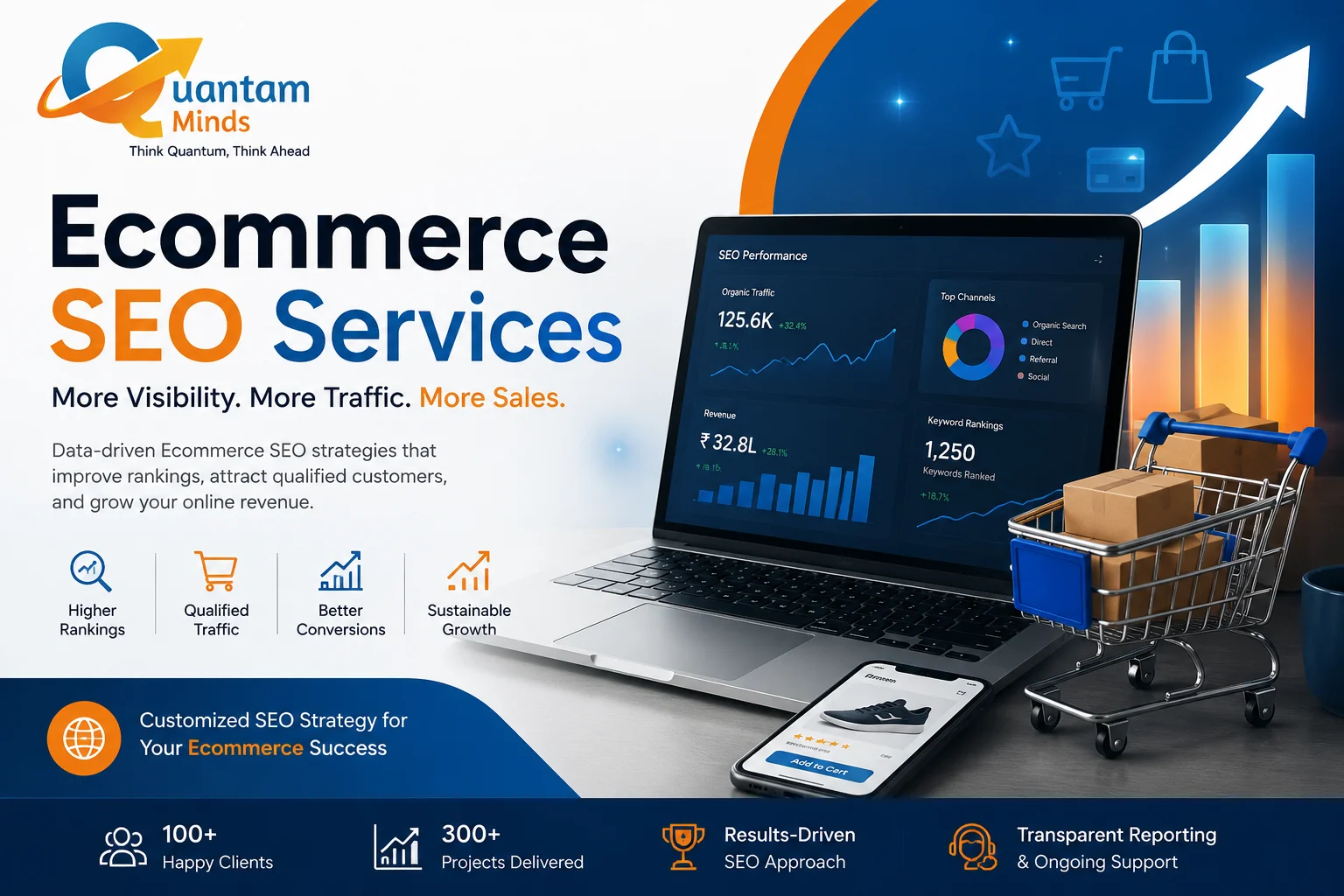

FREQUENTLY ASKED QUESTIONS

Everything You Need To Know Before Starting Your Project

We believe in complete transparency. Here are answers to the most common questions businesses ask before partnering with Quantam Minds.

Ecommerce SEO improves a store’s visibility when customers search for products, categories, brands, and solutions online. It typically combines technical SEO, keyword research, product and category optimization, internal linking, content, and conversion improvements. A well-planned strategy can attract more relevant organic visitors and create a sustainable acquisition channel without relying entirely on paid advertising.

Ecommerce SEO usually requires consistent work over several months because technical improvements, content changes, authority development, and search visibility take time to influence performance. Early improvements may appear in crawling, indexing, impressions, or rankings before revenue changes become visible. The timeline depends on competition, website history, technical condition, catalogue size, content quality, and existing authority.

Neither channel is automatically better. Google Ads can provide targeted visibility quickly, while ecommerce SEO can build organic visibility that does not require payment for every click. Many stores benefit from using both strategically. Paid campaigns can test products and demand, while SEO develops long-term visibility across categories, products, and informational searches, helping diversify customer acquisition over time.

Yes. Shopify SEO and WooCommerce SEO can both support ecommerce growth, although each platform has different technical considerations. Shopify stores may need careful management of collections, product variants, and duplicate URLs, while WooCommerce websites can require greater attention to plugins, performance, taxonomy, and technical configuration. The strategy should be based on the website’s actual structure rather than its platform alone.

For most ecommerce websites, the priority should depend on search demand, commercial value, competition, and current performance. Category pages often target broader commercial searches, while product pages capture specific purchase intent. A strong ecommerce SEO strategy usually optimizes both, but may prioritize categories first when they have significant search potential and multiple products supporting the same demand.

Technical SEO helps search engines efficiently discover, crawl, understand, and index important ecommerce pages. Issues such as duplicate URLs, poor internal linking, faceted navigation, incorrect canonicals, slow pages, JavaScript problems, and weak site architecture can limit organic visibility. For large stores, technical problems can affect thousands of URLs, making scalable technical SEO particularly important for long-term growth.

Still Have Questions?

Talk directly with our experts and get personalized guidance for your business.

KNOWLEDGE HUB

Learn, Grow & Stay Ahead

Explore expert insights, practical guides, industry trends, and digital strategies to help your business grow online.

🚀 New Articles Every Week

Explore 500+ Expert Articles On SEO, AI, Google Ads & Web Development

Practical guides, industry insights, case studies, marketing strategies, AI trends, and technical tutorials written to help businesses grow online.

Visit Knowledge Hub

Table of Contents

Navigate this page
Contact Quantam Minds

Let's Build Something Amazing Together

Have a website, CRM, HRM, ERP or custom software requirement? Connect with our team and discuss your project goals today.

Office Address

Baba Colony, Sector 25, Sonipat, Haryana 131001

Working Hours

Monday - Saturday
09:00 AM - 07:00 PM

Need Immediate Assistance?

Chat directly with our development experts and get quick guidance.

WhatsApp Us
Call Expert WhatsApp Us