From ambitious startups to established enterprises, Quantam Minds helps businesses generate qualified leads, improve online visibility, automate operations, and accelerate growth through strategic digital marketing, custom web development, AI-powered automation, and business software solutions.
Opening a gym is one challenge. Filling it consistently with motivated members is another.
A decade ago, many gyms relied heavily on walk-ins, referrals, banners near residential areas, newspaper advertisements, or seasonal promotional campaigns. Those methods still have their place, but they no longer influence buying decisions the way they once did. Today's fitness journey usually begins with a smartphone, not with a visit to the nearest gym.
Someone decides they want to lose weight. Another person starts looking for strength training after work. A college student searches for an affordable gym nearby, while a professional wants a premium fitness centre with personal training. Before speaking with anyone, they usually search Google, compare reviews, browse Instagram, check membership photos, watch transformation videos, and read customer experiences.
For gym owners, this shift has changed the entire customer acquisition process.
This is why Digital Marketing for Gyms has become less about promotion and more about being present where buying decisions are actually happening.
Most prospective members don't contact the first gym they discover.
Instead, they compare several options.
Their journey often looks something like this:
The interesting part is that this decision often happens before a sales representative has the opportunity to explain anything.
Your digital presence becomes your first salesperson.
The fitness industry has evolved significantly.
Traditional gyms now compete with:
Customers have more choices than ever before.
When multiple gyms offer similar equipment and comparable pricing, factors like online reputation, brand perception, local visibility, and customer experience often become the deciding influences.
This is where a thoughtful Gym Marketing Agency strategy creates value—not by making unrealistic promises, but by helping gyms communicate their strengths more effectively.
Gym owners often invest in new machines, upgraded interiors, better lighting, or additional trainers.
These improvements matter.
But potential members usually cannot experience them until they visit.
Digital marketing bridges that gap.
Professional photography, informative website content, member success stories, Google reviews, short workout videos, and educational social media content allow prospective members to visualise the experience before stepping inside the gym.
Trust develops long before the first workout session.
One gym owner shared an interesting experience during a consultation.
Two prospective members visited on the same day.
One asked detailed questions about membership plans.
The other had almost no questions.
When asked why, the second visitor replied,
"I already checked your Google reviews, Instagram page, and website yesterday. I just wanted to see the gym in person."
That conversation highlights how customer behaviour has changed.
Digital marketing didn't close the sale alone.
It reduced uncertainty before the visit even happened.
Some gyms invest heavily in advertising.
Others focus only on posting motivational quotes on social media.
Neither approach consistently works without building credibility.
Imagine two fitness centres appearing in Google Search.
The first has:
The second has:
Even if both gyms offer similar facilities, most prospective members naturally feel more comfortable contacting the first one.
Digital marketing influences confidence just as much as visibility.
Unlike ecommerce businesses that can sell nationally, gyms usually depend on customers within a limited geographic radius.
People rarely travel 20 kilometres for a daily workout.
They usually search for:
This makes Local SEO for Gyms especially valuable.
Appearing prominently in Google Maps, maintaining an optimised Google Business Profile, and earning authentic customer reviews help nearby prospects discover your business at the exact moment they're ready to compare options.
People don't visit Instagram only for entertainment.
Many use it to judge whether a gym feels active, welcoming, and professional.
Prospective members often look for:
Consistent Social Media Marketing for Gyms helps businesses remain visible while reinforcing the personality and culture of the fitness brand.
Advertising costs have increased across most digital platforms.
This makes it increasingly important to balance paid marketing with long-term organic visibility.
Gyms relying entirely on advertising may experience rising acquisition costs over time.
Businesses combining:
often create a more balanced customer acquisition strategy.
Some channels generate immediate visibility, while others continue supporting growth long after individual campaigns end.
The conversation has shifted.
Many gym owners now ask better questions.
Instead of saying,
"How do I get more enquiries?"
They ask,
"How do I attract members who are genuinely interested, stay longer, and recommend us to others?"
That's an important difference.
Effective Digital Marketing for Fitness Centers isn't simply about increasing traffic or enquiries. It's about attracting the right audience, building trust before the first visit, improving the overall customer journey, and creating a brand that people feel confident recommending to friends and family.
Over time, this approach often contributes to stronger member retention, healthier acquisition costs, better online visibility, and sustainable business growth—outcomes that matter far more than short-lived spikes in enquiries.
Strong visibility begins with being discoverable when people search for a gym. A well-planned SEO strategy helps fitness businesses improve local search rankings, optimise Google Business Profile visibility, and attract members actively searching for gyms, personal trainers, weight loss programs, and fitness centres. Explore how our SEO Services support sustainable organic growth for gyms.
Our specialists will help you understand the complete process, documentation requirements, estimated timelines and the best approach for your Digital Marketing for Gyms project.
We combine digital marketing, creative branding, web development, automation, and business software into one complete growth ecosystem.
Improve rankings, generate qualified traffic, and increase long-term business growth through data-driven SEO strategies.
Your online reputation influences customer decisions long before the first conversation be...
Check Online Reputation Management
Modern customers often judge a business visually before they read about its services or pr...
Check Graphic Designing
Modern customers often discover businesses through Instagram, Facebook, Reels, and short-f...
Check Social Media Marketing
Modern businesses need more than a basic online presence. Our Website Development services...
Check Website Development
Modern businesses cannot rely only on organic reach anymore, especially in competitive ind...
Check Google Ads Services
Modern businesses do not struggle only with competition anymore. They struggle with discov...
Check Seo ServciesWhether you need SEO, Google Ads, Website Development, CRM Software, AI Automation, or a complete digital transformation strategy, our experts are ready to help you grow faster.
The fitness industry has never offered more opportunities—but it has also never been more competitive.
New gyms open every year. Boutique fitness studios continue expanding. Personal trainers are building strong personal brands online. Fitness influencers attract thousands of local followers, while large franchise chains invest heavily in advertising and technology.
Against this backdrop, many independent gyms believe their biggest problem is "not getting enough leads."
In reality, that is often just the visible symptom.
The deeper challenge is that today's customer journey is longer, more digital, and far more influenced by trust than it was a few years ago.
People rarely join the first gym they discover. They compare multiple options, read reviews, watch videos, evaluate facilities, and often revisit your profile several times before making a decision.
Understanding these challenges helps gym owners invest in strategies that solve the real problems rather than simply increasing marketing spend.
In many cities, prospective members can choose from:
When facilities and pricing appear similar, customers begin comparing other factors.
They look for:
Without a clear digital identity, even a well-equipped gym can become just another option in search results.
Many gyms experience predictable spikes around:
Outside these periods, enquiries often slow significantly.
The challenge isn't the seasonal demand itself.
It's relying almost entirely on short-term promotions instead of building consistent visibility throughout the year.
A balanced Gym Digital Marketing Services strategy combines seasonal campaigns with long-term channels such as SEO for Gyms, content marketing, and local search optimisation, helping reduce dependence on temporary offers alone.
Some gyms receive a healthy number of enquiries but still struggle to grow memberships.
The reasons often have little to do with advertising.
Instead, potential members may encounter:
Marketing brings people to the conversation.
The overall customer experience determines whether they become paying members.
Most gyms serve members living or working within a relatively small area.
If someone searches:
and your business doesn't appear prominently, competitors are likely to receive the enquiry first.
Many gyms underestimate the importance of:
These elements often influence whether nearby customers discover your gym at all.
Posting workout videos every day doesn't automatically build memberships.
Neither does sharing motivational quotes.
Many gyms remain active on Instagram or Facebook but struggle to connect that activity with actual business growth.
A more strategic approach focuses on content that helps potential members answer questions like:
When Social Media Marketing for Gyms answers these concerns consistently, engagement becomes more meaningful than simply increasing followers.
Digital advertising continues to evolve.
Competition for keywords related to fitness, personal training, and weight loss has increased in many locations.
As a result:
This doesn't mean advertising has become ineffective.
It means campaigns need stronger targeting, better landing pages, and closer alignment with business objectives.
Combining Google Ads for Gyms with SEO and reputation management often creates a more balanced acquisition strategy than relying on advertising alone.
Choosing a gym is often a personal decision.
People want confidence before committing.
They wonder:
If your online presence doesn't answer these questions, customers may continue searching.
Reviews, transformation stories, trainer introductions, FAQs, facility photos, and educational content all help reduce hesitation before someone schedules a visit.
Many businesses celebrate:
While these numbers can indicate activity, they don't always reflect business performance.
A gym owner is usually more interested in questions such as:
These metrics provide a clearer understanding of marketing effectiveness than vanity statistics alone.
Acquiring a new member generally requires more effort and investment than encouraging an existing member to renew.
Yet many gyms focus almost exclusively on attracting new enquiries.
Digital marketing can also strengthen retention through:
Satisfied members often become the most credible source of future referrals and online reviews.
Search behaviour continues to evolve.
Potential members increasingly use:
At the same time, expectations around website speed, mobile usability, online booking, and digital communication continue rising.
A marketing strategy that worked two or three years ago may no longer produce the same results today.
Continuous optimisation has become more valuable than occasional redesigns or isolated campaigns.
Most gyms already understand the importance of attracting new members. The more difficult challenge is adapting to a customer journey that is increasingly influenced by search visibility, online reputation, local discovery, digital content, and trust signals before a prospect ever walks through the door.
Businesses that recognise these changes early are often better positioned to build sustainable growth. Rather than relying on one marketing channel or seasonal promotions alone, they develop an integrated strategy where Digital Marketing for Gyms, Local SEO for Gyms, Google Ads, content, reviews, and community engagement work together to attract, convert, and retain members over the long term.
Choosing a gym used to be relatively straightforward. Someone might notice a banner on the roadside, receive a recommendation from a friend, or visit the nearest fitness centre after work. Today, the decision-making process is far more digital and much more informed.
Prospective members rarely rely on a single source of information. Instead, they gather small pieces of confidence from multiple platforms before making a decision. A Google search introduces your gym. Instagram reveals your community and culture. Reviews provide social proof. Your website answers practical questions. Google Maps confirms convenience. Recommendations from existing members reinforce trust.
Each touchpoint influences the next.
For gym owners, understanding this journey is important because marketing is no longer about generating visibility alone—it's about creating confidence at every stage of the buying process.
When people decide to start their fitness journey, Google is often the first place they turn to.
Common searches include:
These searches indicate strong purchase intent. The person is not casually browsing—they are actively looking for a solution.
If your gym doesn't appear prominently in search results, many potential members may never discover it, regardless of how good your facilities or trainers are.
This is why SEO for Gyms focuses not only on rankings but also on helping gyms become visible when people are ready to compare fitness options.
Fitness is naturally visual.
People don't just want to read about your gym—they want to see it.
Before scheduling a visit, many prospective members browse Instagram to understand:
An active Instagram profile creates familiarity.
It allows potential members to imagine themselves training in your environment before they ever step inside.
The most effective Social Media Marketing for Gyms isn't about posting every day. It's about consistently showing real experiences that answer the questions potential members are already asking.
Imagine two gyms offering similar membership prices and comparable equipment.
One has hundreds of genuine reviews describing supportive trainers, clean facilities, and noticeable fitness progress.
The other has only a handful of outdated reviews with little recent activity.
Most people instinctively trust the first option.
Customer reviews provide reassurance because they come from people who have already experienced the service.
Interestingly, prospective members don't only look at ratings.
They also notice:
This is where Online Reputation Management and thoughtful review management become valuable. They help gyms demonstrate transparency rather than perfection.
A website should do more than display membership plans.
It should remove hesitation.
Before contacting a gym, prospective members often want answers to questions they may never ask during a phone call.
For example:
A professionally developed website supports this decision-making process by presenting information clearly while creating confidence through member testimonials, trainer profiles, transformation stories, and frequently asked questions.
Good Website Development isn't simply about design.
It's about making decisions easier.
Convenience remains one of the biggest factors when choosing a gym.
Most members prefer a location that fits naturally into their daily routine.
Google Maps has therefore become much more than a navigation tool.
People compare gyms directly within Maps by reviewing:
An optimised Google Business Profile helps businesses appear more complete, trustworthy, and relevant during these local searches.
For many gyms, Google Maps generates highly qualified enquiries because customers are already searching within their preferred location.
Traditional referrals still matter.
People continue asking friends, colleagues, neighbours, and family members for recommendations.
The difference today is that those recommendations are often verified online.
A conversation might begin like this:
"My colleague recommended your gym."
Within minutes, the person is likely to:
Word of mouth no longer ends with a recommendation.
Digital research almost always follows.
Businesses that maintain a consistent online presence reinforce the trust already created through personal referrals.
Joining a gym is rarely an impulsive purchase.
For many people, it represents a commitment to improving their health, confidence, or lifestyle.
That decision is usually influenced by dozens of small observations rather than one marketing campaign.
A prospect might discover your gym through Google, view your location on Maps, scroll through Instagram, read recent member reviews, explore your website, and finally ask a friend for their opinion.
None of these touchpoints guarantees a membership on its own.
Together, however, they create the confidence needed to take the next step.
Consider two fitness centres located just three kilometres apart.
Both have experienced trainers, quality equipment, and similar membership pricing.
The first gym maintains an active Google Business Profile, regularly shares workout content on Instagram, responds to customer reviews, updates its website, and showcases real member success stories.
The second gym relies mainly on offline referrals and rarely updates its online presence.
When a prospective member searches online, the first gym immediately appears more established—not necessarily because it offers better facilities, but because it answers questions before they're asked.
That difference often determines which gym receives the enquiry.
Modern gym marketing isn't about choosing between Google, Instagram, reviews, or referrals. Each platform plays a different role in the customer's decision-making process.
Digital Marketing for Gyms works most effectively when these channels support one another. SEO helps people discover your gym, Google Business Profile Optimization strengthens local visibility, Social Media Marketing builds familiarity, Online Reputation Management reinforces trust, and a well-designed website converts interest into enquiries.
When these elements work together, gym owners create a smoother customer journey—one that feels helpful, trustworthy, and aligned with how people actually choose a fitness centre today.
Reviews often influence membership decisions before a prospect even visits your gym. Building a positive online reputation through Google Reviews, professional responses, and trust-focused customer experiences helps strengthen credibility and improves confidence during the decision-making process. Learn how our Online Reputation Management Services help gyms build lasting customer trust.
Our specialists will help you understand the complete process, documentation requirements, estimated timelines and the best approach for your Digital Marketing for Gyms project.
Every industry has different challenges, customers, and growth goals. We build customized marketing strategies, websites, automation systems, and business software designed specifically for your industry.
Healthcare
Real Estate
Gym & Fitness
Education
Ecommerce
Manufacturing
We create customized digital strategies and software solutions for businesses across every sector.
Discuss Your BusinessThere is no shortage of marketing ideas available to gym owners.
Run Facebook Ads.
Post Instagram Reels every day.
Offer discounts.
Partner with influencers.
Launch referral campaigns.
Send WhatsApp messages.
While each of these can be useful, none of them consistently delivers sustainable growth in isolation.
The gyms that continue growing month after month usually don't rely on one channel. They build an ecosystem where search visibility, advertising, social media, content, customer trust, and communication work together.
The objective isn't simply to generate more enquiries.
It's to attract people who are genuinely interested in becoming long-term members.
Below are the digital marketing strategies that consistently create value for modern gyms when planned around business goals rather than short-term trends.
Most gym memberships begin with an online search.
Someone searching for:
is already looking for a solution.
If your gym appears naturally in these searches, you're reaching people with high buying intent.
Unlike advertising, which stops generating visibility when campaigns end, SEO for Gyms focuses on improving long-term discoverability through:
The goal isn't simply to rank for keywords.
It's to become the gym people discover when they're ready to take action.
Not every business can wait several months for organic visibility to grow.
That's where Google Ads for Gyms become valuable.
Search advertising allows gyms to appear when people are actively searching for fitness solutions.
Examples include:
The most successful campaigns don't target everyone.
Instead, they focus on:
Well-structured campaigns often generate better-quality enquiries because they reach customers already looking for a gym rather than interrupting them while browsing online.
Very few people join a gym based only on an advertisement.
They usually want to understand what training there actually feels like.
Social media helps answer questions customers rarely ask directly.
For example:
Instead of treating Instagram and Facebook as promotional platforms, successful gyms use them to document real experiences.
Content often performs better when it includes:
Effective Social Media Marketing for Gyms builds recognition gradually.
By the time someone books a trial session, they already feel familiar with your brand.
Most gym websites focus only on membership plans.
Customers, however, often have concerns that pricing pages don't answer.
Examples include:
Publishing useful content around these topics helps position your gym as a trusted fitness resource rather than simply another membership provider.
Quality Content Writing supports both SEO and customer education.
It allows your expertise to become visible before someone visits your facility.
Over time, this often contributes to stronger search visibility, better website engagement, and higher customer confidence.
Fitness is difficult to explain through text alone.
People want to see movement.
They want to experience the atmosphere.
Short-form videos help prospective members understand:
This is one reason platforms like Instagram Reels and YouTube Shorts continue influencing gym purchasing decisions.
Interestingly, highly polished videos aren't always the most effective.
Authentic workout sessions, trainer guidance, member progress, and everyday gym moments often feel more believable than heavily scripted promotional content.
Consistency generally matters more than production budget.
Not everyone who enquires joins immediately.
Some people need time.
Others compare multiple gyms before making a decision.
Without follow-up, these prospects often disappear.
Thoughtful Email Marketing helps continue the conversation without becoming intrusive.
Useful emails might include:
Rather than repeatedly selling memberships, valuable emails keep your gym visible until prospects are ready to decide.
For many local gyms, WhatsApp has become one of the most effective communication channels after the initial enquiry.
People prefer quick conversations.
They don't always want lengthy email exchanges.
WhatsApp can simplify:
The key is moderation.
Too many promotional messages often lead to disengagement.
Businesses that use WhatsApp Marketing primarily for useful communication generally build stronger long-term relationships with members.
SEO brings visitors.
Google Ads generate clicks.
Instagram creates interest.
Email encourages follow-up.
WhatsApp supports conversations.
Eventually, nearly every customer lands on your website.
This makes Website Development one of the most important investments for gym marketing.
An effective gym website should help visitors quickly answer questions such as:
A slow or confusing website can weaken the effectiveness of every other marketing channel.
Many gym owners assume reviews matter only after customers join.
In reality, reviews influence decisions much earlier.
Potential members compare:
Professional Online Reputation Management helps ensure these trust signals accurately reflect the quality of your gym.
People rarely expect perfection.
They appreciate businesses that respond professionally and engage with members consistently.
Receiving fifty enquiries sounds impressive.
But if only a handful become paying members, something in the customer journey needs attention.
Strong Gym Lead Generation Services focus on attracting people who are genuinely interested rather than maximising enquiry numbers alone.
High-quality leads usually come from:
These prospects often convert more consistently because they already understand your business before making contact.
The most successful gyms rarely depend on one marketing platform.
Instead, each channel supports a different stage of the member journey.
| Marketing Strategy | Primary Business Value |
|---|---|
| SEO for Gyms | Improves long-term search visibility and organic member enquiries. |
| Google Ads | Captures high-intent prospects actively searching for gyms. |
| Social Media Marketing | Builds brand familiarity, community engagement, and trust. |
| Content Marketing | Educates potential members while strengthening SEO and authority. |
| Video Marketing | Showcases the gym experience and creates emotional connection. |
| Email Marketing | Nurtures enquiries and encourages long-term member relationships. |
| WhatsApp Marketing | Simplifies communication, follow-ups, and member engagement. |
| Website Development | Converts visitors into membership enquiries through a better user experience. |
| Online Reputation Management | Reinforces trust through reviews, ratings, and customer experiences. |
The question is no longer whether gyms should invest in SEO, Google Ads, or social media.
The more important question is how these channels work together.
A prospective member may discover your gym through Google, browse your Instagram profile, read customer reviews, visit your website, enquire via WhatsApp, and finally join after receiving a helpful follow-up email.
Each touchpoint influences the next.
That's why effective Digital Marketing for Gyms isn't built around isolated tactics. It's built around a connected strategy where visibility, trust, communication, and customer experience support one another—creating a stronger foundation for sustainable membership growth and long-term business success.
SEO supports long-term visibility, while Google Ads can generate immediate exposure for high-intent searches. A balanced marketing strategy often combines both, helping gyms appear when potential members search for nearby fitness centres, personal trainers, or weight loss programs. Discover how our Google Ads Services complement long-term organic growth.
Years of Digital Excellence
We don't simply build websites or run campaigns. We create complete digital ecosystems that help businesses attract customers, automate operations, improve conversions, and scale with confidence.
Every project begins with understanding your business objectives.
Websites, CRM, ERP and custom software under one roof.
Every campaign is optimized using measurable KPIs.
Save time through intelligent automation and workflows.
Real experts available whenever you need assistance.
We grow alongside your business, not just deliver projects.
Every gym has a different story.
Some have invested heavily in premium equipment but struggle with local visibility. Others enjoy a loyal member base through referrals but find it difficult to generate consistent enquiries online. Some attract plenty of trial bookings but face low membership conversions, while growing fitness brands often reach a stage where traditional marketing no longer supports their expansion goals.
For this reason, we don't believe gyms should follow a standard marketing blueprint.
Our approach begins with understanding how your business grows—not with deciding which marketing channel to use first.
Digital marketing works best when it supports your business objectives rather than chasing isolated metrics like website traffic, followers, or impressions.
Many marketing conversations begin with a question like:
"What's your monthly advertising budget?"
We usually begin somewhere else.
We want to understand:
The answers often reveal opportunities that advertising alone cannot solve.
Sometimes the biggest issue is weak local visibility.
Sometimes it's poor conversion after enquiries.
Sometimes the website creates friction.
Sometimes the gym simply hasn't communicated its unique strengths clearly.
Without understanding the business first, any marketing strategy becomes guesswork.
Many gyms measure success by asking:
"How many leads did we generate?"
A more useful question is:
"How many people completed the journey from discovering the gym to becoming long-term members?"
That journey typically includes several stages:
Discovery
↓
Research
↓
Comparison
↓
Trust Building
↓
Enquiry
↓
Gym Visit
↓
Membership
↓
Retention
↓
Referral
Each stage requires a different marketing approach.
Someone discovering your gym for the first time has different questions than someone comparing membership plans.
Likewise, an existing member needs different communication than someone who has never visited your facility.
Looking at the complete customer journey often produces better long-term results than focusing only on lead generation.
Not every gym requires the same growth plan.
A newly opened fitness centre usually needs visibility.
An established gym may need stronger positioning.
A franchise preparing to expand may require scalable marketing systems.
Instead of applying identical campaigns everywhere, strategy should evolve alongside the business.
For example:
Primary priorities often include:
The focus usually shifts toward:
Growth often depends on:
Different stages require different decisions.
Recognising that difference prevents unnecessary marketing spend.
People rarely wake up and purchase a gym membership within five minutes.
They think.
They compare.
They postpone.
They research again.
One person joins immediately after watching a transformation video.
Another may read twenty Google reviews before booking a trial.
Someone else waits several weeks before making a decision.
Understanding these patterns influences everything from website content to advertising strategy.
Instead of assuming every visitor behaves the same way, we build marketing around how real people actually make fitness decisions.
One of the biggest mistakes businesses make is treating digital marketing as separate activities.
SEO operates independently.
Social media follows its own schedule.
Advertising runs in isolation.
The website rarely changes.
The customer experiences something completely different.
We believe every channel should strengthen the next.
For example:
Instead of competing for attention, these channels work together to guide prospective members through the decision-making process.
Temporary membership spikes can feel encouraging.
But they don't always indicate long-term business health.
A gym offering aggressive discounts may increase enquiries quickly while attracting members who leave after the promotional period ends.
A slower but more consistent approach often produces healthier growth.
That may include:
Growth becomes more stable because it is supported by trust rather than discounts alone.
Marketing opinions are everywhere.
Customers, staff, competitors, and even friends often suggest what they think should work.
Rather than relying solely on assumptions, we prefer observing how people actually behave.
Questions worth asking include:
Small improvements based on real behaviour often outperform major redesigns based purely on opinion.
Every successful gym develops its own identity.
Some focus on bodybuilding.
Others specialise in functional fitness, weight loss, powerlifting, rehabilitation, yoga, or premium coaching.
Marketing should reflect that personality.
The language, visuals, content, and customer experience should feel authentic to the community the gym wants to build.
People don't simply join facilities.
They join environments where they believe they'll succeed.
Communicating that experience consistently creates a stronger emotional connection than generic promotional messaging.
Digital marketing isn't something that reaches a finish line.
Search behaviour changes.
Competitors evolve.
Fitness trends shift.
Customer expectations continue developing.
Strategies that worked last year may require refinement today.
Rather than treating marketing as a series of disconnected campaigns, we view it as a continuous process of learning, improving, testing, and adapting.
That mindset helps businesses stay relevant without constantly starting over.
At Quantam Minds, our approach to Digital Marketing for Gyms isn't centred on selling individual marketing services. It's centred on understanding how fitness businesses attract members, earn trust, improve retention, and grow sustainably in an increasingly competitive market.
By combining business insight, customer behaviour, local search understanding, digital strategy, and continuous optimisation, we help gyms make smarter marketing decisions that support long-term growth. Because in the fitness industry, success rarely comes from doing more marketing—it comes from doing the right marketing, for the right audience, at the right stage of the customer journey.
Growing a gym isn't simply about running advertisements or posting workout videos every day. Sustainable growth usually comes from following a structured marketing process where every activity supports the next. Instead of chasing short-term membership spikes, our approach focuses on understanding your business, attracting the right audience, improving customer trust, and continuously refining performance based on real data.
Every gym is different, but the overall workflow remains consistent—analyse first, plan strategically, implement carefully, optimise continuously, and measure what truly impacts business growth.
Every successful marketing strategy begins with understanding the business behind the brand.
Before recommending any campaigns, we evaluate your gym's current position, target audience, local competition, digital presence, and member acquisition process. This helps identify what's already working, where opportunities exist, and which challenges need immediate attention.
Rather than making assumptions, this stage provides a clear understanding of where your gym stands today and helps prioritise actions that align with your business goals.
Once the analysis is complete, we create a customised digital marketing roadmap based on your gym's objectives, location, competition, and target audience.
Instead of applying identical marketing tactics to every fitness business, the strategy is designed around how your ideal members search, compare, and choose a gym.
A structured roadmap ensures every marketing activity contributes towards sustainable member acquisition instead of disconnected promotional campaigns.
With a clear strategy in place, the focus shifts to execution.
This stage involves improving every digital touchpoint that influences a prospective member's decision—from search visibility and website experience to content, advertising, reviews, and customer communication.
As implementation progresses, gyms often begin creating a stronger digital presence that supports visibility, trust, and higher-quality membership enquiries.
Digital marketing is never static.
Customer behaviour changes.
Search algorithms evolve.
Competitors launch new campaigns.
Fitness trends shift throughout the year.
Regular monitoring helps identify what is performing well and where adjustments are needed before opportunities are lost.
Continuous optimisation helps improve efficiency while ensuring your marketing strategy adapts to changing customer expectations and market conditions.
Marketing should provide clarity—not confusion.
Instead of focusing only on impressions or follower counts, reporting should explain how marketing activities contribute to business objectives and where future improvements can be made.
Regular reporting typically reviews:
Transparent reporting allows gym owners to make informed decisions, allocate marketing budgets more effectively, and build a long-term growth strategy based on measurable insights rather than assumptions.
Business Analysis
│
â–¼
Strategy & Growth Planning
│
â–¼
Marketing Implementation
│
â–¼
Performance Optimisation
│
â–¼
Reporting & Continuous Growth
Many gyms invest heavily in individual marketing activities—running ads for a few weeks, posting on social media inconsistently, or redesigning their website every few years. While these efforts may generate temporary results, they often lack a long-term direction.
A structured marketing process connects every stage of the customer journey. It helps ensure that search visibility, local discovery, website experience, content, advertising, reputation, and follow-up communication all work together rather than independently.
The outcome isn't simply more marketing activity. It's a more consistent system for attracting qualified prospects, building trust, improving membership conversions, and supporting sustainable business growth over time.
Every marketing campaign eventually leads potential members to your website. A fast, mobile-friendly, and conversion-focused website helps visitors explore membership plans, trainer profiles, facilities, and trial bookings with confidence. Our Website Development Services are designed to create better user experiences that support membership enquiries and long-term business growth.
We combine technology, strategy, creativity and measurable execution to help ambitious businesses build stronger brands, attract more customers and achieve long-term digital growth.
No two gyms operate the same way.
A CrossFit box attracts members differently than a luxury fitness club. A yoga studio builds trust differently from a bodybuilding gym. Likewise, a personal trainer serving one neighbourhood has completely different marketing priorities than a multi-location franchise expanding across several cities.
This is why Digital Marketing for Gyms should never follow a one-size-fits-all approach.
Every fitness business has its own customer journey, pricing model, competition, and community. Marketing becomes far more effective when it reflects those differences instead of applying identical campaigns everywhere.
Below are the types of fitness businesses that benefit from a tailored digital growth strategy.
CrossFit communities are built on culture, consistency, and measurable progress. Members often choose a CrossFit box because of the coaching environment and sense of belonging rather than equipment alone.
People researching CrossFit typically compare coaching quality, programming, competition participation, and community engagement before joining.
A strategic marketing approach helps CrossFit businesses:
Strength athletes usually look beyond standard gym memberships. They evaluate specialised equipment, experienced coaches, competition preparation, and training environment before making a decision.
Powerlifting gyms benefit from demonstrating authority rather than simply advertising facilities.
Effective strategies often include:
This helps attract serious lifters looking for expertise instead of generic fitness centres.
People joining yoga studios are often searching for wellbeing, flexibility, stress management, rehabilitation, or mindfulness rather than intense workouts.
Their decision is influenced by trust, instructor experience, class atmosphere, and personal comfort.
Yoga studios often benefit from:
Building confidence becomes just as important as promoting class schedules.
Many women prioritise privacy, safety, supportive trainers, flexible timings, and a welcoming environment when choosing a fitness centre.
Marketing should acknowledge these priorities without relying on stereotypes.
Digital strategies can help communicate:
Authentic communication often builds stronger trust than promotional messaging.
Functional fitness continues gaining popularity among people seeking improved mobility, endurance, athletic performance, and injury prevention.
Unlike traditional gyms, these studios often need to educate prospects before selling memberships.
Marketing strategies frequently focus on:
Helping prospective members understand the value of functional training often shortens the decision-making process.
Independent trainers rarely compete on equipment.
People invest in the coach.
That makes personal branding one of the strongest marketing assets available.
A strong digital presence helps trainers showcase:
This approach builds credibility before the first consultation and supports long-term client acquisition.
Premium gyms usually attract members looking for more than access to equipment.
They value:
The customer journey often involves higher consideration before joining.
Luxury fitness brands benefit from marketing that reflects quality and exclusivity through:
Rather than competing on price, they compete on perceived value and customer experience.
Boutique studios offering Pilates, HIIT, spinning, dance fitness, boxing, MMA, or specialised group classes often depend on niche audiences and strong community engagement.
Many prospects search for a specific workout style rather than a general gym.
Marketing strategies help boutique studios:
Specialised positioning often produces higher-quality enquiries than broad marketing campaigns.
As gyms expand into multiple cities or regions, marketing becomes significantly more complex.
Each location develops different competitors, customer behaviour, and search demand.
A strategy that works well in one city may require adjustments elsewhere.
Growing fitness brands often require:
A structured digital strategy helps maintain brand identity while allowing each location to compete effectively in its local market.
Corporate fitness facilities often serve employees rather than the general public.
Their marketing priorities typically focus on organisational partnerships, employee wellbeing, and long-term engagement instead of daily membership promotions.
Digital marketing can support:
The emphasis shifts from customer acquisition to participation and programme adoption.
While every gym shares the objective of attracting and retaining members, the path to achieving that goal varies considerably. A yoga studio builds trust through instructor expertise and community experiences. A powerlifting gym earns credibility through specialised coaching and athlete success. A franchise focuses on consistency across multiple locations, while a personal trainer succeeds by building a strong personal brand.
At Quantam Minds, we believe the most effective Digital Marketing for Gyms starts with understanding these differences. Rather than applying the same strategy to every fitness business, we tailor our approach to your business model, target audience, local competition, and long-term objectives. This creates marketing that feels more relevant to potential members and supports sustainable growth built on visibility, trust, and meaningful customer relationships rather than short-term promotional campaigns.
Different fitness businesses connect with audiences in different ways, but consistent social media helps every gym stay visible between customer visits. From workout videos and member success stories to trainer introductions and community events, our Social Media Marketing Services help fitness brands build stronger engagement and long-term brand recognition.
Every gym begins from a different starting point. Some struggle to appear in local search results, while others receive enquiries but find it difficult to convert them into long-term memberships. There are also fitness businesses with excellent facilities that rely almost entirely on referrals because their digital presence has never been developed strategically.
The following case studies represent realistic business scenarios based on common challenges within the fitness industry. They demonstrate how a structured Digital Marketing for Gyms strategy can gradually improve visibility, customer trust, and enquiry quality through consistent optimisation rather than short-term promotional campaigns.
Independent Strength Training & Bodybuilding Gym
The gym had modern equipment, experienced trainers, and a loyal offline member base. However, online enquiries remained inconsistent because nearby competitors had stronger Google visibility, more recent customer reviews, and a more active digital presence.
The website had not been updated for several years, and the Google Business Profile contained limited information and outdated photographs.
The digital growth strategy focused on:
Rather than chasing broad national keywords, the strategy prioritised local search behaviour where most membership decisions actually occurred.
After several months of continuous optimisation, the gym experienced:
Some highly competitive search terms remained challenging, which is common in fitness markets with multiple established competitors. However, overall digital visibility became significantly more stable than before.
Boutique Personal Training Studio
The studio invested regularly in social media but generated relatively few enquiries from Google Search. Most leads came through referrals, limiting consistent business growth.
Although prospective members appreciated the coaching quality during consultations, many discovered competing studios first because they had stronger local search visibility and more comprehensive online content.
The digital strategy focused on:
The emphasis shifted from promoting memberships to demonstrating expertise and building trust before prospects made contact.
Over time, the business observed:
Growth remained gradual, but the enquiries became noticeably more relevant to the studio's premium training services.
Regional Gym Chain
As the business expanded into multiple locations, marketing became increasingly fragmented. Each branch had different Google Business Profiles, inconsistent branding, varying review activity, and separate promotional efforts.
Customers often found conflicting business information depending on which location they searched.
The marketing plan focused on:
The objective was to create a unified digital experience while allowing each location to compete effectively within its own local market.
Following continuous optimisation, the business experienced:
Each location progressed at a different pace depending on local competition, but the overall marketing system became easier to manage and scale.
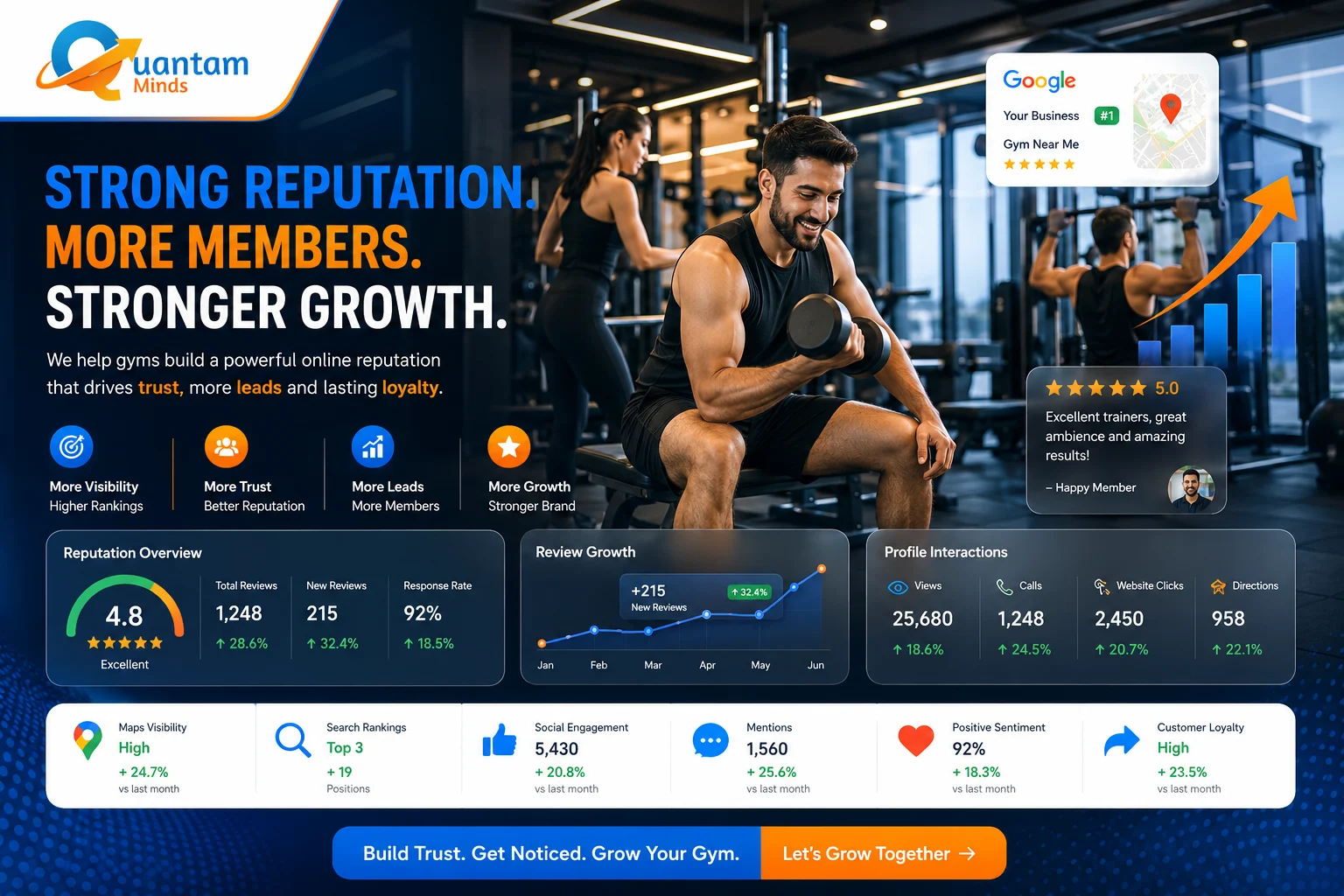
To make this section more authentic and data-driven, consider presenting realistic dashboard-style visuals rather than exaggerated success claims.
| Dashboard Visual | Purpose |
|---|---|
| Google Search Console Growth Dashboard | Demonstrates gradual improvements in search impressions, clicks, and keyword visibility. |
| Google Business Profile Insights | Highlights profile views, website clicks, calls, and direction requests. |
| Local Keyword Ranking Tracker | Shows progress for gym-related searches within the target location. |
| Membership Enquiry Dashboard | Connects digital marketing activity with consultation requests and membership enquiries. |
| Website Engagement Analytics | Displays user behaviour, session duration, and page interaction trends. |
| Google Maps Visibility Report | Illustrates improvements in local discovery and customer actions. |
| Lead Source Comparison | Identifies whether enquiries originated from SEO, Google Ads, social media, referrals, or direct searches. |
| Review Growth & Sentiment Dashboard | Tracks review volume, average rating trends, response rates, and customer sentiment. |
| Conversion Funnel Analytics | Visualises the journey from website visit to enquiry and membership consultation. |
| Monthly Marketing Performance Report | Combines traffic, engagement, enquiries, conversions, and strategic recommendations into a single business dashboard. |
The most credible success stories rarely involve overnight transformations. In the fitness industry, sustainable growth often comes from improving many small elements over time: stronger local search visibility, a better website experience, consistent content, positive member reviews, effective follow-up, and a brand that people trust before they walk through the door.
At Quantam Minds, we view Digital Marketing for Gyms as an ongoing growth strategy rather than a short-term campaign. Every gym operates in a unique market, faces different levels of competition, and serves different member expectations. That is why our focus remains on creating measurable, long-term improvements that help fitness businesses strengthen their digital presence, attract more relevant enquiries, and build lasting relationships with their members.
First impressions often begin long before someone walks into your gym. Professional branding, promotional creatives, membership campaigns, and social media visuals help fitness businesses present a stronger and more consistent identity across every digital platform. Explore our Graphic Designing Services to create a brand that members instantly recognise and trust.
Successful Digital Marketing for Gyms isn't driven by assumptions—it relies on understanding how potential members discover your business, interact with your website, engage with your content, and ultimately decide to join. Every marketing decision should be backed by data, allowing gyms to optimise campaigns, improve customer experiences, and allocate budgets more effectively.
At Quantam Minds, we use a combination of industry-leading marketing, analytics, SEO, and customer insight platforms to create strategies that are informed by real behaviour rather than guesswork. Each tool serves a specific purpose, and together they provide a complete picture of your gym's digital performance.
Google Analytics 4 helps us understand how visitors interact with your website after discovering your gym through search engines, advertisements, or social media.
Instead of simply counting visitors, GA4 reveals how people navigate your website, which pages they engage with most, and where they decide to enquire—or leave.
GA4 helps gyms understand:
These insights help identify opportunities to improve user experience, increase enquiry quality, and optimise the overall membership journey.
Search Console provides valuable insight into how your gym appears within Google Search.
It helps monitor keyword visibility, search impressions, indexing status, and technical issues that may affect your website's ability to attract organic traffic.
Search Console allows us to monitor:
This information supports long-term SEO for Gyms by identifying opportunities to strengthen search visibility and improve organic member acquisition.
Facebook and Instagram remain important platforms for fitness businesses because members often engage with visual content before booking a visit.
Meta Business Suite provides a central location for managing campaigns, publishing content, monitoring engagement, and analysing audience behaviour.
Meta helps evaluate:
Rather than posting content randomly, gyms can understand which topics, formats, and campaigns resonate most with prospective members.
For many gyms, Google Business Profile is one of the most influential local marketing platforms.
It often becomes the first interaction between your business and a prospective member searching nearby.
GBP provides insights into:
A well-optimised profile improves local credibility while helping nearby prospects discover your gym during high-intent searches.
Generating enquiries is only part of the marketing process.
Following up consistently is equally important.
Customer Relationship Management (CRM) systems help organise enquiries, schedule follow-ups, and track the complete membership journey.
CRM platforms help gyms:
A structured CRM process helps transform marketing enquiries into long-term memberships through better organisation and consistent customer communication.
Not every website issue appears in analytics reports.
Heatmaps provide a visual understanding of how visitors actually interact with your website.
They reveal:
Heatmaps uncover:
These insights support website improvements that make it easier for prospective members to book consultations or request membership information.
Ahrefs is one of the industry's leading SEO platforms for analysing organic search performance and understanding the competitive landscape.
Ahrefs helps evaluate:
By understanding how competing gyms attract search traffic, we can identify realistic opportunities to improve visibility and strengthen long-term organic growth.
SEMrush provides a comprehensive view of SEO, advertising, competitor activity, and content performance.
It supports strategic planning across multiple marketing channels rather than focusing on a single area.
SEMrush assists with:
This broader perspective helps gyms make informed decisions while adapting their marketing strategy as competition and search behaviour evolve.
Depending on your business goals, additional platforms may also contribute to a stronger digital marketing strategy.
| Platform | Business Purpose |
|---|---|
| Google Ads | Reach high-intent prospects searching for gym memberships and personal training. |
| Google Tag Manager | Track user interactions and marketing conversions more accurately. |
| Google Looker Studio | Create transparent, easy-to-understand marketing dashboards and performance reports. |
| YouTube Studio | Measure engagement with workout videos, trainer content, and educational fitness videos. |
| WhatsApp Business | Manage membership enquiries, trial bookings, customer support, and follow-up communication. |
| Email Marketing Platforms | Nurture enquiries, share fitness resources, promote events, and encourage membership renewals. |
| Review Management Tools | Monitor customer feedback, strengthen online reputation, and improve trust across review platforms. |
Effective Digital Marketing for Fitness Centers is not about using the largest number of tools—it is about using the right tools to answer the right business questions.
Questions such as:
Answering these questions allows gyms to move beyond assumptions and make decisions based on measurable insights.
At Quantam Minds, technology supports strategy—not the other way around. By combining analytics, SEO platforms, customer behaviour tools, CRM systems, and local marketing insights, we help gyms understand what is working, identify opportunities for improvement, and build a digital marketing strategy that evolves alongside their business and their members.
One of the most common questions gym owners ask is:
"How much should digital marketing cost?"
The honest answer is that there isn't a single price that fits every fitness business.
A newly opened neighbourhood gym trying to build awareness has very different marketing requirements than an established fitness centre, a premium personal training studio, or a franchise operating across multiple locations.
The investment depends on what your business is trying to achieve, where you currently stand in the market, and how competitive your local area has become.
Rather than selecting the lowest-priced package, it's usually more valuable to choose a strategy that aligns with your long-term business goals.
Marketing objectives vary from one gym to another.
Some businesses want to:
Each objective requires a different combination of marketing activities.
A gym focused on local visibility will typically require a different strategy than one preparing to scale across multiple cities.
Marketing requirements often depend on how competitive your location has become.
For example:
Higher competition usually means businesses need:
The level of competition influences both the depth of strategy and the amount of ongoing optimisation required.
Some gyms already have a solid digital foundation.
Others may need significant improvements before marketing campaigns can perform effectively.
Areas commonly evaluated include:
Businesses starting with a stronger digital presence can often focus more quickly on growth initiatives, while others may first need foundational improvements.
A website plays an important role in converting visitors into enquiries.
Marketing campaigns often perform better when visitors can quickly find:
If the website creates confusion or loads slowly, even successful advertising campaigns may struggle to convert visitors.
Improving the website experience can often increase the effectiveness of every other marketing activity.
Some gyms focus primarily on one marketing channel.
Others require a more integrated strategy involving multiple platforms.
Depending on business objectives, marketing may include:
The broader the strategy, the greater the coordination, monitoring, and optimisation required.
Content is no longer limited to blog articles.
Modern gym marketing often includes:
Businesses producing consistent, high-quality content generally create stronger long-term visibility and customer engagement than those relying solely on promotional campaigns.
Not every gym needs the same level of paid advertising.
Some focus on:
Others require continuous lead generation throughout the year.
Advertising investment depends on:
The advertising budget should support business goals rather than simply increasing clicks or impressions.
Marketing decisions improve when business owners understand what is actually working.
Reporting requirements may include:
Transparent reporting allows gyms to optimise marketing budgets based on measurable business outcomes rather than assumptions.
Marketing complexity increases when businesses operate multiple branches.
Each location may require:
Multi-location gyms often require scalable systems that maintain brand consistency while supporting local visibility in each market.
| Pricing Factor | Why It Affects the Overall Strategy |
|---|---|
| Business Goals | Defines whether the focus is visibility, lead generation, retention, or expansion. |
| Local Competition | Determines the level of SEO, advertising, and ongoing optimisation required. |
| Current Digital Presence | Identifies whether foundational improvements are needed before scaling marketing efforts. |
| Website Condition | Impacts user experience, enquiry generation, and campaign effectiveness. |
| Number of Marketing Channels | A broader strategy requires greater coordination and continuous management. |
| Content Requirements | Educational content, videos, and landing pages increase long-term marketing value. |
| Advertising Scope | Geographic reach, campaign objectives, and audience targeting influence workload. |
| Reporting & Analytics | Detailed reporting supports better business decisions and budget optimisation. |
| Number of Gym Locations | Multi-location businesses require localised strategies and centralised performance tracking. |
| Business Growth Stage | A startup gym, an established fitness centre, and a franchise all require different strategic approaches. |
Choosing a digital marketing partner based solely on the lowest price often overlooks the bigger picture. Effective marketing is not simply about running advertisements or publishing social media posts—it involves understanding your business model, your ideal members, local competition, customer behaviour, and long-term growth objectives.
A well-planned Digital Marketing for Gyms strategy is designed to evolve as your business grows. It combines continuous optimisation, data-driven decision-making, and practical business insights to help fitness businesses improve visibility, attract more relevant enquiries, strengthen member relationships, and build sustainable growth over time.
Rather than asking "What is the cheapest marketing option?", a more valuable question is "Which strategy gives our gym the strongest foundation for long-term success?" That shift in perspective often leads to smarter investments and more meaningful business outcomes.
We believe in complete transparency. Here are answers to the most common questions businesses ask before partnering with Quantam Minds.
Talk directly with our experts and get personalized guidance for your business.
Explore expert insights, practical guides, industry trends, and digital strategies to help your business grow online.
Practical guides, industry insights, case studies, marketing strategies, AI trends, and technical tutorials written to help businesses grow online.
Have a website, CRM, HRM, ERP or custom software requirement? Connect with our team and discuss your project goals today.
Baba Colony, Sector 25, Sonipat, Haryana 131001
Monday - Saturday
09:00 AM - 07:00 PM
Chat directly with our development experts and get quick guidance.
WhatsApp Us