Why SEO Has Become Essential for Ecommerce Brands
Selling online has become far more competitive than simply launching an ecommerce website or listing products on a marketplace. Customers now have thousands of choices available within seconds, and they expect to find relevant products quickly through Google, AI-powered search, comparison platforms, social media, marketplaces, and customer reviews.
This has changed how ecommerce brands acquire customers.
Instead of depending entirely on paid advertising or marketplace traffic, successful online stores are investing in SEO for ecommerce websites to build long-term search visibility, attract high-intent shoppers, and create a more sustainable source of organic revenue.
Unlike short-term campaigns that stop generating traffic when the advertising budget ends, SEO creates lasting digital assets. Optimised product pages, category pages, buying guides, and useful content can continue attracting potential customers long after the initial optimisation work is completed.
For growing ecommerce businesses, this makes SEO more than a traffic strategy. It becomes part of the wider customer acquisition and growth system.
Every industry has unique customer behaviour and digital growth challenges. Explore how our industry-focused strategies help businesses succeed—from Digital Marketing for Gyms that increases memberships and local visibility, SEO for Clinics that attracts qualified patient enquiries, and SEO for Educational Institutes that supports student admissions, to Digital Marketing for Real Estate, Digital Marketing for Manufacturers, and Digital Marketing for Hotels, where tailored digital marketing strategies help businesses strengthen search visibility, generate qualified leads, and achieve sustainable long-term growth.
Online Shopping Behaviour Has Changed
Today's customers rarely search for a product and immediately purchase the first option they find.
They research.
They compare.
They read reviews.
They check specifications and prices before deciding which brand or store deserves their money.
A typical shopper may:
- Compare multiple brands
- Read customer reviews
- Watch product demonstration videos
- Check specifications
- Compare prices
- Review delivery options
- Examine return policies
- Search for alternatives
- Visit several ecommerce websites
For example, someone looking for wireless headphones may visit several online stores before placing an order. The final decision may depend on product quality, reviews, website experience, delivery terms, brand credibility, and price—not simply the product itself.
This makes search visibility important throughout the entire buying journey.
An effective ecommerce SEO services strategy helps brands remain discoverable while shoppers are researching, comparing, and deciding what to purchase.
Google Has Become a Major Starting Point for Product Discovery
Many online shopping journeys begin with Google rather than directly with a marketplace or a specific ecommerce brand.
Customers search using highly specific queries such as:
- Best running shoes for beginners
- Organic skincare products
- Office chair for back support
- Gaming laptop under ₹80,000
- Baby stroller with safety features
- Best headphones for online meetings
These searches often indicate strong commercial intent.
A shopper may not know which brand to choose yet, but they already have a product requirement and are actively evaluating available options.
This is where SEO services ecommerce strategies create long-term value.
Instead of waiting for shoppers to discover your brand through advertisements or marketplaces, SEO helps product, category, and informational pages appear when customers are already searching for solutions.
AI-Powered Product Search Is Changing Ecommerce Discovery
Search behaviour continues to evolve.
Consumers increasingly ask AI-powered search platforms detailed shopping questions instead of relying only on short keyword searches.
For example:
- Which laptop is best for graphic designers?
- What are the best eco-friendly water bottles?
- Which smartwatch has the longest battery life?
- What should I consider when buying a home office chair?
- Which running shoes are suitable for beginners?
These searches require more than product names.
AI-powered search experiences tend to favour information that is useful, structured, clear, trustworthy, and genuinely relevant to the question being asked.
For ecommerce brands, this means SEO is no longer limited to inserting keywords into product descriptions.
Product pages, comparison guides, buying guides, FAQs, category content, and supporting resources all have a role to play.
Creating useful content around real customer questions can strengthen visibility across traditional search engines as well as emerging AI-driven discovery platforms.
A successful ecommerce strategy starts with a strong SEO foundation. Explore our SEO Services to see how keyword research, on-page optimization, content strategy, and technical improvements work together to increase organic visibility and support long-term online sales.
Paid Advertising Alone Can Become Expensive
Paid advertising remains an important customer acquisition channel for ecommerce businesses.
It can generate immediate visibility, support product launches, and help brands test demand quickly.
However, advertising costs can become difficult to manage as competition increases.
Businesses may experience:
- Rising cost per click
- Increasing customer acquisition costs
- Lower advertising margins
- Greater competition for commercial keywords
- Dependence on continuous advertising budgets
The fundamental limitation is simple: paid campaigns generally stop generating paid traffic when the budget is paused.
SEO works differently.
Every optimised category page, product page, buying guide, and supporting resource becomes a long-term digital asset that can continue attracting organic visitors without paying for every individual click.
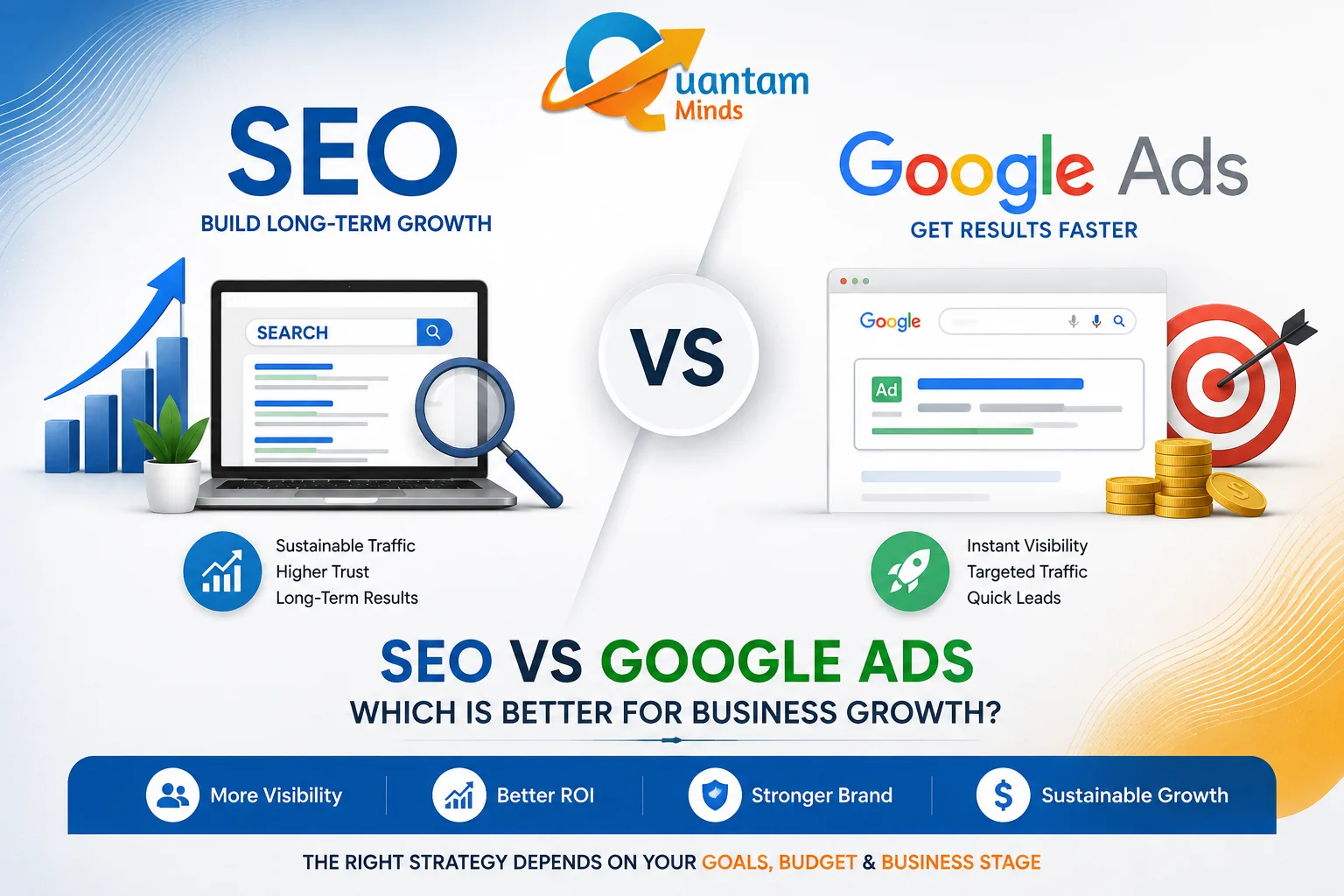
For this reason, many ecommerce brands combine paid advertising for immediate demand with SEO for sustainable customer acquisition.
Long-Term Customer Acquisition Creates Stronger Ecommerce Businesses
One of the biggest advantages of professional ecommerce SEO services is the ability to build an organic customer acquisition channel over time.
Instead of continuously paying to bring every visitor to the website, brands gradually develop search visibility across products, categories, and informational topics.
A stronger organic presence can help businesses:
- Reduce dependence on paid advertising
- Improve marketing efficiency
- Increase brand visibility
- Generate consistent organic traffic
- Reach shoppers with higher purchase intent
- Build stronger customer trust
- Support long-term revenue growth
This becomes particularly valuable when advertising costs fluctuate or marketplace competition becomes more aggressive.
Whether you're targeting customers locally or expanding into competitive markets, a location-focused digital strategy can accelerate business growth. Learn how our Digital Marketing Agency in Sonipat, Digital Marketing Agency in Gurgaon, Digital Marketing Company in Noida, and Digital Marketing Company in Delhi help businesses improve online visibility, generate qualified enquiries, and build sustainable growth through SEO, Google Ads, content marketing, and conversion-focused digital strategies.
Organic Visibility Across Product Categories Matters
Many ecommerce websites focus heavily on optimising their homepage.
But customers rarely discover an online store through the homepage alone.
They may enter through:
- Product pages
- Category pages
- Collection pages
- Brand pages
- Buying guides
- Comparison content
- Educational articles
Every one of these pages represents a potential customer acquisition channel.
Consider an ecommerce furniture brand with hundreds of products. Optimising only the homepage limits its ability to rank for searches related to office chairs, dining tables, wardrobes, study desks, sofas, or other product categories.
A stronger ecommerce SEO company strategy builds search visibility across relevant product and category pages, creating a broader organic footprint and more entry points into the website.
Ecommerce SEO Supports Growth Across Products and Markets
Online stores often experience rapid growth through paid promotions, marketplace sales, or seasonal campaigns. The bigger challenge is maintaining that growth efficiently over time.
SEO supports ecommerce expansion by helping businesses:
- Launch new product categories
- Improve product discoverability
- Target seasonal searches
- Enter new markets
- Build category authority
- Strengthen brand visibility
- Attract informational and commercial traffic
- Support new product launches
Rather than treating SEO as a one-time website project, ecommerce brands can use it as an ongoing growth channel that expands alongside their product catalogue.
Understanding the Modern Ecommerce Customer Journey
The modern ecommerce journey rarely follows a straight line from search to purchase.
A shopper may:
- Search for a product on Google.
- Read buying guides or comparison articles.
- Visit several ecommerce websites.
- Check product reviews and ratings.
- Compare prices and specifications.
- Return to a preferred website.
- Add products to the shopping cart.
- Complete the purchase.
They may also leave the website, compare the same product on a marketplace, watch a video review, and return days later.
Every stage creates an opportunity to gain—or lose—the customer.
Strong SEO for ecommerce websites helps brands remain visible across multiple stages of this journey instead of appearing only when the shopper is ready to purchase.
Consumer Buying Behaviour Has Become More Research-Driven
Modern shoppers expect transparency before committing to an online purchase.
They evaluate:
- Product quality
- Brand credibility
- Customer reviews
- Delivery options
- Return policies
- Product availability
- Website experience
- Payment options
- Customer support
Trust has become almost as important as price.
This is why ecommerce SEO cannot be separated from content quality, technical performance, website usability, and customer experience.
A technically strong website helps search engines access and understand your content.
A useful product page helps shoppers make decisions.
A trustworthy brand experience helps turn that interest into a purchase.
Search Intent Has Evolved Beyond Simple Product Keywords
Customers no longer search only for product names.
Their searches often reveal exactly where they are in the buying journey.
| Search Intent |
Example Search |
| Informational |
Best laptop for students |
| Commercial Investigation |
Nike vs Adidas running shoes |
| Transactional |
Buy wireless earbuds online |
| Product Research |
Best smartwatch for fitness tracking |
| Brand-Specific |
Samsung official store |
| Problem-Based |
Best office chair for back support |
Understanding these different search intents allows ecommerce brands to create appropriate content for each stage.
Informational searches may require buying guides or educational articles.
Commercial searches may benefit from comparison content.
Transactional searches should lead users towards highly optimised category or product pages.
This intent-driven approach helps ecommerce SEO services support both search visibility and conversion opportunities.
Shopify Stores Need a Structured SEO Approach
Shopify provides a strong foundation for ecommerce businesses, but simply launching a Shopify store does not guarantee organic visibility.
Stores still need careful optimisation across product pages, collections, content, internal links, metadata, technical elements, and user experience.
Our Shopify SEO services can focus on areas such as:
- Product page optimisation
- Collection page optimisation
- Shopify technical SEO
- Internal linking
- Metadata optimisation
- Structured data
- Content strategy
- Search intent research
- Page performance
- Conversion-focused improvements
For brands operating on Shopify, working with experienced Shopify experts SEO can help ensure that the platform's capabilities are supported by a strategy designed around actual customer searches and business objectives.
Product and Category SEO Create More Entry Points
A successful ecommerce website should not depend on a handful of pages for organic traffic.
Each relevant product category, collection, and product page can become an entry point for potential customers.
For example, an online fashion store might create search visibility around:
- Men's running shoes
- Women's casual shoes
- Formal shoes
- Sports footwear
- Walking shoes
Each category can target a different search intent while individual product pages capture more specific searches.
This creates a scalable SEO structure where organic visibility can grow alongside the product catalogue.
Business Impact of Ecommerce SEO
A strategic ecommerce SEO investment influences much more than rankings.
It can support measurable business outcomes across the customer acquisition funnel.
| SEO Focus Area |
Business Impact |
| Product SEO |
Improves visibility for individual products |
| Category SEO |
Increases discovery across product collections |
| Technical SEO |
Supports website performance, crawlability, and usability |
| Content Marketing |
Builds authority and buyer confidence |
| Internal Linking |
Improves product discovery and website structure |
| Schema Markup |
Helps search engines understand products and pages |
| Organic Visibility |
Creates a sustainable source of qualified traffic |
| User Experience |
Supports engagement and conversion |
| AI-Optimised Content |
Improves the potential for visibility across emerging search experiences |
| Off-Page SEO |
Strengthens authority and broader search visibility |
| Long-Term SEO |
Supports sustainable customer acquisition and revenue growth |
SEO Has Become a Long-Term Growth Asset for Ecommerce Brands
The ecommerce brands that achieve sustainable growth are not always the ones spending the most on advertising. Often, they are the businesses that consistently appear when customers research products, compare alternatives, evaluate brands, and make purchasing decisions.
Strong organic visibility creates more opportunities to reach high-intent shoppers while reducing complete dependence on paid traffic.
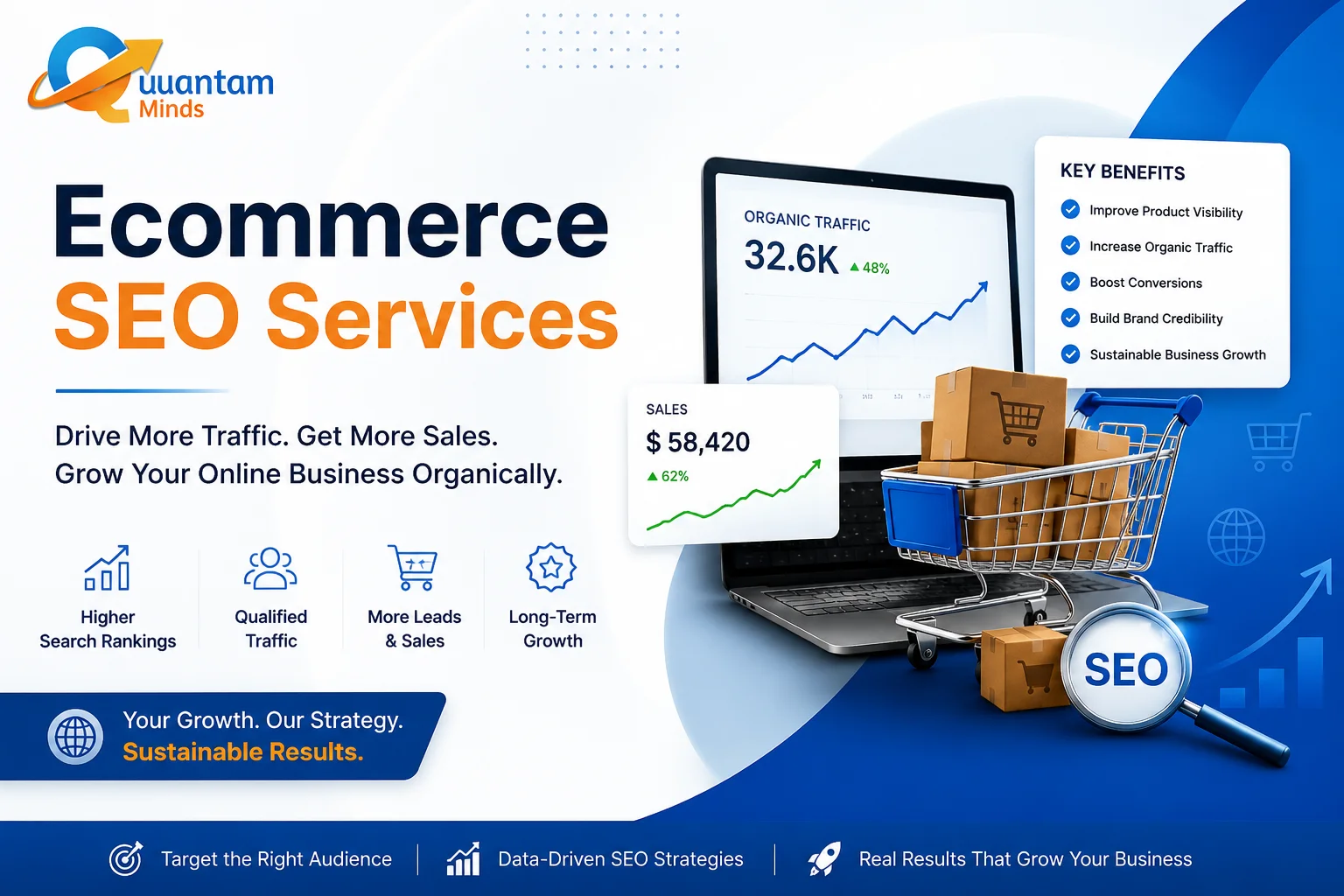
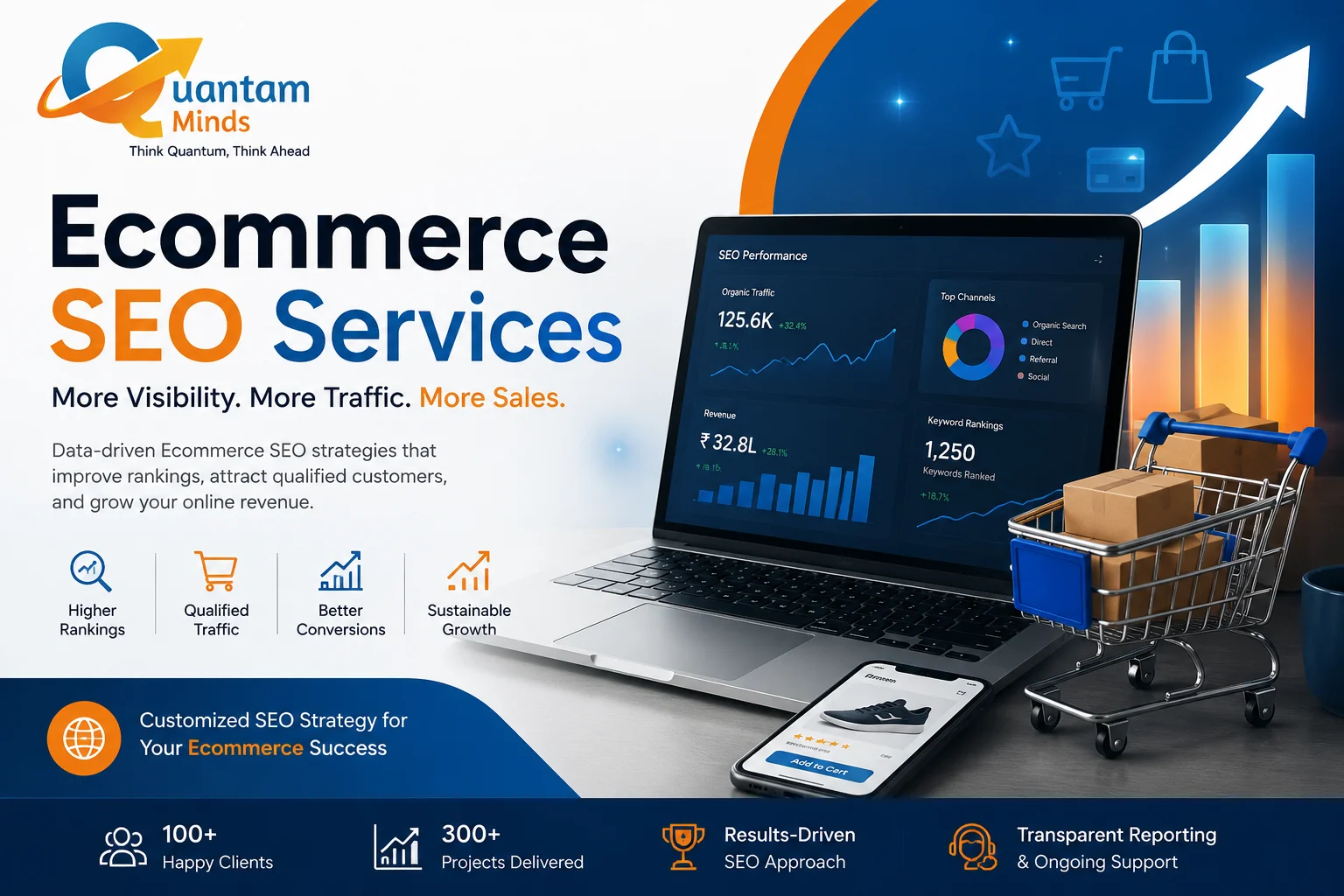
At Quantam Minds, our ecommerce SEO services combine technical SEO, product and category optimisation, content strategy, internal linking, user experience improvements, off page SEO service, and continuous performance analysis to help ecommerce brands strengthen search visibility and attract qualified shoppers.
For Shopify businesses, our Shopify SEO services focus on creating a scalable search foundation across products, collections, content, and technical elements. Whether you need support from an ecommerce SEO agency, an ecommerce SEO company, or specialised Shopify SEO experts, the objective remains the same: build organic visibility that supports stronger customer acquisition, higher-quality traffic, and sustainable ecommerce growth across India.
Every ecommerce business has unique products, customer segments, and growth objectives. Visit our Pricing page to explore flexible digital marketing and ecommerce SEO packages designed to improve search visibility, increase organic traffic, and support long-term online business growth.












 Featured