Why Ecommerce Website Development Has Become Essential for Modern Businesses
A few years ago, many businesses could grow steadily through physical stores, referrals, distributor networks, or social media enquiries. Today, customers expect something very different. Before making a purchase, they compare products, read reviews, evaluate delivery timelines, check return policies, browse multiple websites, and often revisit the same brand several times before completing an order.
That shift has changed what an ecommerce website represents.
It is no longer simply an online catalogue or another sales channel. A professionally planned Ecommerce Website Development solution has become an important part of how businesses attract customers, build trust, manage operations, and create long-term digital assets. Instead of relying entirely on third-party marketplaces or constantly increasing advertising budgets, businesses can create an online shopping experience that they fully control while supporting sustainable growth across multiple digital channels.
The businesses that continue growing online are rarely those with the largest product catalogues alone. More often, they are the ones that make discovering products, comparing options, completing purchases, and returning for future orders feel simple and reliable.
Customer Buying Behaviour Has Changed Faster Than Many Businesses Expected
The online buying journey is no longer straightforward.
A customer may first discover a product through Instagram, compare alternatives on Google, watch YouTube reviews, read customer feedback, visit several ecommerce stores, abandon the purchase, return a few days later through a Google search, and only then decide where to buy.
Every interaction influences the final decision.
This behaviour affects almost every industry across India. Whether it is a fashion brand launching a new collection, a healthcare company selling wellness products, a manufacturer expanding into direct-to-consumer sales, a restaurant introducing packaged food, or a local retailer building an online presence, customers now expect a professional digital shopping experience before placing an order.
Businesses often notice the symptoms before recognising the underlying cause.
Traffic begins increasing but orders remain inconsistent.
Customers abandon shopping carts during checkout.
Product pages receive visitors but generate very few purchases.
Repeat customers become less frequent.
Many assume these are advertising or pricing issues. In reality, they often point towards weaknesses in the website itself, including navigation, mobile experience, product presentation, checkout flow, page speed, or customer trust.
A well-planned Custom Ecommerce Website Development strategy focuses on improving each stage of the buying journey rather than simply increasing visitor numbers.
Social Media Creates Attention—Your Ecommerce Website Converts It
Social media has become one of the strongest channels for introducing products, building communities, and generating customer interest.
It is rarely the ideal place to complete the entire buying process.
Algorithms change regularly.
Advertising costs fluctuate.
Organic reach becomes increasingly competitive.
Businesses that depend entirely on direct messages or social platforms eventually encounter operational challenges.
A growing skincare brand, for example, may receive hundreds of product enquiries every week through Instagram. Initially, replying manually feels manageable. As demand grows, customers begin asking identical questions, stock availability changes throughout the day, payment confirmations become difficult to organise, and order tracking turns into a time-consuming manual process.
Growth begins creating operational pressure instead of efficiency.
A professionally developed Online Store Development solution solves many of these challenges by providing customers with detailed product information, secure payment options, automated inventory updates, order tracking, delivery estimates, customer accounts, and a consistent shopping experience available at any time.
Social media remains valuable—but it performs significantly better when it brings visitors to an ecommerce website specifically designed to convert interest into completed purchases.
Marketplaces Can Increase Sales—But Your Brand Should Own the Customer Relationship
Selling through marketplaces is often an effective way for businesses to enter ecommerce.
They provide immediate access to established audiences, built-in logistics, and existing customer trust.
However, long-term growth introduces different challenges.
Customers frequently remember the marketplace instead of the business.
Similar products appear beside your listings.
Price competition becomes more aggressive.
Building customer loyalty becomes increasingly difficult because the relationship belongs primarily to the platform.
Many growing ecommerce businesses eventually realise they have achieved impressive order volumes while developing very little direct customer ownership.
A professionally built ecommerce website changes that relationship.
Instead of competing only on discounts, businesses can strengthen their own brand identity, recommend complementary products, introduce membership programmes, personalise customer experiences, recover abandoned carts, collect first-party customer data, and encourage repeat purchases through email marketing and loyalty initiatives.
This is one of the reasons many businesses choose Ecommerce Website Development Services alongside marketplace selling rather than replacing one channel with another.
Owning Your Ecommerce Platform Creates Stronger Long-Term Business Value
Every business eventually reaches an important decision.
Should future growth depend entirely on platforms controlled by someone else, or should part of that growth come from digital assets the business owns?
A professionally developed ecommerce website is one of those assets.
Unlike rented visibility through marketplaces or paid advertising, your website continues supporting organic search, content marketing, email automation, customer retention, Google Shopping campaigns, SEO, remarketing, and repeat purchases while giving complete control over the customer experience.
Customers now expect:
- Fast-loading pages
- Secure payment gateways
- Mobile-friendly shopping
- Simple checkout experiences
- Clear delivery information
- Easy return policies
- Transparent pricing
- Reliable order tracking
Meeting these expectations requires much more than attractive design.
It requires thoughtful Ecommerce Website Development Services that combine technology, usability, performance, and customer psychology into one connected shopping experience.
Every Business Requires a Different Ecommerce Strategy
No two ecommerce businesses operate in exactly the same way.
A fashion retailer may require advanced product filters, colour variants, wishlists, and personalised recommendations.
A healthcare business may prioritise subscription orders, customer education, and regulatory compliance.
A manufacturer may need quotation requests alongside online purchasing.
A B2B supplier may require customer-specific pricing and bulk ordering functionality.
A food brand may focus on delivery scheduling and inventory management.
These differences mean every project requires its own development roadmap.
As an experienced Ecommerce Website Development Company, we begin by understanding how your customers purchase, how your operations function, and where your business plans to grow over the coming years.
For some businesses, Shopify Website Development provides the ideal balance of speed, scalability, and ease of management. Others benefit from WooCommerce Website Development, particularly when flexibility, content marketing, and WordPress integration are priorities. Larger or highly specialised businesses often require Custom Ecommerce Website Development or Custom Online Store Development to support unique workflows, integrations, and future expansion.
The platform is important.
The long-term business strategy is even more important because the right ecommerce website should continue supporting growth long after it goes live.
Businesses that invest in scalable infrastructure, intuitive shopping experiences, secure technology, and digital assets they fully control are generally better positioned to adapt to changing customer expectations, expand into new markets, strengthen brand loyalty, and build sustainable online revenue for years to come.
A professionally developed ecommerce website becomes even more valuable when customers can consistently find it through search engines. Pairing your online store with SEO Services helps improve long-term visibility, attract high-intent shoppers, and create a sustainable source of organic traffic beyond paid advertising.
Need Help Choosing the Right Ecommerce Website Development?
Our specialists will help you understand the complete process, documentation requirements, estimated timelines and the best approach for your Ecommerce Website Development project.
Everything Your Business Needs To Grow Online
We combine digital marketing, creative branding, web development, automation, and business software into one complete growth ecosystem.
Search Engine Optimization (SEO)
Improve rankings, generate qualified traffic, and increase long-term business growth through data-driven SEO strategies.
- Technical SEO
- Local SEO
- Ecommerce SEO
- Enterprise SEO
Digital Marketing Agency in Sonipat
Businesses in Sonipat are competing in a market where customers often search online before...
Check Digital Marketing Agency in Sonipat
Digital Marketing for Gyms
Running a successful gym today requires more than quality equipment and experienced traine...
Check Digital Marketing for Gyms
Online Reputation Management
Your online reputation influences customer decisions long before the first conversation be...
Check Online Reputation Management
Graphic Designing
Modern customers often judge a business visually before they read about its services or pr...
Check Graphic Designing
Social Media Marketing
Modern customers often discover businesses through Instagram, Facebook, Reels, and short-f...
Check Social Media Marketing
Website Development
Modern businesses need more than a basic online presence. Our Website Development services...
Check Website Development
Google Ads Services
Modern businesses cannot rely only on organic reach anymore, especially in competitive ind...
Check Google Ads Services
Seo Servcies
Modern businesses do not struggle only with competition anymore. They struggle with discov...
Check Seo ServciesLet's Build A Digital Growth Strategy That Actually Delivers Results
Whether you need SEO, Google Ads, Website Development, CRM Software, AI Automation, or a complete digital transformation strategy, our experts are ready to help you grow faster.
What Prevents Many Ecommerce Website Development Projects from Delivering Sustainable Business Growth?
Launching an online store is an important milestone, but it is rarely the point where ecommerce success begins.
Many businesses invest considerable time selecting products, designing the website, and preparing for launch. Orders start arriving, marketing campaigns generate visitors, and everything appears to be moving in the right direction. Then growth gradually slows.
The products are still competitive.
Advertising continues running.
Customers visit the website.
Yet sales never quite match expectations.
In many situations, the problem isn't a lack of demand. It is that small weaknesses across the shopping experience quietly reduce customer confidence before the purchase is completed.
Sustainable Ecommerce Website Development is not simply about building an attractive online store. It is about creating a digital commerce platform that attracts qualified visitors, converts them into customers, supports efficient operations, and continues scaling as the business grows.
Businesses that identify these challenges early often avoid costly redesigns, unnecessary platform migrations, and repeated investments in short-term fixes.
Why Do Customers Browse Products but Leave Without Buying?
This is one of the most common questions ecommerce businesses ask.
"We're getting visitors every day, people view products, add items to the cart, and then disappear."
Usually, nothing appears obviously wrong.
Advertising campaigns are active.
Products are competitively priced.
Website traffic looks healthy.
The missing piece is often the customer experience.
Purchasing decisions are influenced by dozens of small interactions.
Customers evaluate:
- Product presentation
- Navigation
- Product comparisons
- Pricing transparency
- Shipping information
- Delivery timelines
- Payment confidence
- Return policies
- Overall website credibility
Every unnecessary obstacle introduces hesitation.
A confusing menu, inconsistent product information, hidden delivery charges, poor product images, or unclear calls-to-action may seem minor individually. Together they reduce conversions significantly.
Professional Ecommerce Website Development Services focus on removing these barriers before they become lost sales.
Instead of asking only "How do we increase traffic?" we first ask "Why are interested customers leaving without completing the purchase?"
That question often leads to better long-term business outcomes.
Slow Websites Quietly Increase Customer Acquisition Costs
Website speed influences far more than user experience.
Customers have become increasingly impatient.
If product pages load slowly or checkout takes several extra seconds, many shoppers simply continue comparing alternatives elsewhere.
The impact extends well beyond conversions.
A slow website can contribute to:
- Higher bounce rates
- Lower conversion rates
- Reduced repeat purchases
- Poor mobile engagement
- Increased advertising costs
- Lower search visibility
Many businesses respond by increasing advertising budgets while the actual problem exists inside the website itself.
An experienced Ecommerce Development Company considers performance from the beginning through efficient coding, image optimisation, Core Web Vitals improvements, reliable hosting, caching strategies, and scalable architecture.
Website speed should never become an afterthought.
Mobile Shopping Has Become the Primary Customer Experience
For many ecommerce businesses in India, most visitors now arrive through smartphones.
Yet a surprising number of online stores are still designed primarily around desktop browsing.
Customers experience problems such as:
- Difficult navigation
- Small buttons
- Complicated filters
- Slow product loading
- Frustrating checkout forms
- Poor product image galleries
Most customers never report these issues.
They simply leave.
Whether someone wants to create an ecommerce website for fashion, electronics, healthcare products, beauty brands, or lifestyle goods, mobile usability has become one of the strongest influences on purchasing behaviour.
Modern Custom Ecommerce Website Development should begin with mobile-first thinking instead of adapting desktop layouts afterwards.
Complicated Checkout Processes Reduce Completed Orders
Customers who reach the checkout page have already demonstrated strong purchase intent.
Losing them at this stage is one of the most expensive conversion problems an ecommerce business can experience.
Common checkout barriers include:
- Mandatory account creation
- Lengthy forms
- Multiple checkout screens
- Limited payment options
- Unexpected shipping charges
- Poor mobile usability
- Confusing coupon processes
Every additional step creates another opportunity for abandonment.
A well-planned Custom Online Store Development strategy focuses on creating checkout experiences that feel simple, secure, and trustworthy while maintaining the operational controls businesses require.
The objective isn't only completing more purchases.
It is creating an experience customers are willing to repeat.
Trust Is Built Long Before Customers Enter Payment Details
Customers rarely purchase from unfamiliar businesses based on product listings alone.
Trust develops gradually throughout the buying journey.
It is influenced by dozens of visible signals, including:
- Professional branding
- High-quality product photography
- Detailed product descriptions
- Customer reviews
- Secure payment gateways
- Transparent pricing
- Delivery information
- Return and refund policies
- SSL security
- Easy-to-find contact information
Even small inconsistencies can create hesitation.
An outdated design.
Poor-quality images.
Missing product specifications.
No visible customer support.
Individually these issues appear manageable.
Collectively they reduce purchasing confidence.
One important reality is worth recognising.
Even the best Ecommerce Website Development Company cannot compensate for poor customer service or unreliable products. Technology strengthens trust, but long-term customer loyalty still depends on consistently delivering positive experiences.
Operational Challenges Eventually Affect Customer Experience
As ecommerce businesses grow, operational complexity grows alongside them.
Manual inventory updates, disconnected order management, spreadsheet-based stock control, and delayed shipping communication may appear manageable during the early stages.
Over time they begin affecting customers directly.
Businesses commonly experience:
- Overselling products
- Inventory inaccuracies
- Shipping delays
- Order processing errors
- Customer support challenges
- Synchronisation problems across sales channels
Modern Ecommerce Website Development Services integrate inventory management, order processing, payment gateways, shipping providers, CRM systems, and customer communication into one connected workflow.
Operational efficiency ultimately becomes part of the customer experience.
Weak SEO Foundations Increase Customer Acquisition Costs
Many ecommerce businesses depend almost entirely on paid advertising for sales.
Advertising certainly plays an important role.
However, relying exclusively on paid traffic often increases customer acquisition costs over time.
Without proper ecommerce SEO architecture, businesses frequently struggle with:
- Poor category organisation
- Duplicate product content
- Weak internal linking
- Limited crawlability
- Missing schema markup
- Technical SEO issues
- Low organic visibility
Search engine optimisation should not be treated as a future upgrade.
The strongest Ecommerce Website Development projects incorporate SEO best practices from the beginning so website architecture, product pages, categories, and content support long-term organic growth.
When combined with SEO Services, Content Writing Services, and Google Ads Services, an ecommerce website becomes a long-term customer acquisition platform rather than depending entirely on paid advertising.
Choosing the Right Platform Matters More Than Many Businesses Expect
Platform selection influences far more than development cost.
It affects future flexibility, integrations, maintenance, scalability, and day-to-day business operations.
Some businesses benefit from Shopify Website Development because of its simplicity, security, and ecosystem.
Others prefer WooCommerce Website Development for greater flexibility and content management.
Businesses with highly specialised requirements often require Custom Ecommerce Website Development built around unique workflows, third-party integrations, and long-term expansion plans.
Selecting a platform based only on immediate convenience often leads to expensive migrations later.
The better question is not "Which platform is most popular?"
It is "Which platform will continue supporting this business three to five years from now?"
Sustainable Ecommerce Growth Depends on More Than Customer Acquisition
Generating traffic is only one part of ecommerce growth.
Long-term profitability usually comes from encouraging customers to return.
Successful online stores continuously improve:
- Customer experience
- Personalised product recommendations
- Wishlist functionality
- Loyalty programmes
- Email automation
- Abandoned cart recovery
- Easy reordering
- Customer accounts
- After-sales communication
Acquiring a new customer is valuable.
Building a relationship that leads to repeat purchases is often even more valuable.
Businesses that view Ecommerce Website Development as an ongoing business growth strategy rather than a one-time development project are generally better positioned to improve customer retention, increase lifetime value, strengthen brand loyalty, and build sustainable online revenue in an increasingly competitive ecommerce market.
Even a well-built ecommerce website needs qualified visitors. When immediate visibility is important, Google Ads Services can help place your products in front of customers actively searching for them while supporting faster customer acquisition alongside long-term organic growth.
What Does a High-Performing Ecommerce Website Actually Need?
Launching an online store has become easier than ever.
Building one that consistently attracts customers, converts visitors into buyers, encourages repeat purchases, and supports long-term business growth is far more challenging.
Many businesses invest heavily in advertising, social media marketing, and product sourcing only to discover that visitors browse a few products and leave without placing an order. The first instinct is often to increase marketing budgets. Sometimes that's necessary. Quite often, it isn't.
The website itself may be creating friction that quietly reduces revenue every single day.
Professional Ecommerce Website Development is not simply about creating an attractive storefront. It is about designing an online shopping experience that removes hesitation, builds confidence, simplifies purchasing decisions, and supports future business expansion.
A successful Ecommerce Website Development Company doesn't begin by asking which platform you prefer. It begins by understanding how your customers search, compare, evaluate products, and ultimately decide to purchase.
Every page, feature, and interaction should move customers closer to that decision.
Customer Experience Matters More Than Visual Design Alone
Beautiful websites attract attention.
Exceptional user experience generates sales.
Customers expect to reach products quickly, understand pricing immediately, compare options easily, and complete purchases without unnecessary effort.
When navigation feels confusing or important information is difficult to find, most visitors simply leave.
Good user experience is not about adding more animations or visual effects.
It is about reducing effort.
Businesses often notice measurable improvements after simplifying navigation, improving product categorisation, making calls-to-action clearer, and removing unnecessary distractions. Individually these improvements appear small.
Collectively they influence revenue every day.
That is why experienced Custom Ecommerce Website Development focuses first on customer behaviour instead of visual trends.
Mobile-First Shopping Has Become the Standard
For most ecommerce businesses across India, mobile devices now generate the majority of customer visits.
People browse products while travelling, during lunch breaks, while comparing prices inside physical stores, or relaxing at home.
Their expectations are simple.
The website should load quickly.
Navigation should feel effortless.
Images should display perfectly.
Checkout should require minimal typing.
Unfortunately, many online stores are still designed primarily for desktop users before being adjusted for smaller screens.
Customers rarely complain about poor mobile experiences.
They simply abandon the website.
Modern Online Store Development should always begin with mobile behaviour because that is where most purchasing journeys now start.
Website Speed Directly Influences Revenue
Every second of loading time affects customer behaviour.
Slow product pages interrupt browsing.
Delayed checkout creates uncertainty.
Poor performance increases abandonment.
Website speed also influences search visibility, advertising efficiency, and repeat customer behaviour.
Many businesses attempt to solve declining sales by increasing advertising budgets when the actual issue is website performance.
A professional Ecommerce Website Development Agency plans performance from the beginning through:
- Optimised coding
- Image compression
- Browser caching
- Core Web Vitals optimisation
- Reliable hosting
- CDN integration
- Scalable architecture
Website performance should never become an upgrade after launch.
It should be part of the original development strategy.
Secure Checkout Builds Customer Confidence
Customers share valuable personal information every time they place an order.
They expect that information to remain protected.
Trust grows through multiple signals working together, including:
- Secure payment gateways
- SSL encryption
- Trusted payment badges
- Multiple payment options
- Transparent pricing
- Clear shipping costs
- Visible return policies
- Order confirmation and tracking
A secure checkout process protects more than transactions.
It protects customer confidence.
That confidence often determines whether someone becomes a repeat buyer.
Product Architecture Matters More Than Product Quantity
Adding hundreds of products does not automatically create a better ecommerce business.
Customers need organisation.
Without logical product categories, collections, filters, and navigation, even excellent products become difficult to discover.
Effective Custom Online Store Development focuses on creating product architecture that helps customers find exactly what they need.
A well-structured catalogue supports:
- Faster product discovery
- Better internal search
- Product comparisons
- Cross-selling
- Upselling
- Higher average order values
The inventory may remain identical.
The customer experience changes completely.
Search, Filters, and Navigation Influence Buying Decisions
Visitors who use website search usually have stronger purchase intent than casual browsers.
They already know what they want.
If search produces poor results or filters are confusing, purchasing momentum disappears quickly.
An effective ecommerce website should include intuitive filtering based on factors such as:
- Brand
- Category
- Price
- Colour
- Size
- Availability
- Specifications
- Ratings
This becomes especially valuable for fashion brands, electronics retailers, furniture stores, healthcare businesses, industrial suppliers, and lifestyle products where customers compare multiple options before purchasing.
Product Pages Should Sell, Not Simply Display Products
Product pages often determine whether customers purchase or continue comparing competitors.
Many ecommerce websites still rely on short manufacturer descriptions with limited information.
Modern customers expect much more.
High-converting product pages usually include:
- Detailed descriptions
- High-quality images
- Product videos
- Specifications
- FAQs
- Customer reviews
- Delivery information
- Return policy
- Related products
- Trust indicators
Every product page should answer the questions customers would normally ask inside a physical store.
Good product pages quietly become your most effective sales representatives.
Strong Category Structure Supports Both Customers and SEO
Categories help customers understand your catalogue.
They also help search engines understand your website.
Poor category planning often creates:
- Duplicate content
- Weak internal linking
- Crawl inefficiencies
- Confusing navigation
- Reduced organic visibility
Professional Ecommerce Website Development Services build category structures that improve both customer experience and long-term SEO performance.
When combined with SEO Services, category architecture becomes an important driver of sustainable organic traffic.
Trust Signals Influence Purchasing Decisions
Trust rarely comes from one feature.
It develops through dozens of small signals across the buying journey.
High-performing ecommerce websites typically include:
- Authentic customer reviews
- Real product photography
- Clear shipping policies
- Easy returns
- Secure payment badges
- Contact information
- Business credentials
- Frequently Asked Questions
- Live chat or customer support
- Social proof
None of these elements guarantees a purchase individually.
Together they significantly reduce hesitation.
Every Design Decision Should Support Conversions
Design should never exist only to impress visitors.
It should guide them toward purchasing decisions naturally.
| Website Feature | Business Benefit |
|---|---|
| Clear navigation | Faster product discovery |
| Optimised product pages | Higher purchase confidence |
| Prominent calls-to-action | Better conversion opportunities |
| Simplified checkout | Lower cart abandonment |
| Cross-selling modules | Higher average order value |
| Consistent branding | Greater customer trust |
| Fast page performance | Improved engagement and retention |
The highest-performing ecommerce stores rarely succeed because of one dramatic feature.
They succeed because dozens of small conversion improvements work together.
Analytics Makes Continuous Growth Possible
Without reliable data, businesses rely on assumptions.
Analytics provides clarity.
Instead of guessing why customers abandon carts, businesses can identify exactly where it happens.
Instead of wondering which marketing channel performs best, they can measure customer behaviour across every stage of the buying journey.
Modern Ecommerce Web Development should include analytics integration from the very beginning, including:
- Google Analytics 4
- Google Tag Manager
- Ecommerce conversion tracking
- Funnel analysis
- Customer behaviour monitoring
- Heatmaps
- Event tracking
- Enhanced Ecommerce reporting
When integrated with SEO Services, Google Ads Services, Email Marketing, and customer retention strategies, analytics becomes one of the most valuable long-term business assets.
Scalable Technology Supports Long-Term Ecommerce Growth
An ecommerce website should not only support today's business.
It should support where the business plans to be several years from now.
Choosing between Shopify Website Development, WooCommerce Website Development, or a fully Custom Ecommerce Website Development solution should depend on future scalability, operational requirements, third-party integrations, and long-term business objectives rather than short-term convenience alone.
Businesses that invest in scalable architecture, customer experience, conversion optimisation, and performance from the beginning are generally better positioned to increase online sales, improve customer retention, reduce acquisition costs, and build a stronger digital commerce brand over time.
Need Help Choosing the Right Ecommerce Website Development?
Our specialists will help you understand the complete process, documentation requirements, estimated timelines and the best approach for your Ecommerce Website Development project.
Digital Solutions Built For Every Industry
Every industry has different challenges, customers, and growth goals. We build customized marketing strategies, websites, automation systems, and business software designed specifically for your industry.
Healthcare
- Medical Website
- SEO
- Google Ads
- Appointment System
- CRM
Real Estate
- Property Portal
- Google Ads
- CRM
- Landing Pages
- Lead Automation
Gym & Fitness
- Lead Generation
- Membership CRM
- Instagram Marketing
- Website
- WhatsApp Automation
Education
- Admissions CRM
- SEO
- Student Portal
- Meta Ads
- Website
Ecommerce
- Shopify
- SEO
- Meta Ads
- Google Shopping
- Automation
Manufacturing
- Industies Website
- ERP
- CRM
- Branding
- Automation
Don't See Your Industry?
We create customized digital strategies and software solutions for businesses across every sector.
Discuss Your BusinessOur Ecommerce Website Development Services Are Built Around Business Growth, Not Just Design
A professionally designed online store can make a strong first impression. But impressions alone don't build a sustainable ecommerce business.
We've seen businesses invest in visually appealing websites that struggle to generate repeat customers, while others with simpler designs continue to grow because every part of their website is built around the customer journey. The difference rarely comes down to colours or animations. It comes from strategy.
At Quantam Minds, our Ecommerce Website Development Services begin with understanding your business, your customers, and your long-term goals. Every recommendation is made to support measurable business outcomes, whether that means improving conversions, simplifying operations, increasing customer retention, or preparing your business to scale.
Discovery Begins with Understanding the Business, Not the Technology
Before discussing platforms, layouts, or features, we take time to understand how your business actually operates.
That includes questions many development projects overlook.
- How do customers currently discover your products?
- Which products generate the highest profit rather than just the highest sales?
- What challenges does your team face while managing orders?
- Where do customers typically abandon the buying journey?
- What does success look like six months after launch?
These conversations help identify opportunities that influence long-term growth rather than simply delivering another ecommerce website.
A business selling handcrafted furniture has very different priorities than a fitness brand, a restaurant expanding into packaged products, or a healthcare company offering wellness solutions. Their websites shouldn't follow the same blueprint.
Strategy That Supports Business Decisions
Once we understand your goals, we create a roadmap that aligns technology with your business strategy.
Instead of asking which platform has the most features, we focus on questions that matter more.
Will the website support future expansion?
Can it handle growing product catalogues?
Will it integrate with existing business systems?
How easily can your team manage products, pricing, and promotions?
A well-planned strategy reduces expensive changes later. It also helps ensure that marketing channels such as SEO Services, Google Ads Management, Content Writing, Email Marketing, and WhatsApp Marketing can work together instead of operating in isolation.
UI and UX That Encourage Customers to Keep Shopping
Customers rarely notice good user experience.
They simply enjoy using the website.
Poor user experience, on the other hand, becomes obvious almost immediately.
Confusing navigation, inconsistent layouts, distracting interfaces, or unclear purchasing paths often increase drop-offs without businesses realizing why.
Our UI and UX approach focuses on creating an intuitive shopping journey where customers can browse products, compare options, and complete purchases with minimal effort.
Every design decision is guided by customer behaviour rather than design trends.
Sometimes removing unnecessary elements improves conversions more than adding new ones.
Development Focused on Performance and Scalability
The development stage is where strategy becomes a functional ecommerce platform.
We build websites that prioritize:
- Clean and scalable code
- Fast page loading
- Mobile responsiveness
- Secure architecture
- Flexible product management
- Reliable performance
- Future feature expansion
- Easy administration
One practical observation has remained consistent over the years.
Businesses rarely regret building with future growth in mind. They often regret choosing shortcuts that limit expansion later.
Shopify Website Development for Fast-Growing Online Stores
For businesses looking for a reliable, cloud-based ecommerce solution, Shopify Website Development offers an excellent balance between usability and scalability.
It works particularly well for businesses that want:
- Faster launch timelines
- Simplified store management
- Secure hosting
- Multi-channel selling
- Built-in ecommerce functionality
- Extensive app ecosystem
Whether you're working with a dedicated shopify web developer, an experienced shopify web designer, or planning a complete store redesign, Shopify provides flexibility without requiring businesses to manage complex server infrastructure.
It is often a suitable choice for startups, growing brands, fashion businesses, beauty companies, and direct-to-consumer ecommerce stores.
WooCommerce Website Development for Businesses That Need Greater Flexibility
Some businesses require deeper customization and greater control over their ecommerce ecosystem.
In those situations, WooCommerce Website Development may be a better fit.
WooCommerce allows businesses to integrate ecommerce with an existing WordPress website while supporting:
- Flexible product management
- Custom functionality
- Content-driven SEO strategies
- Extensive plugin ecosystem
- Greater design freedom
- Advanced business-specific workflows
Businesses investing heavily in content marketing often appreciate the flexibility WooCommerce provides for combining ecommerce with long-form educational content.
Custom Ecommerce Website Development for Unique Business Requirements
Not every business fits within standard ecommerce templates.
Manufacturers may require quotation workflows.
B2B companies often need customer-specific pricing.
Healthcare providers may require specialized product management.
Subscription businesses have entirely different purchasing journeys.
This is where Custom Ecommerce Website Development becomes valuable.
Instead of adapting business processes to fit a platform, the website is developed around how the business actually operates.
A custom solution usually requires more planning and investment, but for businesses with unique operational needs, it often provides greater long-term value.
Third-Party Integrations That Keep Your Business Connected
An ecommerce website should never operate independently from the rest of your business.
As your operations grow, disconnected systems often create unnecessary manual work.
We help integrate ecommerce platforms with tools such as:
- Inventory management software
- Accounting systems
- ERP solutions
- CRM platforms
- Customer support software
- Marketing automation tools
- SMS and WhatsApp communication
- Shipping providers
- Analytics platforms
The objective is simple.
Reduce repetitive tasks so your team can focus more on customers and business growth.
Secure Payment Gateways That Build Customer Confidence
Payment is one of the most sensitive stages of the buying journey.
Customers expect secure, familiar, and convenient payment options.
We help implement trusted payment gateways that support:
- UPI payments
- Credit and debit cards
- Net banking
- Digital wallets
- Buy Now Pay Later options where applicable
- International payment support for eligible businesses
Security matters.
Convenience matters just as much.
A smooth payment experience often determines whether an interested customer becomes a completed sale.
Shipping Setup That Supports Business Operations
Shipping influences customer satisfaction long after an order is placed.
We configure shipping systems that accommodate different business models, including:
- Flat-rate shipping
- Weight-based pricing
- Zone-wise delivery
- Free shipping campaigns
- Local delivery options
- Real-time shipping calculations
- Courier partner integrations
- Order tracking notifications
A reliable shipping setup reduces operational confusion while giving customers greater confidence throughout the fulfilment process.
CRM Integration for Better Customer Relationships
Every order represents more than a transaction.
It represents a customer relationship.
CRM integration allows businesses to organize customer information, purchase history, communication, and follow-up activities in one place.
This creates opportunities for:
- Personalized marketing
- Repeat purchase campaigns
- Customer segmentation
- Better support
- Sales follow-ups
- Long-term relationship building
Retaining existing customers often proves more cost-effective than constantly acquiring new ones.
Marketing Integrations That Support Continuous Growth
Launching an ecommerce website without marketing integration is like opening a store without putting up a sign.
Your website should connect naturally with your broader digital marketing ecosystem.
Depending on your business goals, we can integrate tools that support:
- SEO Services
- Google Ads Management
- Content Writing
- Email Marketing
- WhatsApp Marketing
- Lead generation campaigns
- Social media advertising
- Conversion tracking
- Remarketing
- Customer behaviour analytics
These integrations help businesses make informed decisions rather than relying on assumptions.
SEO-Ready Development from the Very Beginning
SEO performs best when it is considered during development, not after the website has already been launched.
Our Ecommerce Website Development approach includes SEO-friendly architecture that supports long-term visibility through:
- Clean URL structures
- Logical category hierarchy
- Mobile-friendly development
- Fast-loading pages
- Structured internal navigation
- Optimized product architecture
- Technical SEO foundations
- Schema-ready implementation
- Crawl-friendly coding practices
This creates a stronger foundation for sustainable organic growth while making future optimization more efficient.
Choosing the Right Ecommerce Development Approach
| Business Requirement | Shopify Website Development | WooCommerce Website Development | Custom Ecommerce Website Development |
|---|---|---|---|
| Faster launch | Excellent | Good | Depends on project scope |
| Ease of management | Excellent | Good | Custom workflow based |
| Design flexibility | High | Very High | Complete flexibility |
| Business-specific functionality | Moderate | High | Extensive |
| SEO capabilities | Strong | Strong | Built around project requirements |
| Scalability | High | High | Designed for business objectives |
| Third-party integrations | Extensive | Extensive | Fully customizable |
| Suitable for | Growing brands, startups, D2C businesses | Content-driven businesses, SMEs | Enterprises, B2B companies, complex ecommerce operations |
There is no single platform that works for every business.
The right decision depends on your products, operational processes, customer expectations, growth plans, and marketing strategy. Our role is to help you make that decision with clarity, ensuring your ecommerce website supports not only today's requirements but also the opportunities your business may pursue in the years ahead.
Choosing the Right Ecommerce Platform Starts With Your Business Goals
One of the most common questions businesses ask before starting an Ecommerce Website Development project is:
"Should we choose Shopify, WooCommerce, or build a completely custom ecommerce platform?"
There isn't one universal answer.
The right platform depends on factors such as:
- Product catalogue size
- Expected monthly orders
- Marketing strategy
- SEO requirements
- Third-party integrations
- Inventory complexity
- Future expansion plans
- Internal technical resources
A growing fashion brand may benefit from Shopify Website Development because of its speed, scalability, and simplified store management.
A content-driven business already operating on WordPress may find WooCommerce Website Development provides greater flexibility for combining SEO, blogging, and ecommerce.
Businesses with unique operational workflows often achieve better long-term results through Custom Ecommerce Website Development, where every feature is designed around the way the business actually operates instead of adapting the business to fit software limitations.
Selecting the right platform early usually reduces future redevelopment costs while creating a stronger foundation for sustainable online growth.
Custom Ecommerce Development Gives Businesses Greater Operational Flexibility
As businesses grow, standard ecommerce templates often begin showing limitations.
Some companies need:
- Customer-specific pricing
- Wholesale portals
- Multi-vendor functionality
- Subscription management
- ERP integration
- Advanced inventory automation
- Multi-location fulfilment
- Custom checkout workflows
In these situations, Custom Online Store Development provides significantly greater flexibility than relying entirely on pre-built templates.
A carefully planned custom solution supports the unique operational requirements of the business while allowing future expansion without repeatedly rebuilding the website.
For many growing brands, the investment in Custom Ecommerce Website Development creates long-term operational efficiency that extends well beyond the website itself.
| Business Requirement | Shopify Website Development | WooCommerce Website Development | Custom Ecommerce Website Development |
|---|---|---|---|
| Launch Speed | Excellent | Good | Depends on project scope |
| Store Management | Very Easy | Moderate | Custom Workflow |
| SEO Flexibility | Strong | Excellent | Fully Customizable |
| Design Freedom | High | Very High | Unlimited |
| Product Catalogue | Medium to Large | Small to Large | Unlimited |
| Third-Party Integrations | Extensive | Extensive | Fully Custom |
| Custom Business Logic | Moderate | High | Complete Control |
| Best For | D2C Brands, Startups | SMEs, Content-Driven Stores | Enterprises, B2B, Complex Ecommerce |
Every Ecommerce Business Requires a Different Development Strategy
Over the years, we've seen businesses across different industries require very different ecommerce solutions.
A healthcare company may prioritize compliance, subscriptions, and customer trust.
A fashion retailer often focuses on product variants, inventory synchronization, and mobile-first shopping experiences.
Manufacturers may require quotation requests alongside direct ordering.
Food and beverage brands often need delivery integrations and location-based fulfilment.
This is why our Ecommerce Website Development Services always begin with business strategy before platform selection. The technology should support how your business operates today while remaining flexible enough to accommodate future growth.
Every ecommerce store is a specialized website, but not every business requires ecommerce functionality. If you're exploring broader digital solutions, our Website Development services cover corporate websites, business portals, landing pages, and custom web applications designed around your business objectives.
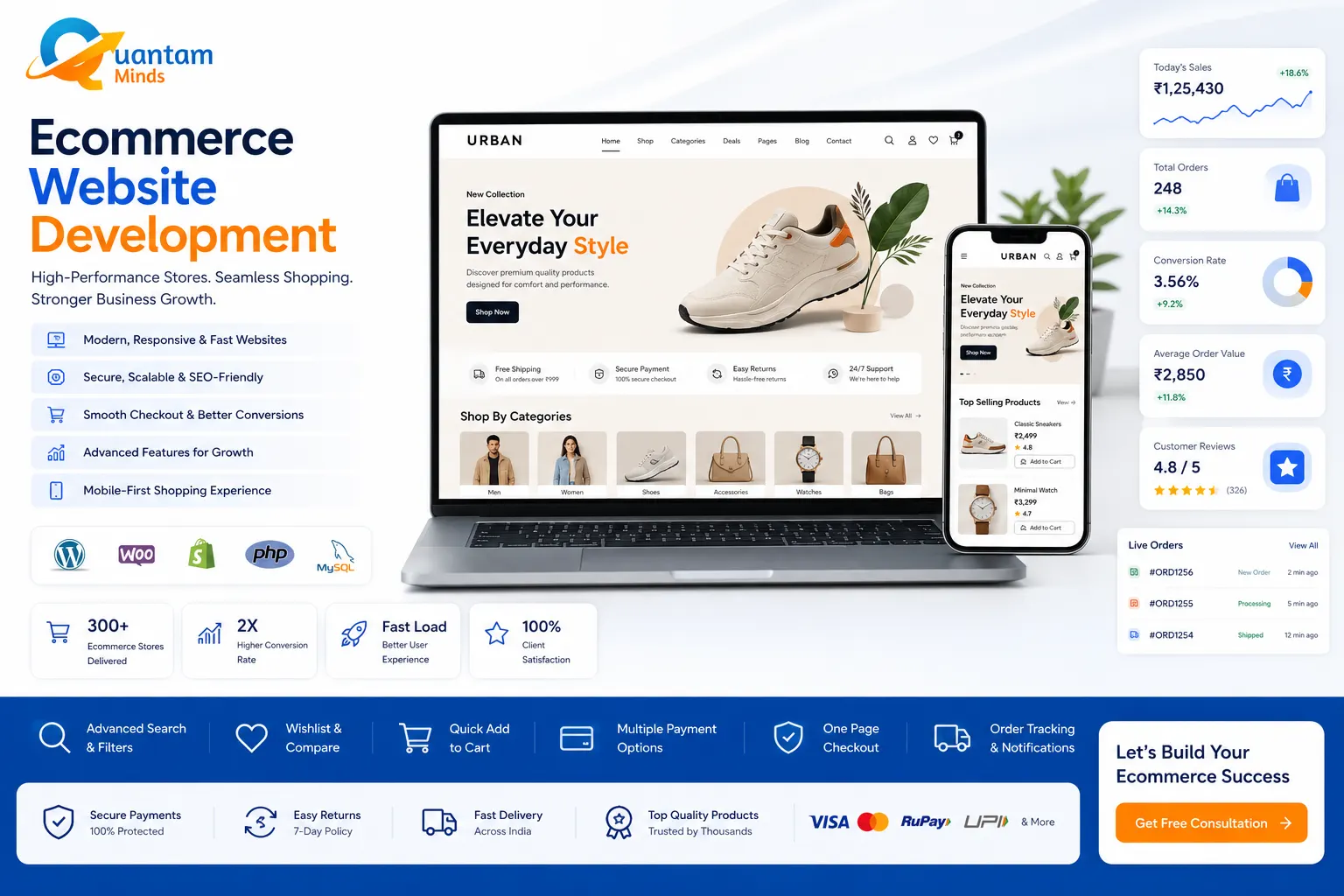
10+
Years of Digital Excellence
More Than A Marketing Agency. Your Growth Partner.
We don't simply build websites or run campaigns. We create complete digital ecosystems that help businesses attract customers, automate operations, improve conversions, and scale with confidence.
Strategy First
Every project begins with understanding your business objectives.
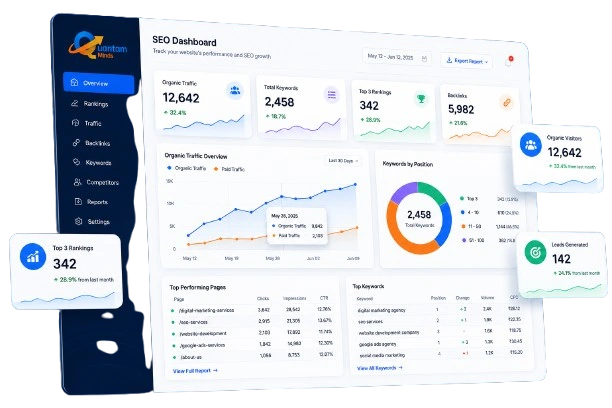
In-House Development
Websites, CRM, ERP and custom software under one roof.
Performance Driven
Every campaign is optimized using measurable KPIs.
AI Automation
Save time through intelligent automation and workflows.
Dedicated Support
Real experts available whenever you need assistance.
Long-Term Partnership
We grow alongside your business, not just deliver projects.
Our Ecommerce Website Development Process Is Built Around Strategy, Scalability, and Long-Term Business Growth
Launching an ecommerce website is not the same as building a successful ecommerce business.
A store can go live within a few weeks, yet still struggle with low conversions, operational inefficiencies, or poor customer retention because the planning behind it was incomplete.
That is why our Ecommerce Website Development Services begin long before design or development starts. Every project follows a structured process designed to understand your business, reduce implementation risks, improve customer experience, and create an online store that continues supporting growth long after launch.
Whether you're planning Shopify Website Development, WooCommerce Website Development, or a fully Custom Ecommerce Website Development solution, every stage is built around measurable business outcomes rather than simply delivering another website.
Step 1 — Business Discovery and Ecommerce Strategy
Understand the Business Before Choosing the Technology
Every ecommerce business operates differently.
A D2C fashion brand has different priorities than a B2B manufacturer. A healthcare company selling wellness products requires a different customer journey than a furniture retailer or electronics brand.
Before recommending platforms or features, we invest time understanding your business.
Our discovery process typically explores:
- Business goals and future growth plans
- Target audience and customer personas
- Product catalogue structure
- Current sales channels
- Existing operational bottlenecks
- Customer buying behaviour
- Inventory workflow
- Order fulfilment process
- Marketing objectives
- Future scalability requirements
Sometimes the biggest opportunity isn't adding new functionality.
It's simplifying existing business processes.
Business Impact:
This stage ensures every development decision supports long-term business objectives instead of solving only today's requirements.
Step 2 — Market Research and Ecommerce Planning
Build Around Customer Behaviour Instead of Competitor Assumptions
Competitor research should inspire better decisions—not duplicate existing stores.
We study how customers interact with competing ecommerce businesses to understand what creates confidence, where users experience friction, and which opportunities remain underserved.
Research typically includes:
- Competitor website evaluation
- Product presentation analysis
- Customer journey assessment
- Checkout experience comparison
- Search visibility review
- Pricing presentation
- Trust-building elements
- Category architecture
- Mobile usability
Instead of asking,
"How can we build something similar?"
We ask,
"How can we create a smoother buying experience?"
Business Impact:
Understanding customer expectations early helps reduce unnecessary complexity while creating opportunities to differentiate your online store.
Step 3 — Ecommerce Architecture and User Experience Planning
Design the Customer Journey Before Designing the Website
Before visual design begins, we create the structure that customers will actually experience.
This includes planning:
| Planning Area | Business Benefit |
|---|---|
| Website architecture | Creates logical navigation |
| Category hierarchy | Makes products easier to discover |
| Product structure | Improves shopping experience |
| Customer journey mapping | Reduces purchase friction |
| Checkout flow | Improves conversion potential |
| Feature prioritisation | Focuses development on business value |
| SEO architecture | Supports long-term organic growth |
| Integration planning | Simplifies business operations |
Well-planned architecture often prevents expensive redevelopment later while making the website easier for both customers and search engines to understand.
Business Impact:
Good planning creates a smoother shopping experience while supporting future marketing, SEO, and business expansion.
Step 4 — UI Design and Ecommerce Development
Build an Online Store That Supports Customers and Business Operations
Once the strategy has been approved, design and development begin together.
Every interface is created to support real purchasing behaviour rather than simply looking modern.
Depending on business requirements, development may include:
- Shopify Website Development
- WooCommerce Website Development
- Custom Ecommerce Website Development
- Product management systems
- Customer accounts
- Wishlist functionality
- Secure payment gateways
- Shipping configuration
- Inventory management
- Third-party integrations
- CRM connectivity
- Marketing automation
- SEO-ready development
- Mobile-first optimisation
Our objective is never to overload the website with unnecessary functionality.
Instead, we prioritise features that improve customer experience while making daily business operations easier.
Business Impact:
A well-developed ecommerce website supports both revenue generation and operational efficiency as the business grows.
Step 5 — Testing, Quality Assurance, and Performance Optimisation
Ensure Every Customer Interaction Works Smoothly Before Launch
A visually complete website is not necessarily ready for customers.
Before launch, we perform extensive testing to identify issues that could affect customer confidence or purchasing behaviour.
Quality assurance includes:
- Mobile responsiveness
- Browser compatibility
- Product functionality
- Payment gateway testing
- Shipping workflow validation
- Checkout testing
- Search functionality
- Product filters
- Performance optimisation
- Security review
- Cross-device testing
We also optimise:
- Website speed
- Image performance
- Core Web Vitals
- Mobile loading
- Code efficiency
- Scalable infrastructure
Business Impact:
Testing reduces avoidable launch issues while improving customer experience, conversion potential, and long-term website stability.
Step 6 — Website Launch and Marketing Readiness
Launch with Confidence and Prepare for Customer Acquisition
Launching an ecommerce website is the beginning of measurable business growth—not the end of the project.
Before launch we verify that every important system works together correctly, including:
- Product catalogue
- Payments
- Shipping
- Customer accounts
- Analytics
- Tracking
- SEO foundations
- Security
- Integrations
The website is also prepared to support future marketing activities including:
- SEO Services
- Google Ads Services
- Email Marketing
- Social Media Marketing
- Conversion optimisation
- Remarketing campaigns
Business Impact:
A structured launch creates a stronger foundation for customer acquisition while reducing post-launch disruptions.
Step 7 — Post-Launch Support and Continuous Ecommerce Growth
Improve the Website Using Real Customer Behaviour
The most successful ecommerce businesses treat their website as a continuously improving business asset.
Customer behaviour often reveals opportunities that planning alone cannot predict.
Over time we help businesses improve:
- Product performance
- Category optimisation
- Customer journeys
- Checkout completion
- Website speed
- Conversion rates
- Customer retention
- Repeat purchase behaviour
- Marketing integrations
- Platform updates
- Security
- Feature enhancements
Real improvements are guided by analytics rather than assumptions.
Business Impact:
Continuous optimisation helps businesses increase customer lifetime value, improve operational efficiency, strengthen organic visibility, and create sustainable ecommerce growth.
Our 7-Step Ecommerce Website Development Framework
| Stage | Primary Objective |
|---|---|
| Business Discovery | Understand business goals, customers, and operational requirements |
| Market Research | Analyse competitors, customer behaviour, and growth opportunities |
| UX & Architecture Planning | Create a customer-focused shopping experience and scalable website structure |
| Design & Development | Build a secure, mobile-friendly, SEO-ready ecommerce platform |
| Testing & Optimisation | Improve speed, functionality, security, and customer experience |
| Launch & Marketing Readiness | Prepare the website for SEO, paid advertising, and customer acquisition |
| Growth & Continuous Optimisation | Improve performance using real customer behaviour and business insights |
Which Ecommerce Platform Is Right for Your Business?
One of the first questions businesses ask before starting an Ecommerce Website Development project is:
"Should we choose Shopify, WooCommerce, or build a completely custom ecommerce platform?"
It's an important question—but not the first one that should be answered.
A better starting point is understanding how your business operates today, where you expect it to grow over the next few years, and what kind of shopping experience your customers expect.
We've seen businesses invest in platforms with hundreds of features they never use. We've also worked with growing brands that quickly outgrew entry-level solutions because their operations became more complex than originally planned.
Neither situation creates long-term value.
The right platform should support your products, your team, your customers, and your future expansion—not simply offer the longest feature list.
Whether you're planning to create an ecommerce website for the first time or replacing an existing online store, choosing the right platform early can reduce redevelopment costs, simplify operations, and provide a stronger foundation for long-term growth.
Shopify Website Development
A Strong Choice for Fast-Growing Direct-to-Consumer Brands
Shopify Website Development has become one of the most widely adopted ecommerce solutions because it allows businesses to launch quickly without worrying about server management, software updates, or infrastructure maintenance.
Instead of spending time managing technical systems, businesses can focus on products, marketing, fulfilment, and customer experience.
Shopify is particularly well suited for brands that want:
- Faster website launches
- Easy day-to-day management
- Secure cloud hosting
- Mobile-friendly shopping experiences
- Multi-channel selling
- Social commerce integration
- Marketplace connectivity
- Large app ecosystem
- Reliable scalability
For many startups and growing D2C brands, Shopify provides an excellent balance between simplicity and long-term flexibility.
An experienced Shopify website developer, Shopify web developer, or Shopify web designer can also customise the platform well beyond standard themes, creating a store that reflects your brand instead of looking like every other Shopify website.
Shopify Is Often Ideal For
- Fashion brands
- Beauty businesses
- Lifestyle products
- Consumer electronics
- Home décor
- Health and wellness products
- Subscription businesses
- Direct-to-consumer ecommerce brands
WooCommerce Website Development
Greater Flexibility for Content-Driven Businesses
Businesses already operating on WordPress often prefer WooCommerce Website Development because it combines ecommerce functionality with one of the world's most flexible content management systems.
This makes WooCommerce particularly valuable for businesses where content marketing plays a major role in customer acquisition.
For example:
A company publishing buying guides, comparison articles, educational resources, FAQs, and long-form product information often benefits from the close relationship between SEO and ecommerce that WordPress provides.
WooCommerce is commonly selected by businesses requiring:
- Flexible website customisation
- Strong blogging capabilities
- SEO-focused content marketing
- Moderate custom functionality
- Greater design freedom
- Lower initial platform costs
Unlike hosted platforms, WooCommerce requires businesses to manage hosting, updates, backups, and security more actively.
That additional responsibility also provides greater control over how the website operates.
WooCommerce Is Often Ideal For
- Small and medium businesses
- Content-first brands
- Professional service businesses
- Educational businesses
- Healthcare companies
- Manufacturers
- Businesses already using WordPress
Custom Ecommerce Website Development
Build the Platform Around Your Business Instead of Changing Your Business for the Platform
Some ecommerce businesses simply don't fit inside standard software.
They may require:
- Customer-specific pricing
- Dealer portals
- B2B ordering systems
- Subscription billing
- Multi-vendor marketplaces
- ERP integration
- CRM connectivity
- Advanced inventory management
- Warehouse automation
- Manufacturing workflows
- Complex product configuration
- Industry-specific approval processes
Trying to force those requirements into a standard ecommerce platform often creates unnecessary operational complexity.
This is where Custom Ecommerce Website Development becomes the more practical investment.
Rather than adapting your business processes to software limitations, the website is designed around the way your organisation actually operates.
Although custom development generally requires more planning and a larger initial investment, it often provides greater long-term operational efficiency for businesses with specialised requirements.
Custom Development Is Often Ideal For
- Enterprise organisations
- Manufacturers
- B2B ecommerce
- Industrial suppliers
- Wholesale businesses
- Healthcare organisations
- Marketplace businesses
- Multi-location retailers
- Businesses expecting significant long-term growth
Platform Comparison at a Glance
| Decision Factor | Shopify Website Development | WooCommerce Website Development | Custom Ecommerce Website Development |
|---|---|---|---|
| Best For | Startups, D2C brands, retailers | SMEs, WordPress websites, content-driven businesses | Enterprises, manufacturers, B2B businesses |
| Launch Speed | Excellent | Good | Depends on project scope |
| Ease of Management | Excellent | Moderate | Custom workflow |
| Design Flexibility | High | Very High | Unlimited |
| Business-Specific Features | Moderate | High | Fully customised |
| SEO Potential | Strong | Excellent | Built around advanced SEO strategy |
| Scalability | Excellent | Strong | Designed specifically for future growth |
| Third-Party Integrations | Extensive | Extensive | Unlimited |
| Maintenance | Low | Moderate | Depends on infrastructure |
| Long-Term Flexibility | High | Very High | Complete flexibility |
Platform Cost Should Never Be the Only Decision
Many businesses begin by searching for:
- ecommerce website price
- ecommerce website development cost
- Shopify website cost
- WooCommerce development pricing
Those are reasonable questions.
But focusing only on initial development cost often creates expensive problems later.
A platform with a lower upfront investment may eventually require:
- Additional plugins
- Custom integrations
- Performance upgrades
- Platform migration
- Operational workarounds
- Increased maintenance
Likewise, investing in enterprise-level functionality before the business actually needs it may increase costs without creating immediate business value.
The goal should be identifying the platform that delivers the greatest long-term return rather than simply the lowest development cost.
Think About the Business You'll Become
Choosing an ecommerce platform should never be based only on today's requirements.
It's equally important to consider where your business is heading.
Questions worth asking include:
- Will your product catalogue grow significantly?
- Do you expect international expansion?
- Will you sell through marketplaces and social commerce?
- Are multiple warehouses likely in the future?
- Will CRM or ERP integration become important?
- Do you expect wholesale customers alongside retail buyers?
- Will automation become part of your operations?
- Is SEO expected to become a major acquisition channel?
The answers often influence platform selection more than technical specifications.
There Is No Universal "Best" Ecommerce Platform
Businesses often ask which platform we recommend most frequently.
The honest answer is:
It depends on the business.
A startup launching its first online store has completely different priorities than an established manufacturer managing thousands of SKUs. A healthcare company selling regulated products operates differently from a fashion retailer running seasonal promotions. A B2B wholesaler requires functionality that many D2C brands will never need.
As an experienced Ecommerce Website Development Company, we don't recommend the same platform for every client.
We recommend the solution that aligns with your products, operations, customer expectations, marketing strategy, and long-term business objectives.
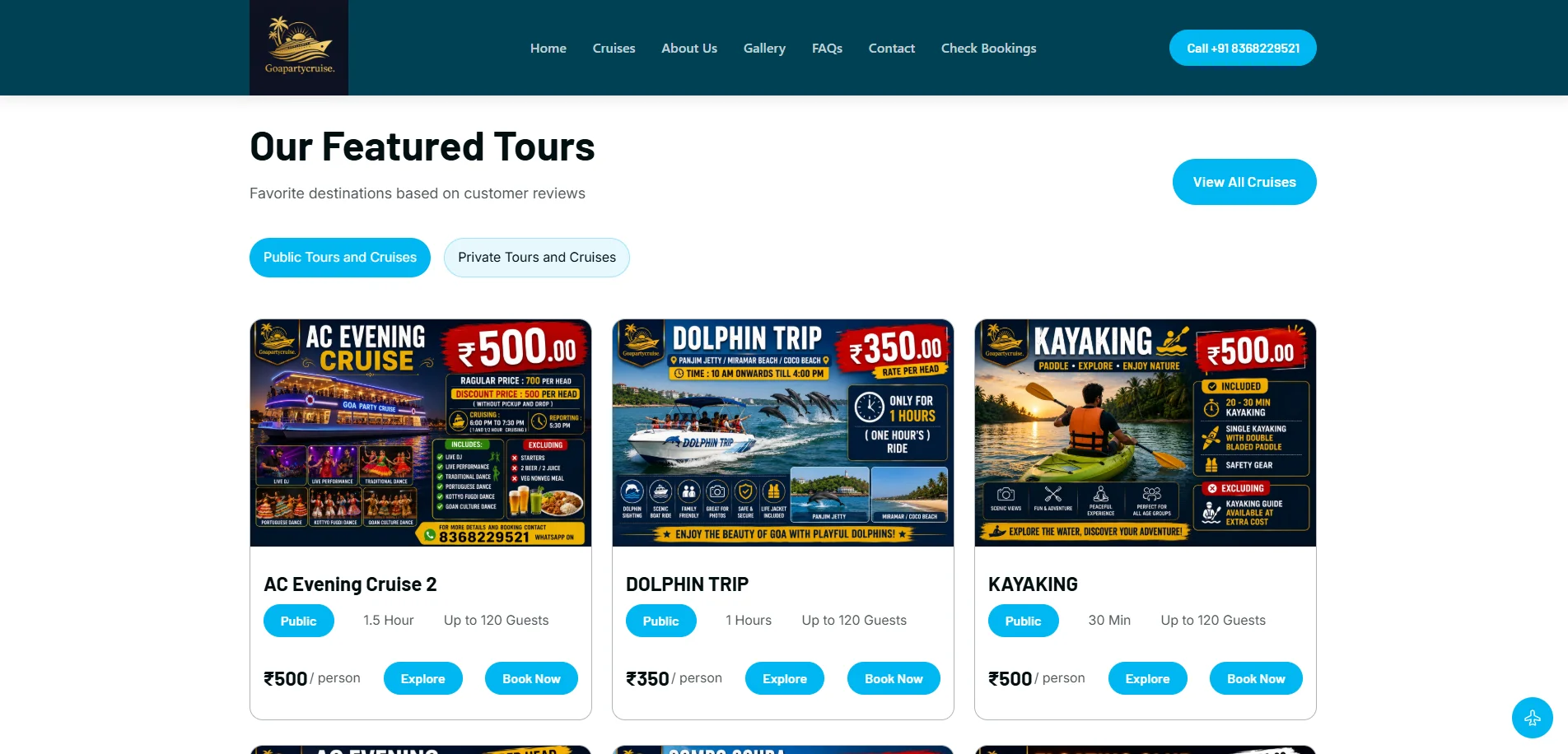
Sometimes that's Shopify Website Development.
Sometimes WooCommerce Website Development provides greater flexibility.
For businesses with specialised operational requirements, Custom Online Store Development often becomes the strongest long-term investment.
The best ecommerce platform isn't the one with the most features.
It's the one that helps your business operate more efficiently, creates a better shopping experience, supports future growth, and gives you the flexibility to adapt as your business continues to evolve.
Why Growing Companies Choose Quantam Minds
We combine technology, strategy, creativity and measurable execution to help ambitious businesses build stronger brands, attract more customers and achieve long-term digital growth.
1545+
Projects Delivered174+
Business Clients10+
Years Experience98%
Client SatisfactionIndustries We Help Grow Through Ecommerce Website Development
No two ecommerce businesses succeed by following exactly the same formula.
A fashion brand competes through branding, product presentation, and customer loyalty. An electronics retailer wins by helping customers compare specifications and make informed buying decisions. A manufacturer often focuses on dealer networks, quotations, and bulk orders rather than individual purchases. Even two businesses selling similar products can require completely different ecommerce strategies because their customers search differently, compare differently, and complete purchases for different reasons.
That is why we approach every Ecommerce Website Development project with a business-first mindset instead of beginning with templates or predefined features.
Our Ecommerce Website Development Services are designed around how customers behave within each industry, helping businesses build online stores that support sales, operations, customer experience, and long-term growth. Whether you're launching a new online business or modernizing an existing store, the goal remains the same—create an ecommerce platform that works the way your business actually operates.
Fashion and Apparel Brands
Create Shopping Experiences That Encourage Repeat Purchases
Fashion ecommerce is driven by discovery, inspiration, and convenience.
Customers often browse multiple collections before purchasing. They compare colours, sizes, fabrics, pricing, delivery timelines, and customer reviews while expecting a smooth shopping experience across mobile and desktop devices.
An effective fashion ecommerce website typically includes:
- Product variations
- Size guides
- Wishlist functionality
- Advanced product filters
- High-quality image galleries
- Customer reviews
- Quick checkout
- Personalized recommendations
Many growing fashion brands also combine Shopify Website Development with loyalty programmes, email marketing, and remarketing campaigns to increase repeat purchases and customer lifetime value.
Healthcare and Medical Businesses
Build Trust Before Customers Complete a Purchase
Healthcare ecommerce depends heavily on credibility.
Whether selling medical devices, healthcare products, wellness supplements, rehabilitation equipment, or personal care products, customers expect complete product information before making purchasing decisions.
A healthcare ecommerce website often includes:
- Structured product categories
- Detailed specifications
- Usage instructions
- Prescription workflows where applicable
- Secure payment systems
- Transparent delivery policies
- Mobile-friendly purchasing
- Easy customer support access
Even small improvements in product presentation can significantly improve customer confidence.
Beauty and Personal Care Brands
Help Customers Make Confident Buying Decisions
Beauty products involve research.
Customers frequently compare ingredients, benefits, skin compatibility, customer experiences, and product recommendations before purchasing.
Successful beauty ecommerce websites often include:
- Product bundles
- Subscription purchases
- Customer reviews
- Educational content
- Ingredient information
- Personalized product suggestions
- Before-and-after galleries
- Routine builders
When supported by Custom Ecommerce Website Development, these features create a shopping experience that encourages customer loyalty rather than one-time purchases.
Electronics and Technology Stores
Simplify Complex Purchase Decisions
Electronics customers rarely purchase impulsively.
They evaluate technical specifications, warranties, compatibility, pricing, and product comparisons before placing an order.
A professionally developed electronics ecommerce website commonly includes:
- Product comparison features
- Technical specifications
- Smart filtering
- Compatibility information
- Product recommendations
- Inventory visibility
- Accessory suggestions
- Technical documentation
As product catalogues grow, website organization becomes just as important as adding new products.
Grocery and Daily Essentials
Deliver Convenience Without Operational Complexity
Customers purchasing groceries expect speed and reliability.
They want products to be available, checkout to be simple, and delivery information to be accurate.
An effective grocery ecommerce platform often supports:
- Live inventory management
- Delivery slot selection
- Repeat ordering
- Location-based delivery
- Product categorization
- Fast mobile checkout
- Subscription purchases
- Promotional offers
As grocery businesses expand, operational efficiency becomes equally important as customer acquisition.
Furniture and Home Living Businesses
Support Longer Buying Journeys With Better Product Experiences
Furniture purchases involve careful research.
Customers compare dimensions, materials, colours, room compatibility, customization options, warranties, and delivery expectations before making a decision.
A strong furniture ecommerce website typically provides:
- Rich product galleries
- Lifestyle photography
- Material specifications
- Product customization
- Delivery estimators
- Collection recommendations
- Inquiry forms for bespoke products
- Room inspiration sections
Many furniture buyers complete much of their research online before ever visiting a showroom.
Fitness and Sports Businesses
Combine Product Sales With Community Engagement
Fitness businesses often sell more than products.
They may offer memberships, training programmes, nutrition products, activewear, supplements, equipment, and digital coaching.
A well-planned ecommerce platform may include:
- Membership integration
- Subscription products
- Product bundles
- Training resources
- Customer reviews
- Personalized recommendations
- Repeat purchase automation
- Loyalty programmes
When combined with SEO Services, Content Writing, Email Marketing, and Google Ads Services, ecommerce becomes a long-term customer engagement channel rather than simply a sales platform.
Restaurants and Food Businesses
Expand Revenue Beyond Traditional Dining
Restaurants increasingly diversify their business through ecommerce.
Many now sell:
- Packaged foods
- Signature sauces
- Bakery products
- Frozen meals
- Meal kits
- Beverages
- Gift hampers
- Branded merchandise
A successful online food store requires:
- Easy ordering
- Local delivery integration
- Product availability
- Delivery scheduling
- Secure payments
- Mobile-first checkout
The ecommerce platform should support restaurant operations without adding unnecessary complexity.
Education and Coaching Businesses
Turn Knowledge Into Scalable Digital Products
Educational businesses increasingly generate revenue beyond classroom learning.
Training institutes, coaching centres, consultants, and educators now sell:
- Online courses
- Certifications
- Digital downloads
- Practice material
- E-books
- Memberships
- Recorded classes
- Learning resources
Unlike traditional retail ecommerce, education platforms often require:
- Student accounts
- Protected content
- Subscription management
- Progress tracking
- Secure access controls
- Integrated payment systems
The ecommerce platform becomes both a learning environment and a business asset.
Manufacturing and Industrial Businesses
Simplify Product Discovery for Business Buyers
Manufacturers increasingly use ecommerce to improve product accessibility and streamline enquiries.
Industrial buyers now research suppliers online before requesting quotations or placing orders.
Manufacturing ecommerce websites often include:
- Product catalogues
- Technical documentation
- Bulk ordering
- Dealer portals
- Quotation requests
- Customer-specific pricing
- Inventory visibility
- Downloadable specifications
For many manufacturers, ecommerce improves both customer experience and internal sales efficiency.
B2B Ecommerce Businesses
Build Platforms Around Complex Buying Processes
Business-to-business ecommerce follows a very different purchasing journey from consumer retail.
Orders frequently involve multiple decision-makers, negotiated pricing, recurring purchases, approval workflows, and long-term customer relationships.
A Custom Ecommerce Website Development solution for B2B businesses may include:
- Role-based user accounts
- Customer-specific pricing
- Purchase approvals
- Bulk ordering
- Credit account management
- CRM integration
- ERP connectivity
- Dealer management portals
- Account dashboards
Rather than adapting business processes to fit standard software, custom platforms are developed around existing operational workflows.
D2C Brands and Consumer Product Companies
Build a Brand Customers Return To
Direct-to-consumer businesses compete on more than pricing.
They compete on customer experience, brand identity, convenience, and post-purchase engagement.
An effective D2C ecommerce website supports:
- Brand storytelling
- Subscription purchases
- Product recommendations
- Loyalty programmes
- Customer accounts
- Personalized offers
- Email automation
- Repeat purchase campaigns
Many fast-growing consumer brands choose Shopify Website Development because it combines scalability with a streamlined shopping experience.
Local Businesses Expanding Beyond Walk-In Customers
Reach Customers Wherever They Choose to Shop
Local businesses are no longer limited to neighbourhood foot traffic.
Customers increasingly search online, compare products, and expect convenient ordering options before visiting a physical store.
Whether you operate a:
- Medical store
- Boutique
- Gift shop
- Pet supply business
- Bookstore
- Electronics retailer
- Home décor outlet
- Specialty food business
A professionally developed ecommerce website helps expand your reach while supporting services such as SEO Services, Google Business Profile Optimization, Google Ads Services, and local digital marketing campaigns.
Startups Launching Their First Online Store
Build Scalable Ecommerce Foundations From Day One
Startups often need more than a basic online store.
They need a platform capable of supporting product validation, customer acquisition, marketing automation, and future growth without requiring frequent redevelopment.
Our Custom Online Store Development approach helps startups launch with:
- Scalable architecture
- Conversion-focused design
- Secure payment integration
- Analytics implementation
- Marketing readiness
- SEO-friendly structure
- Flexible product management
- Future expansion capabilities
Building the right foundation early often reduces redevelopment costs as the business grows.
Every Industry Needs a Different Ecommerce Strategy
The technology behind ecommerce may appear similar.
The customer journey rarely is.
A fashion retailer and an industrial supplier may both sell online, but the way their customers research products, compare options, build trust, and complete purchases is entirely different. A grocery business prioritizes speed and convenience, while a B2B manufacturer may focus on quotations, repeat orders, and account-based purchasing.
That is why every Ecommerce Website Development project begins by understanding the business before recommending a platform.
As an experienced Ecommerce Website Development Company, we don't believe every business should receive the same features, templates, or development approach. Instead, we evaluate your products, operations, customers, and long-term goals to recommend the most suitable solution—whether that's Shopify Website Development, WooCommerce Website Development, or a fully Custom Ecommerce Website Development strategy.
The result is an online store designed around your industry, your customers, and your future growth rather than a generic ecommerce website that simply looks good but struggles to support real business performance.
Fitness businesses are increasingly expanding beyond memberships by selling supplements, merchandise, training plans, and digital programs online. Explore how our Digital Marketing for Gyms solutions help fitness brands attract more members while building additional revenue through effective digital strategies.
Why Businesses Choose Quantam Minds for Ecommerce Website Development
Choosing an ecommerce development partner isn't only about finding someone who can build a website.
It's about finding a team that understands how ecommerce affects customer acquisition, operations, marketing, and long-term business growth.
Many businesses come to us after investing in websites that looked impressive but struggled to support real commercial goals. Products were difficult to manage. Marketing campaigns generated traffic but not enough sales. Integrations became increasingly complex. As the business expanded, the website that once seemed sufficient gradually became a limitation instead of an advantage.
That experience has become increasingly common.
At Quantam Minds, we approach Ecommerce Website Development differently. Every recommendation begins with understanding your business model, customer journey, operational processes, and future growth plans before discussing platforms, themes, or features.
Our objective isn't simply to launch another online store.
It's to help you build a scalable ecommerce business that continues creating value long after development is complete.
We Begin With Business Strategy Before Development
Technology should solve business problems.
It shouldn't create new ones.
Every ecommerce project starts with understanding questions that influence long-term success:
- What are your primary business objectives?
- How do customers currently discover your products?
- Which products generate the highest margins?
- Where are customers leaving before completing purchases?
- Which operational tasks consume unnecessary time?
- What marketing channels will support future growth?
- How will the business scale over the next few years?
This discovery process allows us to recommend the right Custom Ecommerce Website Development strategy instead of applying the same solution to every client.
Many expensive redevelopment projects can be avoided simply by asking the right questions before development begins.
We Recommend Platforms Based on Business Fit, Not Popularity
Every ecommerce platform has strengths.
The important question is whether those strengths match your business.
Some businesses benefit from the simplicity and scalability of Shopify Website Development.
Others need the flexibility offered by WooCommerce Website Development.
Companies with complex workflows, dealer networks, subscription models, or advanced integrations often benefit more from Custom Online Store Development.
Rather than promoting one platform for every project, we evaluate:
| Business Consideration | Why It Matters |
|---|---|
| Product catalogue size | Influences platform scalability |
| Business model | B2B, B2C, D2C, subscriptions, wholesale |
| Marketing strategy | SEO, paid advertising, marketplaces, social commerce |
| Operational workflows | Inventory, fulfilment, CRM, ERP integrations |
| Future expansion | Multi-store, international growth, automation |
| Internal resources | Technical management and ongoing maintenance |
The goal is selecting technology that supports your business—not forcing your business to fit the technology.
Customer Experience Is Designed Around Conversions
An ecommerce website should make purchasing feel simple.
Customers shouldn't have to think about navigation, filters, checkout steps, or finding important information.
When the experience feels effortless, customers are far more likely to complete their purchase.
Our Ecommerce Website Development Services focus on improving every stage of the buying journey through:
- Mobile-first shopping experiences
- Clear product organization
- Faster navigation
- Simplified checkout
- Strong product presentation
- Trust-building design
- Product recommendations
- Easy account management
- Clear calls-to-action
Rather than chasing design trends, we focus on reducing friction that quietly prevents customers from buying.
SEO Is Built Into the Website From Day One
Many ecommerce websites treat SEO as an afterthought.
By then, changing category structures, URLs, internal linking, or navigation often becomes far more complicated.
We build websites with long-term search visibility in mind by implementing:
- SEO-friendly architecture
- Clean URL structures
- Optimized category hierarchy
- Internal linking strategy
- Mobile optimization
- Fast page performance
- Structured data readiness
- Crawl-friendly navigation
When combined with SEO Services, Content Writing, and ongoing optimization, these foundations help businesses build sustainable organic visibility instead of depending entirely on advertising.
Performance Matters More Than Most Businesses Realize
Customers rarely compliment a fast website.
They simply continue shopping.
Slow websites create a very different experience.
Visitors leave.
Shopping carts are abandoned.
Advertising costs increase.
Search visibility becomes harder to improve.
Our development process focuses on performance through:
- Lightweight development
- Optimized media
- Fast page rendering
- Responsive layouts
- Efficient database structure
- Secure infrastructure
- Mobile performance optimization
A fast website benefits every marketing channel, from organic search and Google Ads to email campaigns and social media traffic.
Every Store Is Built to Grow With Your Business
Many online stores work well during the first year.
The challenges often appear later.
Product catalogues expand.
Orders increase.
Marketing becomes more sophisticated.
Additional software integrations become necessary.
Customer expectations continue changing.
Our Ecommerce Web Development approach emphasizes scalability from the beginning by considering:
- Future product expansion
- Marketing automation
- Multi-channel selling
- Inventory management
- Customer segmentation
- Third-party integrations
- Performance under higher traffic
- Operational efficiency
Planning for growth early often reduces redevelopment costs later.
Transparency Is Part of Every Project
Business owners make better decisions when they understand the reasoning behind them.
That is why we believe in discussing:
- Realistic project timelines
- Platform advantages and limitations
- Expected development scope
- Feature priorities
- Long-term maintenance considerations
- Future scalability
If a simpler solution is sufficient, we'll recommend it.
If a custom solution provides greater long-term value, we'll explain why.
The objective is not to increase project scope unnecessarily.
It's to recommend what genuinely supports your business.
Our Relationship Continues After Launch
Launching your ecommerce website is only the beginning.
Once customers begin interacting with the store, valuable insights become available.
Businesses often discover:
- Popular products
- High-performing categories
- Checkout friction
- Customer behaviour patterns
- Repeat purchase opportunities
- Marketing improvements
We continue supporting businesses through:
- Feature enhancements
- Performance optimization
- Security updates
- Platform maintenance
- Product management improvements
- Conversion optimization
- Technical guidance
- Growth planning
The strongest ecommerce businesses rarely stay unchanged.
They continue improving as customer expectations evolve.
Decisions Are Guided by Real Customer Behaviour
Assumptions often lead to unnecessary changes.
Customer behaviour provides much clearer direction.
We help businesses evaluate:
- Which products attract the most engagement?
- Which pages generate the highest conversions?
- Where do customers abandon checkout?
- Which devices convert better?
- Which marketing channels generate repeat buyers?
- What opportunities exist to improve customer retention?
These insights allow improvements to be based on evidence rather than guesswork.
Small optimizations implemented consistently often produce stronger long-term business results than occasional major redesigns.
Your Ecommerce Website Should Support Your Entire Digital Marketing Strategy
An ecommerce website performs best when it becomes the centre of a connected digital ecosystem rather than operating independently.
Depending on your business goals, we integrate your ecommerce platform with broader digital growth services.
| Digital Growth Solution | Business Benefit |
|---|---|
| SEO Services | Improve organic search visibility and attract high-intent customers. |
| Google Ads Services | Generate qualified traffic from customers actively searching for your products. |
| Social Media Marketing | Increase brand awareness and drive product discovery across social platforms. |
| Content Writing | Build customer trust while strengthening search visibility and product education. |
| Email Marketing | Encourage repeat purchases, abandoned cart recovery, and customer retention. |
| WhatsApp Marketing | Improve customer communication through order updates and promotional campaigns. |
| Lead Generation Services | Capture enquiries and nurture prospects before they become customers. |
| Google Business Profile Optimization | Strengthen local visibility for businesses with physical locations. |
| Online Reputation Management | Build trust through authentic customer reviews and stronger brand credibility. |
When these channels work together, customer acquisition becomes more efficient and long-term marketing investments often deliver greater value.
Businesses Choose Quantam Minds Because We Build for Long-Term Growth
Launching an ecommerce website is relatively straightforward.
Building an online business that continues growing year after year requires a different approach.
As an experienced Ecommerce Website Development Company and Ecommerce Website Development Agency, we focus on creating digital commerce platforms that balance customer experience, operational efficiency, scalability, and measurable business outcomes. Whether your business needs Shopify Website Development, WooCommerce Website Development, or fully Custom Ecommerce Website Development, our recommendations are shaped by your business goals rather than predefined packages.
We don't measure success by the day a website goes live.
We measure it by how effectively that website helps your business attract customers, improve conversions, streamline operations, support marketing initiatives, and continue evolving as your business grows.
Because the strongest ecommerce websites aren't simply well designed.
They're built to become long-term business assets.
A successful ecommerce business relies on more than just a great website. Combining Social Media Marketing, professional Graphic Designing, and the strategic expertise of a Digital Marketing Agency in Sonipat helps businesses strengthen their brand, reach new audiences, and create a more consistent customer experience across every digital channel.
Understanding Ecommerce Website Development Cost and What Actually Influences the Investment
One of the first questions every business owner asks is:
"How much does an ecommerce website cost?"
It's a practical question, but the answer is rarely straightforward.
A startup launching its first online store has very different requirements from a retailer managing thousands of products. Likewise, a manufacturer selling to distributors requires completely different functionality than a fashion brand focused on direct-to-consumer sales.
Although both businesses require Ecommerce Website Development, the planning, technology, integrations, and long-term maintenance involved are entirely different.
This is why the ecommerce website development cost depends less on the number of pages being built and more on the business objectives the website is expected to support.
Rather than viewing development as a one-time expense, it is often more useful to think of it as an investment in a digital asset that can support sales, marketing, operations, and customer relationships for many years.
Business Goals Define the Overall Project Scope
Every ecommerce business has different priorities.
Some businesses simply want to start selling online.
Others are planning to:
- Launch a direct-to-consumer brand
- Replace marketplace dependency
- Expand internationally
- Automate order management
- Build customer loyalty
- Support B2B purchasing
- Integrate multiple sales channels
The broader the objectives become, the more comprehensive the development strategy usually needs to be.
Why It Matters
A website designed only for today's requirements may require significant redevelopment as the business grows. Planning around future business goals often creates better long-term value than focusing only on the initial launch.
Platform Selection Influences Both Initial and Long-Term Investment
One of the biggest factors affecting pricing is the platform itself.
Different platforms involve different development approaches, licensing models, maintenance requirements, and scalability.
For example:
| Platform | Typical Business Fit |
|---|---|
| Shopify Website Development | Businesses seeking faster deployment, lower technical management, and scalable hosted infrastructure. |
| WooCommerce Website Development | Businesses using WordPress that require flexibility and content-driven ecommerce. |
| Custom Ecommerce Website Development | Businesses needing specialized workflows, advanced integrations, or enterprise-level functionality. |
Why It Matters
Choosing the right platform isn't simply about launch cost.
It also affects future maintenance, expansion possibilities, operational efficiency, and ongoing ownership costs.
Custom Functionality Has a Major Impact on Development Cost
Basic ecommerce functionality includes products, shopping carts, secure checkout, and payment processing.
Many businesses require considerably more.
Examples include:
- Dealer portals
- Subscription billing
- Customer-specific pricing
- Membership platforms
- Marketplace functionality
- Product configurators
- Booking systems
- Loyalty programmes
- Quotation workflows
- Advanced customer dashboards
Each additional feature requires planning, user experience design, development, testing, and long-term support.
Why It Matters
Custom functionality often provides operational advantages, but it also increases project complexity and development effort.
Product Catalogue Size Changes Development Requirements
The number of products affects much more than data entry.
Larger catalogues require:
- Better category planning
- Product attribute management
- Advanced search functionality
- Smart filtering
- Variant management
- Bulk product imports
- Inventory synchronization
- Performance optimization
A store selling 75 products requires a very different architecture than one managing 20,000 SKUs.
Why It Matters
As product catalogues grow, website structure becomes increasingly important for customer experience, operational efficiency, and search visibility.
Third-Party Integrations Improve Efficiency but Increase Project Scope
Modern ecommerce businesses rarely operate using the website alone.
Many require integrations with existing business systems such as:
- CRM platforms
- ERP software
- Inventory management
- Accounting software
- Shipping partners
- Marketing automation
- Email platforms
- WhatsApp automation
- SMS services
- Third-party APIs
These integrations reduce manual work and improve operational efficiency, but they also increase implementation complexity.
Why It Matters
Well-planned integrations often save hundreds of hours of manual work as businesses scale.
Payment Gateway Requirements Vary Between Businesses
Offering flexible payment options improves customer confidence.
Depending on your business model, your ecommerce website may support:
- UPI
- Credit & debit cards
- Net banking
- Digital wallets
- EMI payments
- Buy Now Pay Later (BNPL)
- International payments
- Multi-currency transactions
Certain payment providers require additional compliance, testing, or custom integration.
Why It Matters
Payment strategy influences both customer experience and overall development effort.
Design Complexity Should Support Sales, Not Just Appearance
Many businesses assume more design automatically creates a better website.
In reality, effective ecommerce design focuses on helping customers make purchasing decisions quickly and confidently.
Depending on your brand, the project may require:
- Custom UI/UX design
- Interactive product pages
- Premium branding
- Motion design
- Personalized shopping journeys
- Advanced product galleries
- Lifestyle presentation
- Mobile-first optimization
Other businesses benefit from a simpler, faster approach that emphasizes usability over visual complexity.
Why It Matters
Good design improves conversion rates.
Complex design without business purpose usually increases development cost without improving results.
SEO Is More Cost-Effective When Planned During Development
Many businesses think about SEO only after the website has launched.
By then, important structural changes become more time-consuming and expensive.
Planning SEO during Ecommerce Website Development allows technical foundations to be implemented from the beginning, including:
- Search-friendly URLs
- Logical category hierarchy
- Internal linking strategy
- Mobile optimization
- Technical SEO structure
- Schema markup
- Crawl-friendly navigation
- Product page optimization
Why It Matters
When combined with SEO Services and professional content, these foundations help reduce future optimization work while improving long-term organic visibility.
Security and Performance Are Long-Term Business Investments
Website performance directly influences customer experience.
Security protects customer trust.
Both should be considered during development rather than treated as optional upgrades later.
Planning often includes:
- SSL implementation
- Secure authentication
- Performance optimization
- Image optimization
- CDN configuration
- Backup systems
- Malware protection
- Server optimization
Why It Matters
A secure, fast ecommerce website supports better customer confidence, stronger SEO performance, and improved advertising efficiency.
Ongoing Maintenance Is Part of Website Ownership
Launching an ecommerce website is not the end of the project.
Businesses typically continue investing in:
- Security updates
- Platform upgrades
- Plugin management
- Product uploads
- Feature improvements
- Performance optimization
- Bug fixes
- Compatibility updates
Why It Matters
Regular maintenance helps prevent technical issues while keeping the website aligned with changing customer expectations and technology updates.
Planning for Growth Often Reduces Future Costs
One of the most common lessons growing businesses share is this:
Building only for today's requirements often leads to redevelopment much sooner than expected.
If your business plans to:
- Expand product categories
- Enter new markets
- Add warehouses
- Introduce automation
- Increase marketing investment
- Integrate additional software
- Sell internationally
…it is often more cost-effective to consider those possibilities during the planning stage.
Growth planning does not mean building every feature immediately.
It means building a foundation that can support future expansion without requiring a complete rebuild.
Factors That Commonly Influence Ecommerce Website Development Pricing
| Pricing Factor | Why It Influences Cost |
|---|---|
| Business Goals | Determines overall project scope and functionality requirements. |
| Platform Selection | Shopify, WooCommerce, and custom platforms involve different development approaches and maintenance models. |
| Product Catalogue Size | Larger catalogues require better architecture, filtering, and performance optimization. |
| Custom Features | Memberships, subscriptions, dealer portals, quotation systems, and custom workflows increase development effort. |
| Third-Party Integrations | CRM, ERP, shipping, accounting, and marketing integrations require additional planning and implementation. |
| Design Complexity | Custom UI/UX, interactive features, and premium branding increase design and development scope. |
| SEO Foundation | Technical SEO implementation during development supports long-term search visibility. |
| Payment Gateway Requirements | Multiple payment methods, international payments, and custom checkout flows increase implementation complexity. |
| Security & Performance | Advanced optimization and infrastructure planning improve scalability and customer experience. |
| Ongoing Maintenance | Future updates, enhancements, monitoring, and technical support should be considered as part of long-term ownership. |
Indicative Ecommerce Website Development Pricing
The figures below provide a general indication of how project requirements may influence investment. They are intended as planning estimates rather than fixed quotations.
| Project Scope | Indicative Investment |
|---|---|
| Ecommerce Website Development | Starting from ₹45,000 |
| Product Upload Assistance | ₹3,000 onwards |
| Premium UI/UX Design | ₹8,000 onwards |
| Shopify Website Development Setup & Configuration | ₹10,000 onwards |
| Advanced WooCommerce Website Development Configuration | ₹8,000 onwards |
| Custom Feature Development | ₹10,000 onwards |
| API Integration (per integration) | ₹5,000 onwards |
| CRM Integration | ₹7,500 onwards |
| ERP Integration | ₹15,000 onwards |
| Inventory Management Integration | ₹7,500 onwards |
| Shipping Partner Integration | ₹5,000 onwards |
| Additional Payment Gateway Integration | ₹5,000 onwards |
| WhatsApp Integration & Automation | ₹5,000 onwards |
| Email Marketing Integration | ₹5,000 onwards |
| SEO Foundation & Technical Setup | ₹7,500 onwards |
| Advanced Product Filters & Search | ₹8,000 onwards |
| Multi-language Support | ₹10,000 onwards |
| Multi-currency Functionality | ₹10,000 onwards |
| Marketplace / Multi-vendor Features | ₹30,000 onwards |
| Annual Website Maintenance (Optional) | Based on project requirements |
Disclaimer: The pricing above is indicative and intended to provide a general understanding of project scope. The final investment depends on multiple factors, including platform selection, business requirements, number of products, custom functionality, third-party integrations, design complexity, security requirements, and long-term growth objectives. A detailed consultation allows us to recommend the most suitable solution and provide an accurate project estimate based on your specific business needs.
Ready to Build an Ecommerce Website That Supports Long-Term Business Growth?
Every ecommerce business reaches a point where the next stage of growth depends on better systems, a stronger customer experience, and smarter digital decisions.
Whether you're planning to create ecommerce website for the first time, upgrade an existing online store, migrate to a new platform, or explore Custom Ecommerce Website Development, the decisions you make today can influence your business for years to come.
A well-planned ecommerce website isn't simply another marketing asset. It becomes the foundation for attracting customers, improving conversions, supporting repeat purchases, and integrating future digital initiatives such as SEO Services, Google Ads Management, Social Media Marketing, Email Marketing, and Lead Generation Services.
Before choosing a platform or requesting a quotation, it's worth discussing your business objectives, operational requirements, customer expectations, and long-term growth plans. In many cases, a short strategic conversation helps identify opportunities and potential challenges that are easy to overlook during the early planning stage.
If your goal is to build an online store that supports sustainable business growth rather than just launching another website, we'd be happy to understand your requirements and recommend an approach that fits your business.
Let's Start with a Conversation
Every project begins with understanding your business, not selling a predefined package.
During an initial consultation, we can discuss:
- Your business goals and ecommerce vision
- The most suitable platform for your requirements
- Shopify Website Development, WooCommerce Website Development, or a custom solution
- Customer experience and conversion opportunities
- SEO and digital marketing readiness
- Required integrations and future scalability
- Indicative project scope and development roadmap
Our recommendations are based on your business requirements, not a one-size-fits-all approach.
Why Businesses Choose to Work with Quantam Minds
- Business-first planning before development begins
- Tailored ecommerce solutions aligned with long-term objectives
- SEO-ready development with scalable architecture
- Transparent communication throughout the project
- Mobile-first and performance-focused development
- Integration with your broader digital marketing strategy
- Ongoing support as your business grows
- A collaborative approach focused on continuous improvement
Get in Touch
If you're exploring Ecommerce Website Development Services and want practical guidance before making a decision, we're here to help.
Quantam Minds
Address: Baba Colony, Sector 25, Sonipat, Haryana 131001
Phone: +91 798 2069 569
Email: contact@quantamminds.com
A successful ecommerce website is rarely the result of rushing into development.
It starts with understanding the business, planning for growth, and making informed decisions that continue creating value long after the website goes live. That's the approach we bring to every partnership, helping businesses build online stores that are prepared not only for today's opportunities but also for tomorrow's growth.
Everything You Need To Know Before Starting Your Project
We believe in complete transparency. Here are answers to the most common questions businesses ask before partnering with Quantam Minds.
Still Have Questions?
Talk directly with our experts and get personalized guidance for your business.
Learn, Grow & Stay Ahead
Explore expert insights, practical guides, industry trends, and digital strategies to help your business grow online.
Popular Topics
Explore 500+ Expert Articles On SEO, AI, Google Ads & Web Development
Practical guides, industry insights, case studies, marketing strategies, AI trends, and technical tutorials written to help businesses grow online.
Table of Contents
Navigate this pageLet's Build Something Amazing Together
Have a website, CRM, HRM, ERP or custom software requirement? Connect with our team and discuss your project goals today.
Office Address
Baba Colony, Sector 25, Sonipat, Haryana 131001
Call Us
+91 798 2069 569Email Us
contact@quantamminds.comWorking Hours
Monday - Saturday
09:00 AM - 07:00 PM
Need Immediate Assistance?
Chat directly with our development experts and get quick guidance.
WhatsApp Us