services

Meta Ads Agency for Qualified Leads, Sales & Business Growth

A Meta Ads agency helps businesses plan, launch, and optimize Facebook and Instagram advertising through audience research, conversion-focused creatives, retargeting, and performance tracking. The approach suits local businesses, ecommerce and D2C brands, gyms, clinics, restaurants, startups, coaching institutes, and real estate companies, helping improve qualified lead generation, sales, customer acquisition, and long-term digital growth through measurable, carefully managed campaigns.

1545+

Projects Delivered

174+

Business Clients

10+

Years Experience
  • Data-led campaign planning
  • Audience-first targeting
  • Facebook & Instagram expertise
  • Conversion-focused optimization
  • Transparent performance reporting
  • Continuous creative testing
paidadvertising

Meta Ads Services

Get expert guidance for your business.

TRUSTED DIGITAL GROWTH PARTNER

Trusted By 100+ Businesses Across Multiple Industries

From ambitious startups to established enterprises, Quantam Minds helps businesses generate qualified leads, improve online visibility, automate operations, and accelerate growth through strategic digital marketing, custom web development, AI-powered automation, and business software solutions.

Healthcare Real Estate Education Manufacturing Fitness Hospitality Ecommerce Retail Travel Professional Services Startups Corporate

Why Meta Ads Have Become Important for Modern Customer Acquisition

Customers do not always begin their buying journey by searching for a business. Increasingly, they discover products, services, offers, creators, and brands while scrolling through Facebook and Instagram. That makes paid social different from search advertising: search captures existing intent, while Meta Ads can help create and shape demand before someone actively looks for a solution.

From Search-First to Discovery-First Behaviour

Consider someone scrolling Instagram who sees a short video showing a new fitness studio, a skincare product, a restaurant experience, or a property walkthrough. They may not have searched for it five minutes earlier.

Explore our SEO Services to build long-term organic visibility alongside paid advertising.

The advertisement creates the first moment of awareness.

That distinction matters.

Google Search is often strongest when someone already knows what they want: “gym near me,” “skin clinic in Karnal,” “buy running shoes online.”

Meta can reach someone earlier:

“I didn't know this gym offered personal training.”
“That product solves the problem I've been dealing with.”
“That restaurant looks worth trying.”

This is discovery intent, and it gives businesses another opportunity to enter the customer journey.

Strengthen your social presence with strategic Social Media Marketing.

Visual-First and Mobile-First Discovery

Facebook and Instagram are naturally suited to visual communication. A product demonstration, before-and-after presentation where appropriate, property walkthrough, food image, trainer introduction, or short educational video can communicate something that a text advertisement cannot.

Mobile usage makes this even more important. Ads need to make sense quickly, load properly, and lead to a mobile-friendly experience.

For an ecommerce brand, that may mean a product-focused Reel leading directly to a product page. For a clinic, it could be educational content followed by a consultation enquiry. For a real estate business, a property video may create interest before the customer ever searches for the project by name.

Targeting Makes Discovery More Relevant

The value of Facebook and Instagram advertising is not simply reaching more people. It is reaching audiences that have a reasonable connection to the offer.

Campaigns can be structured around factors such as audience characteristics, interests where applicable, previous engagement, website activity, customer lists, and other available signals.

Create stronger campaign visuals with professional Graphic Designing services.

But targeting alone does not fix a weak campaign.

A relevant audience can still ignore an unclear offer or poor creative. Strong performance usually comes from the combination of audience + message + creative + offer + landing experience + measurement.

Retargeting Keeps the Journey Moving

Most people will not convert the first time they encounter a brand.

Someone may watch a product video, visit the website, browse a service, or add an item to their cart and leave.

Retargeting gives the business another opportunity to reconnect with that audience.

The journey becomes:

Awareness → Engagement → Consideration → Retargeting → Conversion

For example, an ecommerce customer might view a product but not purchase. A later, relevant ad can bring them back to the product page. A real estate prospect might watch a property video without enquiring, then receive another useful message about the project.

The purpose is not to repeatedly chase everyone. Good retargeting is selective and relevant.

Social Proof and Creative Presentation Matter

People often evaluate businesses through what they see before they contact them.

Reviews, customer experiences, demonstrations, testimonials, creator content, product visuals, educational videos, and consistent branding can reduce uncertainty.

This is particularly important for businesses where trust influences the purchase decision—clinics, gyms, coaching institutes, professional services, real estate, and higher-value ecommerce products.

Turn more relevant ad traffic into enquiries with focused Landing Page Design.

Organic Social vs Paid Social

Organic social media can build community, credibility, and brand familiarity, but reach and distribution can vary.

Paid advertising provides more control over:

  • Audience selection
  • Budget
  • Campaign objective
  • Geographic targeting
  • Retargeting
  • Creative testing
  • Conversion measurement

That does not make organic social unnecessary. In practice, the two can reinforce each other.

Organic content can build trust while paid campaigns distribute selected messages to carefully defined audiences.

Build an ecommerce experience designed to support paid traffic and conversions.

Meta Ads vs Traditional Advertising

Traditional advertising can provide broad awareness, but measuring exactly who engaged, what they did next, and which audience produced customers can be more difficult.

Meta Ads provide considerably more granular campaign data, allowing businesses to compare creatives, audiences, landing pages, costs, and conversions.

The advantage is not simply digital distribution. It is the ability to learn and optimize from campaign behaviour.

Meta Ads vs Search Advertising

The distinction is straightforward:

Meta Ads Search Advertising
Creates or captures demand Primarily captures existing intent
Strong visual discovery Strong keyword-driven intent
Useful for prospecting Useful for active searches
Strong retargeting opportunities Strong high-intent queries
Creative-led Query and offer-led
Useful for awareness + consideration Often strong closer to purchase

A business selling high-intent local services might rely heavily on Google Ads and Local SEO, while an ecommerce brand launching a visually compelling product may find Meta particularly useful for discovery and retargeting.

Often, the strongest strategy is not Meta versus Google—it is Meta working alongside SEO, Google Ads, content, and conversion optimization.

The Business Impact

For local businesses, Meta Ads can introduce offers and services to relevant nearby audiences.

For ecommerce and D2C brands, they can support product discovery, catalog promotion, and retargeting.

For gyms and clinics, educational creatives can build familiarity before an enquiry.

For restaurants, visual content can stimulate demand around specific offers or occasions.

For real estate, property visuals can help prospects discover developments before they begin active property searches.

For startups, paid social can help test positioning and creative messaging while longer-term channels such as SEO develop.

Give returning visitors a stronger conversion experience with professional Website Development.

The important point is that Meta Ads should not be treated simply as a way to “get more reach.” Their real value comes from placing the right message in front of relevant people, understanding how they respond, and improving the journey from first impression to measurable business action.

Free Business Consultation

Need Help Choosing the Right Meta Ads Services?

Our specialists will help you understand the complete process, documentation requirements, estimated timelines and the best approach for your Meta Ads Services project.

Free Expert Consultation
Transparent Process
Dedicated Project Manager
Personalized Business Solutions

Everything Your Business Needs To Grow Online

We combine digital marketing, creative branding, web development, automation, and business software into one complete growth ecosystem.

Digital Marketing Company in Karnal

Digital Marketing Company in Karnal

A digital marketing company in Karnal helps businesses build stronger online visibility, a...

Check Digital Marketing Company in Karnal
AI SEO Services

AI SEO Services

AI SEO helps businesses become easier to discover and understand across Google and AI-powe...

Check AI SEO Services
Ecommerce SEO Services

Ecommerce SEO Services

Ecommerce SEO helps online stores improve how their products, categories, and brand appear...

Check Ecommerce SEO Services
Digital Marketing Agency in Bangalore

Digital Marketing Agency in Bangalore

A digital marketing agency in Bangalore helps startups, local businesses, and growing comp...

Check Digital Marketing Agency in Bangalore
Ecommerce SEO Services

Ecommerce SEO Services

Running an online store today requires more than great products. Ecommerce SEO services he...

Check Ecommerce SEO Services
Digital Marketing for Hotels

Digital Marketing for Hotels

In today's competitive hospitality market, Digital Marketing for Hotels helps hotels, reso...

Check Digital Marketing for Hotels
Digital Marketing for Manufacturers

Digital Marketing for Manufacturers

Manufacturing businesses need more than a strong production capability to stay competitive...

Check Digital Marketing for Manufacturers
Digital Marketing for Real Estate

Digital Marketing for Real Estate

Digital marketing for real estate helps builders, developers, property consultants, and re...

Check Digital Marketing for Real Estate
READY TO GROW?

Let's Build A Digital Growth Strategy That Actually Delivers Results

Whether you need SEO, Google Ads, Website Development, CRM Software, AI Automation, or a complete digital transformation strategy, our experts are ready to help you grow faster.

Biggest Meta Ads Challenges Businesses Face

Running Facebook and Instagram campaigns is easy to start. Running them profitably is a different matter. A business can generate thousands of impressions and still struggle to produce a single meaningful customer. The problem is often not the advertising platform itself, but what happens between targeting, creative, offer, landing page, tracking, and follow-up.

Combine paid remarketing with stronger organic search visibility through SEO Services.

High Cost Per Lead and Poor-Quality Enquiries

A low cost per lead can look attractive until the sales team discovers that most enquiries are irrelevant.

For example, a real estate business may receive dozens of leads from a property campaign, but many may have no realistic budget or buying intent. A clinic may generate appointment enquiries that never respond to calls.

The real metric is therefore cost per qualified opportunity, not simply cost per form submission.

Weak Audience Targeting

Broad targeting is not automatically bad, but it needs a clear reason behind it. Problems arise when businesses target audiences without understanding who is actually likely to buy.

A gym targeting everyone within a city, for instance, may spend heavily reaching people with little interest in memberships. Better audience planning considers customer characteristics, previous engagement, website behaviour, and campaign purpose.

Strengthen local visibility beyond paid campaigns with Local SEO Services.

Incorrect Campaign Objectives

Campaign objectives influence what the platform tries to optimize toward.

A business wanting qualified enquiries should not evaluate success purely through reach or engagement. An ecommerce brand focused on purchases needs a different measurement framework from a restaurant promoting local awareness.

Choosing an objective that does not match the desired business outcome can produce activity without meaningful results.

Develop consistent, test-ready campaign creatives with Graphic Designing.

Poor Creative Performance and Ad Fatigue

Even a well-targeted audience can stop responding when it sees the same creative repeatedly.

Common warning signs include:

  • Falling CTR
  • Rising costs
  • Lower engagement
  • Increasing frequency
  • Declining conversions

This is ad fatigue.

Creative testing should therefore be ongoing. Different hooks, formats, offers, visuals, messages, and customer concerns can reveal what actually resonates.

Build a stronger content ecosystem around your paid campaigns with Social Media Marketing.

Weak Landing Pages

An advertisement can generate an excellent click-through rate and still fail after the click.

Imagine an ad promising a consultation offer, but the landing page provides no clear explanation, has a slow mobile experience, or hides the enquiry form.

The advertising campaign gets blamed, even though the conversion problem sits on the website.

Meta Ads performance should therefore be evaluated across the entire journey:

Ad → Click → Landing Page → Enquiry → Qualified Lead → Customer

Poor Conversion Tracking and Meta Pixel Implementation

Without reliable tracking, businesses cannot confidently understand which campaigns or audiences contribute to conversions.

Incomplete Meta Pixel implementation, incorrectly configured events, missing purchase values, or inconsistent website tracking can distort campaign data.

That creates a dangerous situation: decisions are being made from incomplete information.

Weak Retargeting and Overlapping Audiences

Not every visitor should receive the same advertisement.

A person who watched a video, someone who visited a product page, and an existing customer are at different stages of the journey.

Retargeting should reflect those differences.

Audience overlap can also cause campaigns to compete for similar people, making budget allocation less efficient and making performance harder to interpret.

Limited Testing

One creative, one audience, and one campaign rarely provide enough information to build a reliable strategy.

Testing should have a purpose:

  • Which message works?
  • Which offer attracts better prospects?
  • Which creative format performs?
  • Which audience responds?
  • Which landing page converts?

Testing everything simultaneously, however, can make results difficult to interpret. Controlled experimentation is usually more useful.

Budget Wastage and the “Spend More” Mistake

Increasing advertising spend does not automatically fix a weak campaign.

If the problem is poor targeting, a weak offer, low-quality creative, or a broken conversion path, increasing the budget can simply increase the amount of money being spent inefficiently.

A better approach is to identify the bottleneck first.

Local Services vs Ecommerce Challenges

For local businesses, lead quality, location relevance, phone calls, bookings, and follow-up speed can be major issues.

For ecommerce brands, the focus often shifts toward product economics, add-to-cart behaviour, checkout completion, purchase conversion rate, repeat purchases, and customer acquisition cost.

The same campaign structure should not automatically be applied to both.

Poor Lead Follow-Up

Advertising does not finish when someone submits a form.

A lead that receives a response two hours later may behave very differently from one contacted within minutes. Sales scripts, WhatsApp follow-up, call handling, qualification, and CRM processes can all influence the final outcome.

This is why Meta Ads should be viewed as part of a customer acquisition system, not an isolated marketing activity.


Quick Fixes vs Long-Term Priorities

Quick Fix Long-Term Priority
Replace weak creative Build a repeatable creative testing system
Pause expensive ads Understand why acquisition costs increased
Adjust audience Build structured audience and retargeting segments
Improve ad copy Refine positioning and customer messaging
Fix tracking errors Establish reliable attribution
Increase budget cautiously Scale only after campaign economics are understood
Change landing-page CTA Improve the complete conversion journey

The strongest Meta Ads strategy does not assume every problem can be solved inside Ads Manager. Sometimes the biggest improvement comes from the offer, landing page, creative production, sales process, or measurement framework.

The goal is not simply to spend more. It is to understand where the customer journey is breaking, fix that point, and then scale what proves commercially useful.

How Customers Discover and Respond to Facebook & Instagram Ads

Facebook and Instagram advertising works differently from search advertising because customers often encounter a business before they have decided to look for it. A person may be scrolling through Instagram for entertainment and suddenly discover a product, restaurant, gym, clinic, property, or service that fits a need they already have—or creates interest they had not considered.

That makes understanding customer intent especially important.

Discovery-Based Search Behaviour

On Google, people commonly express an existing need through a search. On Meta platforms, discovery happens through feeds, Stories, Reels, recommendations, creators, and shared content.

A customer might see a fitness studio Reel and think, “I should start training again.” Another might see a skincare demonstration and begin researching the product immediately.

The advertisement becomes the starting point of the journey.

Facebook and Instagram Discovery

Facebook can work particularly well for local offers, community-oriented businesses, events, services, and audiences already engaging with relevant interests or pages.

Instagram is highly visual and often suits products, lifestyle brands, restaurants, fitness, beauty, fashion, real estate, and creator-led businesses.

Reels and short-form video can demonstrate a product or experience quickly. Stories can create urgency around limited offers, appointments, events, or promotions.

Product Demonstrations and Social Proof

Customers rarely evaluate an unfamiliar brand from an advertisement alone.

They may look for:

  • Reviews and ratings
  • Customer experiences
  • Product demonstrations
  • Testimonials
  • Before-and-after examples where appropriate
  • Creator recommendations
  • Brand credentials
  • Website information
  • Pricing and offers

For an ecommerce business, seeing a product in use can answer questions that a static product image cannot. For a clinic, educational content may establish familiarity before someone considers an appointment. For real estate, a walkthrough can communicate location, design, and lifestyle much faster than a text-heavy advertisement.

Different Levels of Customer Awareness

Not every person seeing an ad has the same intent.

Problem-aware:
“I need to lose weight but don't know which training approach to follow.”

Solution-aware:
“I think personal training could help me.”

Brand-aware:
“I've seen this gym before and I'm considering joining.”

Each audience needs different messaging.

Trying to sell immediately to someone who has only just discovered a problem can create unnecessary resistance. Conversely, showing basic awareness content to someone who has already visited the pricing page may waste an opportunity.

The Modern Customer Journey

A useful Meta Ads journey looks like:

Discovery → Engagement → Research → Retargeting → Enquiry/Purchase

For example:

A person watches an Instagram Reel from a local gym → visits the website → checks membership options → leaves → later sees a relevant retargeting ad → returns → submits an enquiry.

The original Reel did not necessarily produce the conversion directly. It helped create the first interaction.

Retargeting and Engaged Audiences

People who have already interacted with a business can be valuable audiences.

Depending on the campaign setup, this can include people who:

  • Watched a video
  • Engaged with Instagram content
  • Visited the website
  • Viewed a product
  • Added an item to cart
  • Submitted an enquiry
  • Previously purchased

Retargeting allows the message to reflect that previous interaction rather than treating the customer like a completely new prospect.

Lookalike and Similar Audience Concepts

Businesses can also use existing customer or high-quality audience signals to identify people with potentially similar characteristics or behaviour.

The important point is quality. A lookalike built from thousands of weak leads may simply help find more weak leads.

For this reason, audience strategy should consider who actually became a valuable customer, not only who completed a form.

Conversational and AI-Influenced Discovery

Customer discovery is also becoming more conversational. People increasingly ask platforms, search engines, and AI tools questions rather than using short keyword phrases.

Someone might ask:

“What are some good gyms for beginners near me?”
“Which skincare products are suitable for sensitive skin?”
“What should I check before buying a property in this area?”

This means the creative and landing experience should answer real customer questions clearly. The brand needs to make sense beyond the advertisement itself.

How Behaviour Changes by Business Type

Business Type Typical Discovery Behaviour Strong Opportunity
Ecommerce Product discovery and comparison Product demos + retargeting
Gyms Lifestyle and transformation content Reels + local lead campaigns
Clinics Education and trust building Expert-led content + enquiries
Restaurants Visual experience discovery Food creatives + local offers
Real Estate Property and lifestyle research Walkthroughs + retargeting
Coaching Problem and outcome research Educational content + lead campaigns
Startups Problem/solution discovery Explainer content + audience testing

Ultimately, effective Facebook and Instagram advertising is not simply about showing an ad to a large audience. It is about understanding where someone is in their decision-making process and giving them a reason to take the next step.

The strongest creative starts the conversation; the website, offer, trust signals, retargeting, and follow-up help turn that attention into a business opportunity.

Free Business Consultation

Need Help Choosing the Right Meta Ads Services?

Our specialists will help you understand the complete process, documentation requirements, estimated timelines and the best approach for your Meta Ads Services project.

Free Expert Consultation
Transparent Process
Dedicated Project Manager
Personalized Business Solutions
INDUSTRIES WE SERVE

Digital Solutions Built For Every Industry

Every industry has different challenges, customers, and growth goals. We build customized marketing strategies, websites, automation systems, and business software designed specifically for your industry.

Don't See Your Industry?

We create customized digital strategies and software solutions for businesses across every sector.

Discuss Your Business

Meta Ads Strategies That Help Businesses Generate Qualified Leads and Sales

There is no single Meta Ads setup that works for every business. A clinic, ecommerce store, gym, and real estate company may all advertise on Facebook and Instagram, but their customers behave differently. Effective campaign planning starts with the business outcome, then works backward through audience, creative, offer, landing page, tracking, and optimization.

Meta Ads Strategy

Challenge: Businesses often start campaigns without a clear commercial objective.
Approach: Define the customer, offer, funnel stage, campaign objective, budget, and conversion event before launching.
Best fit: Almost every business.
Opportunity: Align advertising with leads, purchases, bookings, or enquiries.
Long-term impact: Creates a repeatable paid acquisition framework instead of isolated campaigns.

Facebook Ads Services

Challenge: Broad campaigns can produce reach without meaningful action.
Approach: Combine audience segmentation, relevant creatives, offers, retargeting, and conversion tracking.
Best fit: Local businesses, services, real estate, education, and established audiences.
Opportunity: Generate targeted enquiries and awareness.
Impact: Better understanding of which audiences and messages contribute to acquisition.

Instagram Ads Services

Challenge: Attractive content does not automatically produce conversions.
Approach: Use Reels, Stories, carousels, product demonstrations, testimonials, and clear CTAs according to the audience.
Best fit: Ecommerce, D2C, fitness, beauty, restaurants, lifestyle, and visually driven brands.
Opportunity: Turn visual discovery into website visits and purchases.
Impact: Stronger brand discovery and repeatable creative learning.

Lead Generation Campaigns

Challenge: Businesses may collect many enquiries but few qualified prospects.
Approach: Match targeting and messaging with qualification questions, relevant offers, and fast follow-up.
Best fit: Clinics, gyms, education, real estate, professional services.
Opportunity: Generate measurable enquiries.
Impact: Better lead quality and more informed customer-acquisition decisions.

Ecommerce Conversion Campaigns

Challenge: Product clicks do not necessarily become purchases.
Approach: Connect product creatives with appropriate landing pages, conversion tracking, catalogue opportunities, retargeting, and purchase-focused campaigns.
Best fit: Ecommerce and D2C brands.
Opportunity: Product discovery, cart recovery, and sales.
Impact: Stronger understanding of acquisition economics.

Retargeting Campaigns

Challenge: Most first-time visitors do not convert immediately.
Approach: Re-engage relevant visitors with messages based on previous interactions.
Best fit: Ecommerce, real estate, education, services.
Opportunity: Recover interested prospects.
Impact: Makes better use of existing traffic.

Remarketing Audiences

Challenge: Treating every visitor as a new prospect wastes context.
Approach: Segment website visitors, video viewers, engaged users, product viewers, leads, and customers where appropriate.
Best fit: Businesses with existing traffic or engagement.
Opportunity: More relevant follow-up.
Impact: More structured customer journeys.

Lookalike Audience Strategy

Challenge: Scaling beyond a small existing audience can become difficult.
Approach: Build audiences from meaningful customer or high-quality conversion signals rather than weak leads.
Best fit: Growing ecommerce, D2C, and lead-generation businesses.
Opportunity: Prospecting at greater scale.
Impact: Provides a framework for audience expansion.

Local Business Advertising

Challenge: Local businesses need nearby, relevant customers—not broad reach.
Approach: Combine geographic targeting with location-specific offers, creative, social proof, and clear contact options.
Best fit: Gyms, restaurants, clinics, salons, education, and local services.
Opportunity: Calls, bookings, enquiries, and visits.
Impact: Builds a more locally focused acquisition channel.

Creative Testing

Challenge: One advertisement eventually becomes less effective.
Approach: Test hooks, formats, messaging, offers, visuals, and CTAs with a clear testing hypothesis.
Best fit: All businesses, particularly ecommerce and consumer brands.
Opportunity: Discover stronger messages.
Impact: Builds a reusable creative learning system.

Video & Reels Advertising

Challenge: Short attention spans make weak openings expensive.
Approach: Demonstrate the product, answer a customer question, show an experience, or introduce the problem quickly.
Best fit: Fitness, restaurants, ecommerce, real estate, education, D2C.
Opportunity: Capture attention and communicate value quickly.
Impact: Expands creative options for prospecting and retargeting.

Offer-Based Campaigns

Challenge: Customers have little reason to act now.
Approach: Use relevant offers such as consultations, trials, bundles, seasonal promotions, or limited availability without creating misleading urgency.
Best fit: Local services, ecommerce, gyms, restaurants, coaching.
Opportunity: Give qualified prospects a clear next step.
Impact: Helps test which offers generate commercially useful responses.

Landing Page Optimization

Challenge: A good advertisement can still fail after the click.
Approach: Align headline, offer, proof, messaging, mobile experience, form, and CTA with the advertisement.
Best fit: Lead-generation and high-consideration businesses.
Opportunity: Convert more relevant visitors.
Impact: Improves the economics of existing advertising traffic.

Meta Pixel & Conversion Tracking

Challenge: Incomplete tracking creates unreliable campaign decisions.
Approach: Configure relevant events, verify website actions, use appropriate attribution and UTM structures, and connect lead or purchase data where possible.
Best fit: Businesses investing seriously in paid acquisition.
Opportunity: Understand what produces meaningful actions.
Impact: Better optimization and budget decisions.

Campaign Optimization

Challenge: Campaign performance changes as audiences, creatives, costs, and market conditions change.
Approach: Review performance at campaign, ad-set/audience, creative, landing-page, and conversion levels before making changes.
Best fit: Ongoing campaigns.
Opportunity: Reduce waste and scale useful patterns carefully.
Impact: Creates a more disciplined paid acquisition system.


Meta Ads Strategy Comparison

Strategy Primary Goal Best Fit Main Measurement
Lead Generation Enquiries Services Qualified CPL
Ecommerce Conversion Purchases Ecommerce CPA / ROAS
Retargeting Re-engagement Most businesses Conversion rate
Lookalike Prospecting Audience expansion Scaling brands CPA / Lead quality
Local Advertising Local enquiries Local businesses Qualified leads
Creative Testing Improve messaging All businesses CTR + conversion
Reels/Video Discovery Visual brands Engagement + conversion
Offer Campaigns Immediate action Promotions/services Leads/sales
Landing Optimization Better conversion Lead businesses CVR
Tracking Measurement All businesses Attribution quality

Lead Generation vs Ecommerce Sales

Lead-generation campaigns should optimize for the quality of enquiries, not simply form volume. A ₹200 lead that never answers may be less valuable than a ₹600 lead that becomes a customer.

Ecommerce campaigns need stronger attention to product economics, purchase conversion, average order value, repeat purchases, and acquisition cost.

The campaign objective should reflect the actual business model.

Organic Social vs Paid Social

Organic social builds familiarity and community over time. Paid social provides greater control over distribution, audience selection, budget, testing, and retargeting.

A sensible strategy can use both:

Organic content → Trust → Paid amplification → Retargeting → Conversion


Priority Framework

Priority 1 — Foundation
Tracking, offer, audience, landing page, campaign objective.

Priority 2 — Acquisition
Prospecting campaigns, relevant creatives, audience testing.

Priority 3 — Retention
Retargeting, customer segmentation, repeat-purchase campaigns.

Priority 4 — Optimization
Creative testing, landing-page testing, budget allocation.

Priority 5 — Scale
Expand winning audiences and creatives only after campaign economics are understood.

Quick Decision Guide

  • Need local enquiries? Start with lead-generation and location-focused campaigns.
  • Need ecommerce sales? Prioritize conversion campaigns, product creatives, and retargeting.
  • Have website traffic but weak conversions? Examine landing pages and tracking first.
  • Have many visitors but few repeat interactions? Build retargeting audiences.
  • Have strong customer data? Explore audience expansion and lookalike strategies.
  • Creative performance declining? Refresh and systematically test new concepts.

Low-Budget vs Growth-Stage Priorities

Limited Budget Growth Stage
One clear objective Multiple funnel stages
Focused audience Broader prospecting
Few strong creatives Continuous creative testing
Essential retargeting Segmented retargeting
Basic conversion tracking Advanced attribution
Tight geographic focus where relevant Wider market expansion
Careful budget allocation Controlled scaling

The strongest Meta Ads strategy is rarely the one with the most campaigns. It is the one where audience, message, creative, offer, landing experience, tracking, and follow-up work together. That is what turns Facebook and Instagram advertising from social-media spending into a measurable customer-acquisition channel.

Why Quantam Minds

10+

Years of Digital Excellence

WHY QUANTAM MINDS

More Than A Marketing Agency. Your Growth Partner.

We don't simply build websites or run campaigns. We create complete digital ecosystems that help businesses attract customers, automate operations, improve conversions, and scale with confidence.

Strategy First

Every project begins with understanding your business objectives.

In-House Development

Websites, CRM, ERP and custom software under one roof.

Performance Driven

Every campaign is optimized using measurable KPIs.

AI Automation

Save time through intelligent automation and workflows.

Dedicated Support

Real experts available whenever you need assistance.

Long-Term Partnership

We grow alongside your business, not just deliver projects.

Schedule Free Strategy Session

Which Meta Ads Strategy Works Best for Different Business Types?

Meta Ads work differently depending on what a business sells, how customers make decisions, and how quickly they can convert. A restaurant may need immediate local discovery, while a B2B company may need several interactions before a prospect is ready to talk. The campaign strategy should follow the buying journey—not force every business into the same advertising model.

Local Businesses

Challenge: Reaching nearby customers without wasting budget outside the service area.
Behaviour: Customers often respond to local offers, reviews, convenience, and visual proof.
Strategy: Location-focused lead, message, or offer campaigns.
Targeting: Relevant geographic audiences and engaged users.
Creative: Local offers, customer experiences, team introductions.
Retargeting: Website and social engagement audiences.
Priority: Calls, bookings, enquiries, visits.
Conversion: Simple mobile forms, calls, WhatsApp, or booking pages.

Businesses targeting customers across the NCR can combine paid social campaigns with location-focused search strategies to improve visibility at different stages of the buying journey.

Ecommerce Brands

Challenge: Turning product discovery into profitable purchases.
Behaviour: Customers compare products, prices, reviews, and alternatives.
Strategy: Conversion campaigns supported by product creatives and retargeting.
Targeting: Prospecting plus product-engagement audiences.
Creative: Demonstrations, benefits, reviews, UGC, and comparisons.
Retargeting: Product viewers, cart users, and previous customers.
Priority: Purchases and acquisition cost.
Conversion: Product-page and checkout performance.

D2C Brands

Challenge: Building demand while competing for attention.
Behaviour: Discovery is heavily influenced by visuals, creators, reviews, and brand identity.
Strategy: Creative-led prospecting combined with retargeting.
Targeting: Customer and engagement signals.
Creative: Reels, lifestyle demonstrations, testimonials, and UGC.
Retargeting: Engaged audiences and product visitors.
Priority: Sales and repeat purchase.
Conversion: Product experience, offer, checkout, and retention.

Explore a digital marketing approach built around manufacturing and B2B buyer journeys.

Gyms & Fitness Businesses

Challenge: Generating serious membership enquiries rather than casual interest.
Behaviour: Prospects respond to outcomes, trainers, facilities, community, and location.
Strategy: Local lead campaigns and educational/video creatives.
Targeting: Relevant local audiences and engaged prospects.
Creative: Training sessions, facilities, testimonials, and offers.
Retargeting: Video viewers and website visitors.
Priority: Qualified membership enquiries.
Conversion: Fast follow-up and simple booking.

See how digital marketing can support customer acquisition for gyms.

Clinics & Healthcare Businesses

Challenge: Building trust while maintaining appropriate messaging.
Behaviour: Patients research expertise, services, credibility, and reviews.
Strategy: Educational and trust-focused campaigns where appropriate.
Targeting: Relevant geographic and audience segments.
Creative: Educational content, qualified professionals, and clear service information.
Retargeting: Engaged users and website visitors.
Priority: Appropriate appointment enquiries.
Conversion: Clear service pages and convenient booking.

Explore a search-focused approach designed for clinic visibility and patient discovery.

Restaurants

Challenge: Competing for local attention and converting discovery into visits or orders.
Behaviour: Food visuals, reviews, location, occasions, and offers influence decisions.
Strategy: Local awareness, offer, engagement, and conversion campaigns.
Targeting: Nearby audiences and relevant customer segments.
Creative: Food photography, Reels, ambience, and seasonal promotions.
Retargeting: Engaged social audiences.
Priority: Reservations, orders, or visits.
Conversion: Simple ordering or booking journey.

Explore digital marketing strategies designed to strengthen hotel discovery and bookings.

Coaching & Educational Institutes

Challenge: Leads often require consideration before enrolment.
Behaviour: Students and parents research outcomes, curriculum, credibility, fees, and reviews.
Strategy: Lead campaigns supported by educational content.
Targeting: Relevant demographic and interest signals.
Creative: Faculty, student experiences, course benefits, and FAQs.
Retargeting: Video viewers and website visitors.
Priority: Qualified enquiries.
Conversion: Lead qualification and counselling follow-up.

Build stronger search visibility for education-related customer journeys.

Real Estate Businesses

Challenge: High-value decisions require substantial trust and consideration.
Behaviour: Buyers research location, price, amenities, developers, and property options.
Strategy: Lead-generation campaigns supported by walkthroughs and retargeting.
Targeting: Geographic and relevant buyer segments.
Creative: Property tours, floor plans, amenities, and location benefits.
Retargeting: Video viewers and property-page visitors.
Priority: Qualified site-visit enquiries.
Conversion: Lead qualification and sales follow-up.

Explore a digital growth approach designed around real estate customer journeys.

Startups

Challenge: Limited brand awareness and uncertain messaging.
Behaviour: Prospects may need education before conversion.
Strategy: Test problem-solution messaging before scaling.
Targeting: Carefully defined prospecting and engagement audiences.
Creative: Product demonstrations, founder-led content, and explainers.
Retargeting: Engaged visitors and content viewers.
Priority: Learning plus qualified acquisition.
Conversion: Demo, signup, trial, or enquiry.

B2B Businesses

Challenge: Smaller audiences and longer sales cycles.
Behaviour: Buyers research expertise before contacting sales.
Strategy: Educational lead campaigns and account-relevant messaging.
Targeting: Professional and business-relevant audiences where available.
Creative: Case studies, insights, reports, and expert content.
Retargeting: Website and content engagement.
Priority: Qualified opportunities.
Conversion: Strong landing pages and sales qualification.

Professional Services

Challenge: Customers need confidence before engaging.
Behaviour: Expertise, reputation, proof, and relevance matter.
Strategy: Lead campaigns built around specific services or problems.
Targeting: Geographic and relevant audience segments.
Creative: Expertise, case studies, educational content, and testimonials.
Retargeting: Website visitors and engaged users.
Priority: Qualified consultations.
Conversion: Trust-focused landing pages.

Franchise Businesses

Challenge: Maintaining consistent messaging while adapting to local markets.
Behaviour: Customers often evaluate convenience, reputation, location, and brand familiarity.
Strategy: Central creative framework with local campaign execution.
Targeting: Location-specific audiences.
Creative: Local branch content combined with brand assets.
Retargeting: Local engagement and website audiences.
Priority: Local enquiries or franchise leads.
Conversion: Location-specific landing pages.


Business-Type Comparison

Business Primary Strategy Main Opportunity Key Conversion
Local Business Local Lead Ads Nearby demand Calls/Enquiries
Ecommerce Conversion Ads Product sales Purchase
D2C Creative + Retargeting Brand/product discovery Purchase
Gym Local Lead Ads Membership demand Enquiry
Clinic Trust + Lead Ads Appointment discovery Booking
Restaurant Local + Offer Ads Immediate discovery Order/Reservation
Coaching Lead + Education Course consideration Enquiry
Real Estate Lead + Retargeting Property discovery Site Visit
Startup Testing + Prospecting Market validation Signup/Demo
B2B Education + Leads Qualified demand Consultation
Professional Service Lead Ads Trust-based discovery Consultation
Franchise Localized Campaigns Branch demand Enquiry

Recommended Meta Ads Focus by Business Model

Lead Generation Model: Local businesses, clinics, gyms, education, real estate, and professional services should prioritize lead quality, qualification, follow-up, and conversion rate.

Ecommerce Model: Ecommerce and D2C brands should emphasize product discovery, purchase optimization, retargeting, acquisition cost, and revenue.

Subscription/SaaS Model: Startups should test messaging, educate prospects, and optimize toward trials, demos, or qualified signups.

Long Sales Cycle: B2B and real estate businesses should measure the progression from lead to qualified opportunity rather than judging campaigns solely on CPL.


Recommended Strategy by Business Maturity

Growth Stage Primary Focus
Early Stage One clear objective + strong creative + reliable tracking
Validation Audience and message testing
Growth Prospecting + structured retargeting
Scaling Creative systems + audience expansion
Mature Full-funnel optimization + acquisition economics

Lead Generation vs Ecommerce Campaign Priorities

Lead generation:
Focus on qualified leads → sales qualification → appointments → customers.

Ecommerce:
Focus on product view → add to cart → purchase → acquisition cost → revenue.

Neither model should rely on surface-level metrics alone.

The right Meta Ads strategy is the one that reflects how the customer actually buys. When campaign objectives, audience targeting, creative, landing experience, retargeting, and measurement are aligned with that journey, businesses can make better decisions about where to invest—and where not to.

How Quantam Minds Builds a Meta Ads Strategy

A productive Meta Ads campaign starts before the first advertisement is published. Quantam Minds begins by understanding what the business sells, who it needs to reach, how customers make decisions, and what a valuable conversion actually looks like. This prevents campaign management from becoming a simple exercise in spending and reporting numbers.

Business Discovery and Model Analysis

The first step is understanding the commercial model, offer, pricing, service area, sales cycle, margins, and growth objectives.

A local clinic generating appointment enquiries needs a different approach from an ecommerce brand selling products nationwide. We also examine whether the business needs immediate leads, purchases, bookings, signups, or longer-term brand demand.

Audience and Customer Persona Research

We identify the people most likely to become customers and understand their motivations, concerns, objections, and decision triggers.

This includes examining:

  • Customer profiles
  • Problems and needs
  • Purchase motivations
  • Location
  • Buying stage
  • Previous interactions
  • Existing customer data
  • Common objections

The goal is not simply to define an audience. It is to understand why that audience should care about the offer.

Competitor Advertising Research

Competitor analysis looks at how similar businesses position themselves, what offers they communicate, which creative formats they use, and where opportunities may exist.

The purpose is not to copy competitors. It is to understand the market's advertising language and identify ways to communicate more clearly.

Customer Journey Mapping

We map the journey from first exposure to conversion:

Discovery → Engagement → Consideration → Retargeting → Enquiry/Purchase

A prospect seeing a gym Reel for the first time should not necessarily receive the same message as someone who has already visited the membership page.

Campaign Objective and Audience Strategy

The campaign objective is selected according to the desired business outcome.

Possible goals include:

  • Lead generation
  • Website conversions
  • Ecommerce purchases
  • Engagement
  • Traffic
  • Awareness
  • Retargeting

Audience structures are then designed around prospecting, engaged users, website visitors, customers, and other relevant signals.

Offer and Creative Strategy

The offer gives people a reason to act. The creative explains why they should pay attention.

Quantam Minds considers:

  • Hooks
  • Visual concepts
  • Video/Reels
  • Testimonials
  • Product demonstrations
  • Offers
  • Benefits
  • Objection handling
  • Calls to action

For example, a real estate campaign may require property walkthroughs and location benefits, while an ecommerce campaign may depend heavily on product demonstrations and customer proof.

Ad Copy and Landing Page Assessment

The advertisement and landing page should tell the same story.

If an ad promotes a consultation, the landing page should make that consultation easy to understand and request. If an ad promotes a product, the destination should immediately reinforce the product's value.

We review messaging, page speed, mobile experience, trust signals, forms, CTAs, and conversion friction.

Tracking, Campaign Structure and Budget

Before meaningful optimization begins, tracking needs to be reliable.

This may include Meta Pixel, relevant conversion events, UTM parameters, website analytics, lead tracking, and purchase values where applicable.

Campaigns are then structured around clear objectives and audience groups rather than creating unnecessary complexity.

Budget allocation starts conservatively where appropriate. Campaign economics are evaluated before scaling.

Testing and Retargeting

Testing should answer specific questions.

Which hook attracts better prospects?
Which creative produces stronger engagement?
Which offer generates better-quality enquiries?
Which landing page converts more effectively?

Retargeting then reconnects with people who have already interacted with the brand, using messaging appropriate to their previous behaviour.

Lead Quality and Performance Optimization

A campaign generating 100 leads is not automatically better than one generating 30.

Quantam Minds looks beyond lead volume to understand:

Lead → Qualified Lead → Sales Conversation → Customer

Performance optimization considers campaign cost, audience quality, creative performance, conversion rates, acquisition cost, and downstream business results.


Meta Ads Workflow

Stage Activity Primary Output
1 Business Discovery Growth brief
2 Business Analysis Campaign priorities
3 Audience Research Customer profiles
4 Competitor Research Market insights
5 Journey Mapping Funnel structure
6 Campaign Planning Campaign architecture
7 Creative Planning Ad concepts
8 Tracking Setup Reliable measurement
9 Launch Initial campaigns
10 Testing Performance insights
11 Optimization Improved efficiency
12 Reporting Business decisions

Campaign Implementation Roadmap

Month 1 — Foundation

  • Business and audience discovery
  • Competitor advertising analysis
  • Customer journey mapping
  • Offer development
  • Tracking and Meta Pixel review
  • Landing page assessment
  • Initial creative concepts
  • Campaign launch

Month 2 — Testing

  • Audience testing
  • Creative testing
  • Offer testing
  • Landing-page analysis
  • Lead-quality assessment
  • Retargeting implementation
  • Budget adjustments based on evidence

Month 3 — Optimization

  • Remove consistently weak combinations
  • Strengthen promising creatives
  • Refine audiences
  • Improve conversion paths
  • Analyze qualified lead data
  • Expand retargeting

Months 4–6 — Controlled Growth

  • Scale proven campaigns carefully
  • Expand creative variations
  • Test additional audiences
  • Develop stronger retargeting segments
  • Improve acquisition economics
  • Connect advertising data with customer outcomes

The timeline is indicative. A new campaign with limited historical data may require more testing, while an established account with reliable conversion data can move faster.


Meta Ads KPI Framework

KPI What It Helps Measure
Reach Audience exposure
Frequency Repeated exposure
CTR Creative/message response
CPC Click efficiency
Landing Page Views Post-click interest
Leads Enquiry volume
Qualified Leads Lead quality
CPL Lead acquisition cost
Conversion Rate Funnel efficiency
CPA Customer acquisition efficiency
Purchases Ecommerce outcome
ROAS Revenue relative to ad spend
Revenue Commercial contribution

The most important KPI depends on the business model. A clinic should not judge success using the same metric as an ecommerce store.


Testing Framework

A practical testing sequence is:

1. Message → What problem or benefit resonates?

2. Creative → Which format communicates it best?

3. Audience → Which relevant audience responds?

4. Offer → What creates a meaningful reason to act?

5. Landing Page → What happens after the click?

6. Conversion → Which combinations produce valuable customers?

Testing too many variables simultaneously can make results difficult to interpret. Structured testing produces more useful learning.


Suggested Workflow Diagram

Business Discovery

Audience + Competitor Research

Customer Journey Mapping

Offer + Creative Strategy

Campaign & Audience Structure

Tracking + Landing Page Setup

Campaign Launch

A/B Testing

Lead/Sales Quality Analysis

Retargeting + Optimization

Reporting

Controlled Scaling

The central principle is simple: Quantam Minds does not treat Meta Ads as a collection of campaigns to keep running indefinitely. The objective is to build a measurable advertising system, learn from actual customer behaviour, improve the weak points, and scale only when the underlying economics make sense.

Trusted By 174+ Businesses

Why Growing Companies Choose Quantam Minds

We combine technology, strategy, creativity and measurable execution to help ambitious businesses build stronger brands, attract more customers and achieve long-term digital growth.

1545+

Projects Delivered

174+

Business Clients

10+

Years Experience

98%

Client Satisfaction
Dedicated Industry Experts
Transparent Project Execution
Tailored Business Solutions
Modern Technology Stack
Performance Driven Strategy
Long-Term Business Partnership
Trusted by Startups • SMEs • Enterprises Across India
Discuss Your Project

Why Businesses Choose Quantam Minds for Meta Ads

Running Facebook and Instagram advertising is not difficult. Building a campaign that can be measured, improved, and connected to actual business outcomes requires considerably more thought.

Quantam Minds approaches Meta Ads management from the business backward. We first understand what the company needs—qualified enquiries, purchases, bookings, consultations, signups, or stronger customer acquisition—and then build the advertising strategy around that objective.

Business-Focused Advertising Strategy

A campaign should serve a business objective, not simply produce attractive dashboard numbers.

A local clinic may care about qualified appointment enquiries. An ecommerce brand may care about profitable purchases. A gym may need membership leads, while a startup may want to test demand for a new product.

The campaign structure, audience, creative, offer, and measurement should reflect those differences.

Customized Campaign Planning

Quantam Minds does not rely on one fixed campaign structure for every account.

Planning considers:

  • Business model
  • Target audience
  • Sales cycle
  • Geographic market
  • Product or service value
  • Customer acquisition economics
  • Existing website traffic
  • Previous advertising data
  • Available creative resources
  • Business growth stage

This creates a strategy that can evolve as the business learns more about its customers.

Audience-First Thinking

A strong advertisement shown to the wrong audience is still a weak campaign.

We study who the business wants to attract, what those customers care about, what objections they have, and where they are likely to be in the decision-making process.

Prospecting and retargeting are then treated differently rather than showing the same message to everyone.

Data-Backed Decisions

Campaign decisions should be based on evidence.

We examine performance across:

  • Campaigns
  • Audiences
  • Creatives
  • Placements
  • Landing pages
  • Conversion events
  • Lead quality
  • Customer outcomes

A campaign with a low CPL is not automatically a winner if the resulting leads rarely become customers.

Creative and Performance Alignment

Creative is not treated as decoration.

The hook, visual, copy, offer, and CTA all influence whether someone stops scrolling, understands the value, and takes the next step.

Quantam Minds combines creative testing with performance analysis to identify which messages deserve further investment.

Facebook and Instagram Advertising Expertise

Different formats can serve different purposes:

  • Facebook Feed
  • Instagram Feed
  • Stories
  • Reels
  • Carousel ads
  • Video
  • Lead forms
  • Product-focused advertising

The objective is not to use every format. It is to choose formats that make sense for the audience, offer, and campaign goal.

Conversion-Focused Campaign Structure

We look beyond the advertisement itself.

The complete journey matters:

Ad → Landing Page → Enquiry/Purchase → Follow-Up → Customer

If the advertisement generates clicks but the landing page creates friction, increasing the ad budget is unlikely to solve the underlying problem.

Lead Quality and Ecommerce Experience

For lead-generation businesses, we focus on the difference between a lead and a qualified lead.

For ecommerce brands, the focus moves toward product views, carts, purchases, acquisition cost, revenue, and repeat customer potential.

This distinction helps businesses make better budget decisions.

Retargeting Expertise

Customers rarely convert after one interaction.

Retargeting can reconnect with people who have already visited the website, viewed products, watched content, engaged with social profiles, or taken other relevant actions.

The message can then reflect their previous interaction rather than starting the conversation from zero.

Transparent Reporting

A useful report should answer:

What happened?
Why did it happen?
What did we learn?
What should we change next?

Reporting should cover meaningful metrics such as qualified leads, conversion rate, acquisition cost, purchases, revenue, and campaign-level performance—not just impressions and reach.

Ethical and Continuous Optimization

Quantam Minds does not promise guaranteed leads, sales, or ROAS. Advertising performance depends on the market, offer, creative, audience, website, competition, budget, and customer behaviour.

The approach is to test, measure, learn, and improve.

If a campaign is not working, the right response may be changing the creative, audience, offer, landing page, or sales process—not simply spending more.


Trust Indicators Businesses Should Expect

A professional Meta Ads partner should provide:

  • Clear campaign objectives
  • Defined KPIs
  • Transparent reporting
  • Documented testing
  • Realistic expectations
  • Reliable conversion tracking
  • Clear budget recommendations
  • Regular optimization
  • Explanation of major strategic decisions
  • No guaranteed performance claims

The relationship should feel consultative. You should understand why money is being allocated to a campaign and what evidence supports the next decision.

Core Business Values

Our approach is built around:

Clarity — campaigns should have a clear purpose.

Accountability — performance should be measurable.

Relevance — audiences and messages should match the business.

Transparency — reporting should show both strengths and weaknesses.

Practicality — budgets should be allocated according to realistic opportunities.

Continuous improvement — campaigns should learn from actual customer behaviour.


A Budget-Conscious Perspective

A smaller advertising budget does not mean a business should simply run smaller versions of every campaign.

Sometimes the smarter approach is narrower:

One audience + one strong offer + a focused landing page + a small creative testing set + reliable tracking.

Once the business has useful data, the campaign can expand.

For larger budgets, the strategy may include broader prospecting, multiple creative concepts, structured retargeting, audience expansion, and more extensive testing.

The principle remains the same: scale should follow evidence, not impatience.


What Businesses Should Expect From a Meta Ads Partner

Before starting, businesses should expect clear answers to:

  • Who are we targeting?
  • What are we asking them to do?
  • Why should they respond?
  • Which campaign objective are we using?
  • How will conversions be tracked?
  • How will lead quality be evaluated?
  • What happens if performance is weak?
  • What will be tested?
  • When should we consider increasing the budget?
  • Which business metrics determine success?

A good Meta Ads agency should be comfortable discussing what is not working as well as what is.


Traditional Social Advertising vs Strategic Meta Ads Management

Traditional Social Advertising Strategic Meta Ads Management
Focuses heavily on reach Focuses on business outcomes
Boosts individual posts Builds structured campaigns
Broad audience assumptions Audience-first planning
Limited testing Structured creative testing
Measures clicks and engagement Measures leads, sales and acquisition
Same message for many users Messaging adapted to funnel stages
Limited retargeting Structured prospecting + retargeting
Campaign-centric Customer-journey focused
Budget based on activity Budget based on evidence
Reporting focuses on platform metrics Reporting connects advertising with business metrics
Often short-term promotion Builds a repeatable acquisition system
Creative treated separately Creative connected to performance

Ultimately, businesses should not choose a Meta Ads partner simply because they can launch campaigns quickly. The more important question is whether the partner can understand the business, identify where customers are being lost, measure what matters, and make sensible decisions with the available budget.

That is the role Quantam Minds aims to play: not just managing Facebook and Instagram advertising, but helping businesses build a more disciplined, measurable approach to paid customer acquisition.

Businesses We Help Grow Through Meta Ads

Meta Ads can support very different business models, but the campaign logic should change with the buying journey. A restaurant needs immediate local attention; a SaaS startup may need education and repeated exposure; an ecommerce brand often needs product discovery and retargeting. Quantam Minds builds campaigns around those differences.

Local Businesses

Challenge: Reaching nearby customers without wasting budget. Behaviour: Customers respond to convenience, offers, reviews, and local relevance. Opportunity: Geo-focused campaigns and local offers. Targeting: Relevant nearby audiences and engaged users. Creative: Location, services, customer experiences, and promotions. Strategy: Lead, message, booking, or offer campaigns. Retargeting: Website and social engagement. Conversion: Calls, WhatsApp, bookings. Growth: Build consistent local demand.

Ecommerce Brands

Challenge: Converting product discovery into profitable purchases. Behaviour: Customers compare products, prices, reviews, and alternatives. Opportunity: Product-focused conversion campaigns. Targeting: Prospecting plus product-engagement audiences. Creative: Demonstrations, UGC, reviews, comparisons, and benefits. Strategy: Purchase campaigns supported by retargeting. Retargeting: Product viewers and cart users. Conversion: Product page and checkout performance. Growth: Improve acquisition economics and scale proven products.

D2C Brands

Challenge: Building brand demand while competing for attention. Behaviour: Discovery is influenced by visuals, creators, reviews, and social proof. Opportunity: Creative-led prospecting. Targeting: Relevant audiences and customer signals. Creative: Reels, lifestyle content, demonstrations, testimonials. Strategy: Prospecting + retargeting. Conversion: Product purchase and repeat customer potential. Growth: Build a repeatable creative and acquisition system.

Gyms & Fitness Businesses

Challenge: Generating serious membership enquiries rather than casual clicks. Behaviour: Prospects evaluate trainers, facilities, location, community, and outcomes. Opportunity: Local lead campaigns. Creative: Training videos, facilities, testimonials, and offers. Strategy: Lead generation with clear qualification. Retargeting: Video viewers and website visitors. Conversion: Fast follow-up and simple booking. Growth: Build a predictable local enquiry pipeline.

Clinics

Challenge: Building trust before requesting an appointment. Behaviour: Patients research expertise, services, credibility, and reviews. Opportunity: Educational and trust-focused advertising. Targeting: Relevant local audiences. Creative: Educational videos, professional introductions, service information. Strategy: Appropriate lead or appointment campaigns. Retargeting: Engaged users and website visitors. Conversion: Clear service pages and booking paths. Growth: Strengthen awareness and qualified patient enquiries.

Restaurants

Challenge: Turning local attention into visits or orders. Behaviour: Customers respond strongly to food visuals, reviews, atmosphere, location, and offers. Opportunity: Local discovery campaigns. Creative: Food photography, Reels, ambience, seasonal offers. Strategy: Reach, engagement, offer, or conversion campaigns depending on the objective. Retargeting: Engaged social audiences. Conversion: Ordering, reservations, or visits. Growth: Maintain visibility around relevant occasions and demand periods.

Coaching Institutes

Challenge: Enquiries may require considerable consideration before enrolment. Behaviour: Students and parents compare outcomes, courses, faculty, fees, and credibility. Opportunity: Educational lead campaigns. Creative: Faculty, student experiences, course benefits, FAQs. Strategy: Lead generation supported by educational content. Retargeting: Video viewers and website visitors. Conversion: Lead qualification and counselling. Growth: Build a stronger pool of qualified prospects.

Real Estate Businesses

Challenge: High-value decisions require repeated trust-building. Behaviour: Buyers research projects, location, pricing, amenities, and developers. Opportunity: Property discovery and lead generation. Creative: Walkthroughs, floor plans, amenities, location videos. Strategy: Lead campaigns with structured qualification. Retargeting: Property viewers and video audiences. Conversion: Site visits and qualified enquiries. Growth: Develop a full-funnel property acquisition system.

Startups

Challenge: Limited brand recognition and uncertain messaging. Behaviour: Prospects often need education before conversion. Opportunity: Test different problem-solution messages. Creative: Product demonstrations, founder-led videos, explainers. Strategy: Prospecting + learning-focused campaigns. Retargeting: Engaged users and website visitors. Conversion: Trials, demos, signups, or enquiries. Growth: Use paid social to validate messaging before scaling.

Professional Services

Challenge: Customers need confidence before contacting the business. Behaviour: They research expertise, reputation, relevance, and proof. Opportunity: Problem-specific lead campaigns. Creative: Expert insights, case studies, testimonials, educational content. Strategy: Lead generation with trust-focused messaging. Retargeting: Website visitors and content engagement. Conversion: Consultation or enquiry. Growth: Build authority while generating relevant opportunities.

B2B Businesses

Challenge: Smaller audiences and longer buying cycles. Behaviour: Decision-makers research before speaking to sales. Opportunity: Educational demand generation. Targeting: Relevant professional and business audiences where available. Creative: Case studies, research, expert insights, product explainers. Strategy: Content-led campaigns and qualified lead generation. Retargeting: Website and content engagement. Conversion: Sales-qualified opportunities. Growth: Build awareness before prospects enter the sales conversation.

Franchise Businesses

Challenge: Maintaining brand consistency while generating demand locally. Behaviour: Customers evaluate reputation, convenience, location, and familiarity. Opportunity: Localized branch campaigns. Targeting: Location-specific audiences. Creative: Local branch experiences supported by brand assets. Strategy: Local lead or conversion campaigns. Retargeting: Local website and social engagement. Conversion: Calls, enquiries, bookings, or visits. Growth: Create repeatable local campaign frameworks across locations.


Which Businesses Benefit Most From Visual Advertising?

Visual advertising tends to be particularly useful when customers can understand the value quickly through images or video.

Strong examples include:

  • Ecommerce
  • D2C
  • Restaurants
  • Gyms
  • Real estate
  • Beauty and lifestyle businesses
  • Coaching
  • Consumer services

A product demonstration or property walkthrough can communicate value far faster than a long advertisement.

Which Businesses Are Better Suited to Lead Campaigns?

Lead campaigns are particularly relevant when the customer needs a conversation before purchasing:

  • Clinics
  • Gyms
  • Real estate
  • Coaching institutes
  • Professional services
  • B2B businesses
  • Local services
  • Franchise enquiries

Here, lead quality matters more than lead volume.

Which Businesses Benefit Most From Ecommerce Conversion Campaigns?

Ecommerce and D2C brands are the clearest fit because the customer can often move directly from advertisement to product page to purchase.

These businesses should closely monitor:

Product View → Add to Cart → Checkout → Purchase → Revenue

Creative quality, product economics, landing-page experience, and retargeting become especially important.

Which Businesses Need Stronger Retargeting?

Retargeting becomes more valuable when customers take longer to decide or products have higher consideration.

This is particularly relevant for:

  • Ecommerce
  • Real estate
  • Clinics
  • Coaching
  • B2B
  • Professional services
  • High-value products
  • Subscription businesses

Someone who has already viewed a product, watched a detailed video, visited a pricing page, or explored a service should not necessarily receive the same message as a completely new prospect.

Ultimately, Meta Ads should reflect how each business actually acquires customers. Quantam Minds uses that customer journey to determine whether the account needs stronger prospecting, better creative, qualified lead generation, ecommerce conversion campaigns, retargeting—or a combination of them.

Meta Ads Creative, Tracking and Landing Page Foundations Businesses Should Get Right

A Meta Ads campaign can have strong targeting and still underperform if the creative is weak, tracking is incomplete, or the landing page does not deliver what the advertisement promised. These elements work as one system. When one breaks, the business may blame the campaign when the real problem is somewhere else in the customer journey.

Ad Creative Strategy

Creative is often the first decision point. The advertisement needs to communicate who it is for, what problem it addresses, and why the customer should care quickly.

Use a mix of:

  • Static images
  • Short videos
  • Reels
  • Stories
  • Carousels
  • Product demonstrations
  • Testimonials
  • Educational content

The format should follow the business and audience rather than trends alone.

Hooks, Copy and Calls to Action

The first few seconds or first line of an advertisement matters. A useful hook might address a problem, demonstrate a benefit, answer a question, or introduce a compelling offer.

The copy should then provide enough context to support the decision.

A clear CTA such as Book a Consultation, Get Pricing, Shop Now, or Request a Callback should match the actual conversion goal.

Offer Presentation and Creative Testing

Even good creative can struggle when the offer is unclear.

Businesses should test different:

  • Hooks
  • Headlines
  • Visual styles
  • Offers
  • Customer benefits
  • CTAs
  • Video openings
  • Testimonials

Testing should be structured. Changing everything simultaneously makes it difficult to understand what caused the improvement or decline.

Ad Fatigue and Audience Segmentation

Repeated exposure can reduce response over time. Falling CTR, increasing frequency, and rising acquisition costs may indicate creative fatigue.

Refreshing creative does not necessarily mean redesigning everything. Sometimes a new opening, customer angle, testimonial, product demonstration, or offer is enough.

Audience segmentation also matters. A first-time prospect should not necessarily receive the same message as someone who has already visited the website.


Meta Pixel and Conversion Tracking

The Meta Pixel helps connect website actions with advertising activity. Businesses should configure relevant conversion events rather than simply installing the basic tracking code and assuming everything is measured.

Depending on the business, useful events can include:

  • Page views
  • Lead submissions
  • Contact actions
  • Product views
  • Add to cart
  • Checkout
  • Purchases
  • Registrations

Conversions API can also be relevant where businesses need a more resilient server-side measurement setup alongside browser-based tracking.

Tracking should be tested regularly. A campaign cannot be optimized reliably when its conversion signals are incomplete or incorrect.

UTM Tracking and CRM Integration

UTM parameters can help identify campaign, audience, creative, and traffic sources within analytics systems.

For lead-generation businesses, connecting advertising with a CRM or lead-management system can provide a much clearer picture:

Ad → Lead → Qualified Lead → Sales Conversation → Customer

This is especially important because the cheapest lead is not always the most valuable.

Landing Page Relevance

The landing page should continue the conversation started by the advertisement.

If the ad says:

“Book a Free Fitness Consultation”

the landing page should immediately explain that consultation, establish trust, and provide an obvious booking path.

A page filled with unrelated information creates friction.

Mobile Optimization and Lead Forms

Because Meta traffic is heavily mobile-oriented, the landing experience should be tested on actual mobile devices.

Check:

  • Loading speed
  • Headline visibility
  • CTA placement
  • Form length
  • Button usability
  • Image/video loading
  • Contact options
  • Trust signals

For some local businesses, native lead forms may reduce friction. For others, a dedicated landing page provides better qualification and context.

Lead Follow-Up

Tracking does not end when the form is submitted.

A business should know:

  • Who receives the lead?
  • How quickly is it contacted?
  • How is the lead qualified?
  • What happens if there is no response?
  • Which leads eventually become customers?

A strong advertising campaign can still produce poor commercial results if enquiries are handled slowly.


Meta Ads Technical & Creative Checklist

Creative

  • Clear hook
  • Relevant visual
  • Strong offer
  • Appropriate CTA
  • Multiple formats
  • Fresh creative variations

Tracking

  • Meta Pixel verified
  • Conversion events tested
  • Conversion API considered where relevant
  • UTM parameters implemented
  • Analytics connected
  • CRM/lead tracking aligned

Landing Page

  • Message matches advertisement
  • Mobile-friendly
  • Fast enough
  • Clear CTA
  • Short, relevant forms
  • Trust signals
  • Conversion tracking working

Follow-Up

  • Lead notification system
  • Defined response process
  • Qualification criteria
  • CRM status tracking
  • Sales outcome reporting

Advertising Issue → Business Impact

Issue Possible Business Impact
Weak hook Low attention and CTR
Repetitive creative Ad fatigue
Wrong CTA Lower conversion intent
Poor targeting Wasted spend
Broken Pixel events Unreliable optimization
Missing purchase tracking Poor ecommerce measurement
Slow landing page Lost mobile conversions
Long lead form Higher abandonment
Weak offer Low response
Slow lead follow-up Lost opportunities
No CRM tracking Cannot measure lead quality

Small Business vs Scaling Business Priorities

Small businesses should first get the fundamentals right: one clear objective, a focused audience, strong creative, reliable tracking, a relevant landing page, and fast lead follow-up.

Scaling businesses can add greater complexity: multiple creative concepts, structured prospecting and retargeting, Conversion API, CRM integration, systematic testing, audience expansion, and deeper attribution.

More technology is not automatically better. It becomes useful when the business has enough volume and complexity to justify it.


Creative Testing Framework

A practical testing sequence is:

1. Hook — Does the opening earn attention?
2. Message — Does it address a real customer concern?
3. Creative — Which format communicates the idea best?
4. Offer — Is there a meaningful reason to act?
5. CTA — Is the next step obvious?
6. Landing Page — Does the page continue the same message?
7. Conversion — Does the resulting action create business value?

Avoid declaring a winner from very limited data. Testing needs enough meaningful activity to make the comparison useful.


Landing Page Decision Guide

Use a dedicated landing page when:

  • The offer needs explanation
  • The service has a higher consideration level
  • Lead qualification matters
  • Multiple trust signals are needed

Consider native Meta Lead Forms when:

  • The enquiry is simple
  • Mobile friction needs to be minimized
  • The business has an effective follow-up process

For ecommerce:
Send customers to the most relevant product or category experience rather than a generic homepage.

The practical rule is simple: the advertisement creates the expectation; the landing page must fulfill it. When creative, tracking, landing pages, and follow-up are connected properly, businesses gain much clearer visibility into what their Meta Ads are actually contributing to customer acquisition.

How to Measure Meta Ads Success and Business ROI

A Meta Ads campaign should not be judged by how busy the dashboard looks. High reach, thousands of impressions, or a low CPC can be useful indicators, but they do not tell a business whether advertising is creating customers.

The more meaningful question is:

How much valuable business did the campaign generate relative to what was invested?

That requires connecting platform performance with leads, sales, revenue, and customer acquisition.

Start With the Right Measurement Layer

At the top of the funnel, businesses can monitor reach, impressions, frequency, CPM, CTR, and CPC.

These metrics help explain whether advertisements are being seen and whether people are responding.

  • Reach: Number of people exposed to the ads
  • Impressions: Total ad displays
  • Frequency: Average number of exposures per person
  • CTR: Percentage of impressions resulting in clicks
  • CPC: Average cost for a click
  • CPM: Cost per 1,000 impressions
  • Landing Page Views: People who actually reached the destination page

Useful? Absolutely.

Enough to determine ROI? No.

Lead-Generation Measurement

For clinics, gyms, real estate companies, coaching institutes, local businesses, and professional services, measurement should move further down the funnel:

Ad → Lead → Qualified Lead → Sales Conversation → Customer

A campaign producing 100 leads at ₹300 each may appear stronger than one producing 40 leads at ₹500 each.

But if only five of the first campaign's leads are qualified while 20 from the second become genuine sales opportunities, the economics are very different.

Track:

  • Leads
  • Cost per lead
  • Qualified leads
  • Cost per qualified lead
  • Lead-to-customer rate
  • Conversion rate
  • Customer acquisition cost
  • Revenue generated

Ecommerce Measurement

For ecommerce, the journey is different:

Ad → Product View → Add to Cart → Checkout → Purchase

Important metrics include:

  • Add-to-cart rate
  • Checkout rate
  • Purchase conversion rate
  • Cost per purchase
  • Average order value
  • Customer acquisition cost
  • Revenue
  • ROAS

ROAS can help measure revenue generated relative to advertising spend, but it should not be viewed in isolation. A high ROAS campaign can still be commercially weak if margins are poor or customer retention is low.


Meta Ads KPI Comparison

KPI What It Shows Business Importance
Reach Audience exposure Awareness
Impressions Ad delivery Exposure
Frequency Repeated exposure Fatigue monitoring
CTR Ad response Creative relevance
CPC Click cost Traffic efficiency
CPM Impression cost Media cost
Landing Page Views Post-click activity Traffic quality
Leads Enquiry volume Acquisition
CPL Lead cost Lead efficiency
Qualified Leads Relevant opportunities High
Conversion Rate Action efficiency High
CPA Customer acquisition cost High
Purchases Sales High
ROAS Revenue/ad spend High for ecommerce
Revenue Commercial contribution Very High
CAC Cost to acquire customer Very High

Monthly Performance Reporting Framework

A useful monthly report should answer four questions.

1. What happened?
Review spend, reach, clicks, leads, purchases, and conversions.

2. What changed?
Compare campaigns, audiences, creatives, landing pages, and costs with the previous period.

3. What did we learn?
Identify which messages, audiences, offers, or products generated meaningful responses.

4. What happens next?
Define the next testing, optimization, budget, and creative priorities.

A typical reporting structure can include:

Campaign Performance → Audience Performance → Creative Performance → Conversion Performance → Lead/Sales Quality → Revenue → Next Actions


Lead Generation vs Ecommerce Measurement

Lead Generation

Focus primarily on:

Qualified Leads → Appointments → Customers → Revenue

Do not stop at CPL.

Ecommerce

Focus primarily on:

Purchases → CPA → Revenue → Margin → ROAS → Customer Value

The correct KPI depends on the business model.


Paid Social vs Google Ads

Meta Ads and Google Ads often capture different parts of the customer journey.

Meta Ads can introduce products and services through discovery, visual content, prospecting, and retargeting.

Google Ads often captures people who are already searching for a product, service, brand, or solution.

For example:

Someone sees a gym advertisement on Instagram and becomes interested. Later, they search Google for the gym's name or compare local memberships.

In that situation, Meta may have influenced the initial discovery while Google captured later intent.

Businesses should therefore be cautious about evaluating each channel in complete isolation.


Vanity Metrics vs Business Metrics

Vanity metrics:

  • Likes
  • Followers
  • Impressions
  • Reach
  • Video views

These can provide context, but they are rarely sufficient for judging commercial performance.

Business metrics:

  • Qualified leads
  • Customers
  • Cost per qualified lead
  • Customer acquisition cost
  • Purchases
  • Revenue
  • ROAS
  • Lead-to-customer rate
  • Conversion rate

The second group should carry more weight when making budget decisions.


Measuring Lead Quality

A practical lead-quality framework might classify enquiries as:

Lead → Qualified → Sales Opportunity → Customer

Businesses can then calculate:

Qualified Lead Rate = Qualified Leads ÷ Total Leads

and:

Lead-to-Customer Rate = Customers ÷ Total Leads

This provides a much more realistic picture than simply reporting the number of forms generated.

CRM integration is particularly valuable here because Meta cannot independently know whether a submitted enquiry eventually became a paying customer.


Revenue and Attribution Framework

For stronger measurement, connect advertising data with website analytics and sales records where practical.

A simplified framework is:

Ad Spend

Clicks / Website Visits

Leads or Purchases

Qualified Opportunities

Customers

Revenue

Then evaluate:

Customer Acquisition Cost = Total Acquisition Cost ÷ New Customers

For ecommerce, compare advertising spend against attributable revenue while considering margins and repeat purchases.

Also consider assisted conversions. A Meta interaction may not receive the final conversion credit but can still contribute to the customer's journey.

Attribution models have limitations, so reported platform conversions should be treated as measurement signals rather than perfect representations of reality.


What Business Owners Should Actually Monitor

A practical monthly dashboard should prioritize:

For Lead-Generation Businesses

  1. Qualified leads
  2. Cost per qualified lead
  3. Lead-to-customer rate
  4. Customer acquisition cost
  5. Revenue generated
  6. Campaign and creative performance

For Ecommerce Businesses

  1. Purchases
  2. Cost per purchase
  3. Revenue
  4. ROAS
  5. Average order value
  6. Purchase conversion rate
  7. Customer acquisition cost

Then use CTR, CPC, CPM, frequency, reach, and impressions to diagnose why those business metrics changed.

That distinction is important.

A falling CTR might indicate creative fatigue. A rising CPL might indicate audience competition. A strong CTR with poor conversions might point toward the landing page or offer.

The dashboard becomes useful when the numbers lead to better decisions.


The Strategic Bottom Line

Meta Ads should not be evaluated as a race for impressions, likes, or cheap clicks.

They should be evaluated through the complete commercial journey:

Relevant Audience → Meaningful Engagement → Qualified Lead/Purchase → Customer → Revenue

The objective is not always to reduce advertising costs at any price. It is to understand how efficiently advertising creates valuable customers and where improvements can increase that efficiency over time.

If you want to understand where your current Facebook and Instagram campaigns are losing potential customers, Quantam Minds' Meta Ads Services can help assess the campaign structure, audience strategy, creative performance, conversion tracking, landing experience, and business-level results.

Start with the numbers that matter to the business—not the numbers that simply make the advertising dashboard look active.
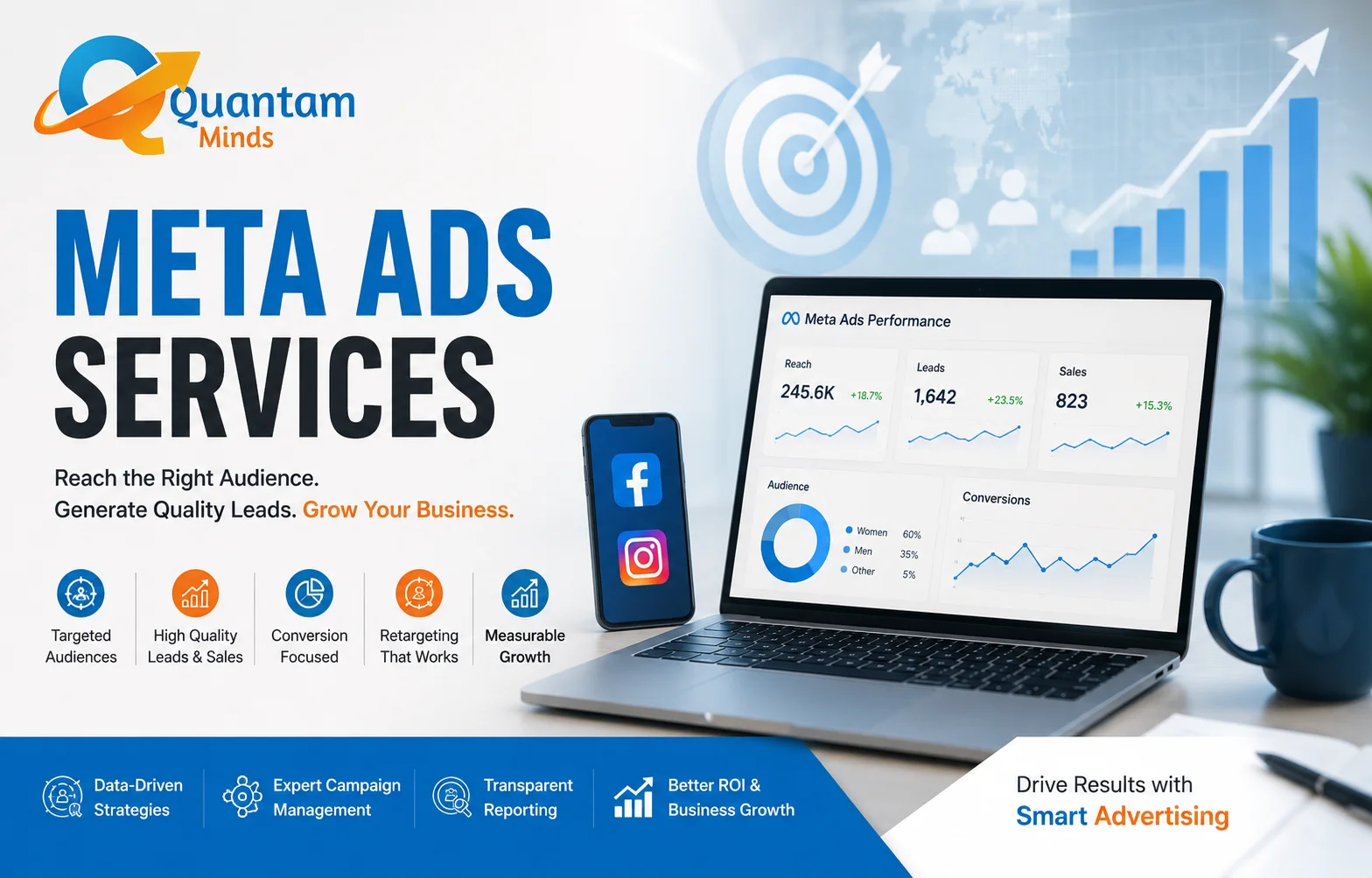

FREQUENTLY ASKED QUESTIONS

Everything You Need To Know Before Starting Your Project

We believe in complete transparency. Here are answers to the most common questions businesses ask before partnering with Quantam Minds.

Meta Ads services involve planning, launching, tracking, and optimizing paid advertising campaigns across Facebook and Instagram. A professional approach typically covers audience research, campaign objectives, creative testing, retargeting, conversion tracking, and landing-page performance. The goal is not simply to generate impressions, but to help businesses attract relevant prospects, generate qualified enquiries or sales, and understand how advertising contributes to customer acquisition.

A Meta Ads agency can improve lead generation by aligning audience targeting, campaign objectives, creative messaging, offers, landing pages, and follow-up processes. The important distinction is between generating leads and generating qualified leads. For businesses such as clinics, gyms, real estate companies, and professional services, campaign success should ultimately be evaluated by lead quality, customer conversion, acquisition cost, and revenue.

Yes. Facebook and Instagram advertising can be useful for small businesses when campaigns are focused rather than overly broad. A local business might begin with one service, one geographic market, a clear offer, and a small set of creative variations. Starting with reliable tracking and a manageable campaign structure allows the business to learn before increasing its advertising budget.

There is no universal Meta Ads budget because appropriate spending depends on the business model, audience size, customer value, competition, geography, and conversion rate. A sensible approach is to start with a budget that can generate enough meaningful data for testing without creating unnecessary financial pressure. Budget should increase when campaign economics and lead or sales quality provide a reasonable basis for doing so.

Meta Ads primarily support social discovery by introducing products and services to audiences on Facebook and Instagram, while Google Ads often captures people actively searching for specific products, services, or solutions. They can complement each other. For example, Meta may create initial awareness while Google captures later search intent. The right mix depends on customer behaviour, buying cycle, competition, and business objectives.

Initial campaign data can appear quickly, but meaningful performance evaluation usually requires more than a few days. Businesses need enough activity to understand audience response, creative performance, conversion behaviour, and lead quality. Some campaigns generate enquiries quickly, while higher-consideration businesses may require repeated exposure and retargeting. Meta Ads should therefore be treated as an ongoing optimization process rather than an instant-results channel.

Clicks without customers usually indicate a problem somewhere after the advertisement or with the quality of the traffic. Possible causes include weak offers, poor audience relevance, slow landing pages, unclear messaging, complicated forms, weak trust signals, or poor sales follow-up. A proper Meta Ads audit should examine the complete journey from ad click to lead, qualified opportunity, customer, and revenue.

Retargeting can be valuable because people who have already interacted with a business may require less education than completely new prospects. Website visitors, product viewers, engaged users, or previous content viewers can receive messages relevant to their earlier interaction. However, retargeting should be structured carefully. Excessive frequency, weak creative variation, or targeting people with little buying intent can reduce its effectiveness.

Businesses should measure Meta Ads according to their commercial objective. Lead-generation businesses should monitor qualified leads, cost per qualified lead, lead-to-customer rate, customer acquisition cost, and revenue. Ecommerce brands should focus on purchases, cost per purchase, revenue, ROAS, and customer acquisition cost. Reach, impressions, CTR, and CPC provide useful diagnostic information, but they should not replace business-level metrics.

No responsible Meta Ads agency should guarantee a specific number of leads, sales, or ROAS. Advertising performance depends on factors such as audience, offer, creative quality, competition, website experience, budget, pricing, and customer demand. A professional Meta Ads strategy should instead establish measurable objectives, reliable tracking, structured testing, transparent reporting, and continuous optimization based on actual business results.

Still Have Questions?

Talk directly with our experts and get personalized guidance for your business.

KNOWLEDGE HUB

Learn, Grow & Stay Ahead

Explore expert insights, practical guides, industry trends, and digital strategies to help your business grow online.

🚀 New Articles Every Week

Explore 500+ Expert Articles On SEO, AI, Google Ads & Web Development

Practical guides, industry insights, case studies, marketing strategies, AI trends, and technical tutorials written to help businesses grow online.

Visit Knowledge Hub

Table of Contents

Navigate this page
Contact Quantam Minds

Let's Build Something Amazing Together

Have a website, CRM, HRM, ERP or custom software requirement? Connect with our team and discuss your project goals today.

Office Address

Baba Colony, Sector 25, Sonipat, Haryana 131001

Working Hours

Monday - Saturday
09:00 AM - 07:00 PM

Need Immediate Assistance?

Chat directly with our development experts and get quick guidance.

WhatsApp Us
Call Expert WhatsApp Us